How to Pack and Label Moving Boxes for a Stress-Free LA Move

- Why Labeling Matters More Than Packing in LA
- Supplies You Actually Need (And What to Skip)
- The Color-Coding System I Use With Every Client
- What to Write on Each Box Beyond the Color
- The Inventory Sheet That Saves Insurance Claims
- Special Handling: Fragile, Heavy, and "Open First" Boxes
- Room-by-Room Labeling Order That Saves Hours
- Common Labeling Mistakes I See Every Week
- FAQ
Last month I worked with a client moving from a 2-bedroom in Mid-Wilshire to a townhouse in Eagle Rock. She'd packed for three weeks, hired great movers, and felt totally on top of things — until day two in the new place, when she couldn't find her coffee maker, her toddler's favorite blanket, or the box with all her chargers. Forty-eight unlabeled boxes, all stacked in the garage. We spent four hours opening boxes one by one. That's when she said the line I hear constantly: "I wish someone had just told me how to label these properly."
I'm Julia C., a Personal Moving Consultant at Green Moving, and in my experience, the difference between a chaotic move and a calm one almost never comes down to how strong your movers are. It comes down to how you packed and labeled your boxes the week before. Let me walk you through the exact system I share with every client, because once you've used it, you'll never go back.
Why Labeling Matters More Than Packing in LA
Here's something most people don't realize until they're standing in a new apartment surrounded by 60 boxes: in LA, you often don't get the luxury of a slow unpack. Maybe you've got two days before work starts, or your old lease ends Saturday and the new one begins Sunday. Maybe you're moving into a high-rise in Koreatown with a 4-hour freight elevator window and need movers to drop boxes in the right rooms fast.
When boxes are labeled clearly, my crew can place them in the correct room without asking you 40 questions. That alone saves 30-60 minutes of billable time on a typical local move — real money when our crews start at $129/hour. More importantly, you can find your toothbrush, your kid's pajamas, and your phone charger on night one without crying in a hallway. Knowing how to pack label moving boxes the right way is genuinely the highest-leverage thing you can do in the entire moving process. It costs nothing but a sharpie and 20 minutes of planning.
Supplies You Actually Need (And What to Skip)
Let me save you a Target run. Here's what I tell clients to buy for a typical 1-2 bedroom LA apartment:
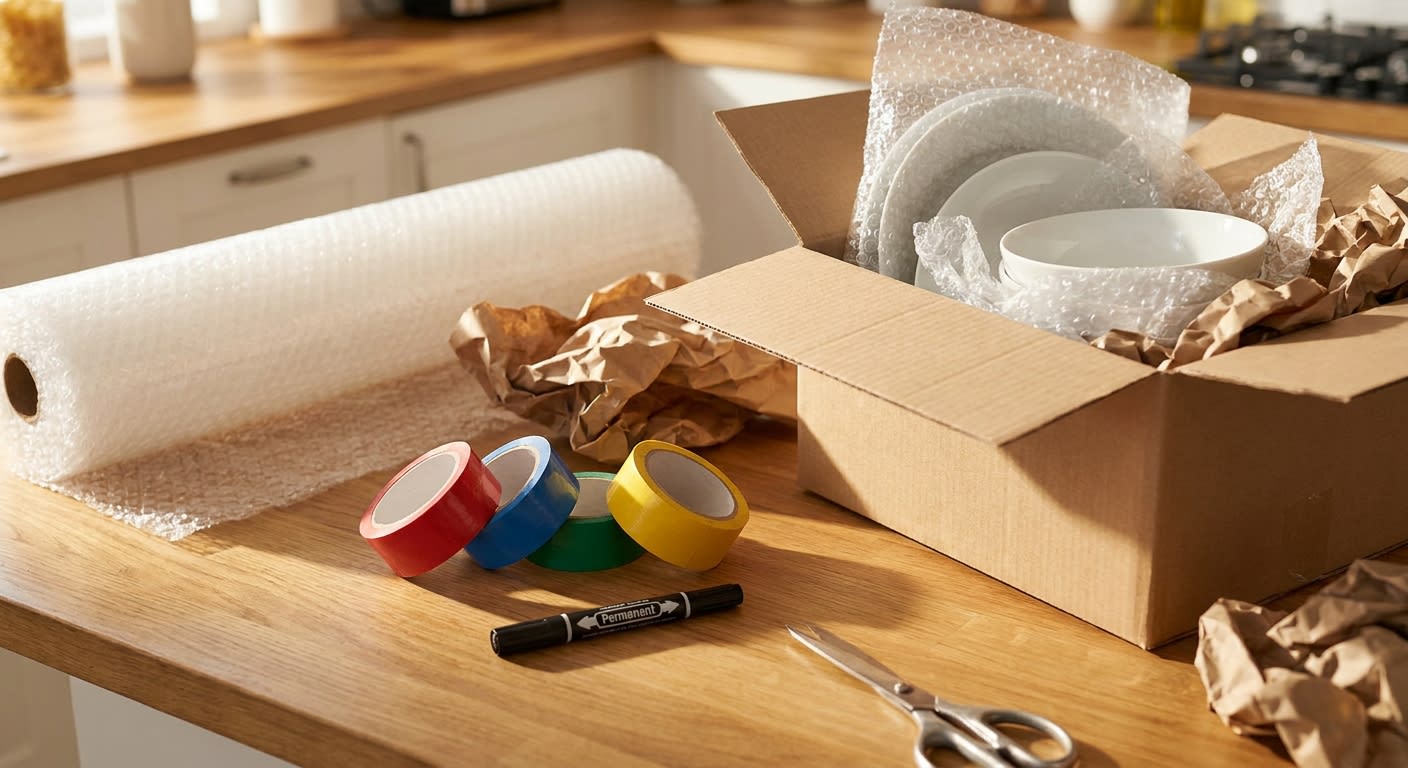
- Colored painter's tape — 4-5 colors, one per room. Painter's tape peels off cleanly, unlike duct tape.
- Two black Sharpies — fine point and chisel tip. You'll lose one. Buy two.
- Pre-printed labels or blank shipping labels — 4x6 size, one pack of 50.
- A clipboard with an inventory sheet — printed or in your Notes app.
- Box cutter for the new place — and put it in your "Open First" box, not packed in a box you can't find.
What to skip: those expensive pre-printed "Kitchen / Bedroom / Living Room" sticker sets from container stores. They cost $25 and you can do the same thing with $4 of painter's tape. For boxes themselves, my colleague's comparison guide on the best packing boxes for LA moves covers exactly which sizes and brands hold up. I won't repeat it here — just know that grocery store boxes are a false economy when half of them collapse on the way to Pasadena.
The Color-Coding System I Use With Every Client
This is the heart of the system. Assign one color of painter's tape to each room in your new home — not your old home, your new one. That's the key. You're labeling for where boxes are going, not where they came from.
Here's a typical setup:
- Red = Kitchen
- Blue = Primary Bedroom
- Green = Living Room
- Yellow = Bathroom
- Orange = Office / Second Bedroom
- Purple = Kids' Room
Stick a 3-inch strip of the colored tape on the TOP and TWO SIDES of every box. Top so movers see it when they're stacking, sides so you see it when boxes are pushed against a wall. Then, on a piece of the colored tape on the new home's doorway, stick a matching strip. My crew walks in, sees red tape on the kitchen door, and every red-taped box goes there. No questions, no thinking. If you want a deeper dive into color systems, my colleague Sarah Chen wrote a great guide on color-coding for unpacking that builds on the same idea.
What to Write on Each Box Beyond the Color
The color tells the movers where it goes. The writing tells YOU what's inside when you're unpacking. Here's the format I use, written on the side of the box (not the top — once it's stacked, you can't read the top):
BOX #14 / KITCHEN / DISHES + MUGS / FRAGILE / OPEN WEEK 1
That gives me five pieces of information: a number that matches my inventory sheet, the destination room, contents, handling note, and unpack priority. The "Open Week 1" tag is huge. Most clients have boxes of seasonal stuff, books, and decor that don't need to be opened immediately. Marking those "Open Month 2" means you can stack them in a closet or garage and ignore them while you focus on essentials.
Write big. Use the chisel-tip Sharpie. If you're packing at night with bad lighting (a very LA experience in old buildings), your handwriting gets worse than you think. I've seen clients squint at their own writing trying to figure out if it says "books" or "boots."
📦 Don't have time to pack and label 60 boxes yourself? My team's professional packing service handles the entire process with a labeling system built in. Call (949) 266-9445 for a free packing estimate.
The Inventory Sheet That Saves Insurance Claims
Here's the part most people skip and regret. Keep a numbered inventory list as you pack. Box #1, Box #2, all the way up. Next to each number, write the contents in slightly more detail than what's on the box itself.
For example, the box might say "KITCHEN / DISHES + MUGS." On your inventory sheet: "Box #14 — 8 dinner plates (Heath Ceramics), 6 mugs, 4 cereal bowls, glass cake stand wrapped in towels."
Why bother? Three reasons. First, if a box goes missing or arrives damaged on a long-distance move, you have documentation for the insurance claim. Second, if you're putting some boxes in storage and others in the new place, you can tell your movers "boxes 32-48 to storage, the rest to the apartment" without opening anything. Third, two months later when you're hunting for that one specific item, you can search your phone notes for "passport" or "warranty paperwork" instead of opening 12 boxes.
I use a simple spreadsheet template on my phone — Box #, Room, Contents, Fragile Y/N, Open Priority (1/2/3). Takes 30 extra seconds per box and pays back hours later.
Special Handling: Fragile, Heavy, and "Open First" Boxes
A few boxes need extra labeling beyond the standard system.
FRAGILE boxes get a red FRAGILE label or red Sharpie writing on all four sides plus the top. Don't rely on movers seeing one little fragile sticker. I also write "THIS SIDE UP" with arrows on glassware and lamp boxes. For the actual packing techniques on breakables, my colleague Sarah's guide on packing glassware and dishes is what I send every client.
HEAVY boxes — books, dishes, tools — get a "HEAVY" warning written on the side. This isn't just for movers; it's for you. Two months from now when you're rearranging the garage, you don't want to lift a 60-pound box thinking it's pillows.
OPEN FIRST boxes are the most important boxes you pack. I tell every client to pack two: one for the bedroom (sheets, pillows, pajamas, toothbrushes, phone chargers, medications, a change of clothes) and one for the kitchen (coffee setup, two mugs, a few plates, basic utensils, dish soap, paper towels, trash bags). Label these with bright neon tape AND write "OPEN FIRST" in huge letters. Load them last so they come off the truck first.
Room-by-Room Labeling Order That Saves Hours
Pack and label in a deliberate order, not randomly as you find time. The sequence I recommend:
Weeks 4-3 before move: Storage areas, garage, seasonal items, books, decor. These all get "Open Month 2" priority labels. You don't need them right away.
Weeks 2-1 before move: Closets (off-season clothes), guest room, formal dining items, anything you don't use daily. Label as "Open Week 2."
Final week: Daily-use kitchen items, bathroom, primary bedroom, kids' rooms. These are "Open Week 1." Pack the OPEN FIRST boxes the night before the move.
Green Moving was built around lower-stress moves, and one of the things I love about working here is that we donate 1% of every move to California environmental causes — so when clients use reusable plastic bins instead of cardboard, it lines up with our environmental values too. If you want to nerd out on the cardboard vs. plastic question, our team has a full cost analysis on reusable moving supplies.
Common Labeling Mistakes I See Every Week
After hundreds of moves across LA and Orange County, the same mistakes show up again and again:
Labeling only the top of the box. Once boxes are stacked, you can't see the top. Label the sides too — at least two of them.
Vague labels like "Misc" or "Stuff." Six weeks from now you will not remember what was in the "Misc" box. Be specific even if it feels silly.
Labeling for the OLD home, not the NEW one. If your old place had a separate dining room but your new place doesn't, "Dining Room" on a box is useless. Label for where it's GOING.
No fragile markings, then surprise that things broke. Movers can't read your mind. If it's fragile, label it loudly.
Mixing rooms in one box. One box, one room. Always. Mixing rooms creates a logistical mess that costs you time on both ends.
FAQ
How many boxes will I need for a typical LA apartment?
For a 1-bedroom apartment, plan on 25-40 boxes. For a 2-bedroom, 45-70. For a 3-bedroom house, 80-120. These numbers vary wildly based on how much you own — heavy book and kitchen people need way more. Always order 15-20% more than you think; returning unused boxes is easier than running out at midnight.
Should I label boxes before or after packing them?
I put the colored tape on first (so I know which room I'm packing for), then write the contents and box number AFTER sealing the box. Writing on a sealed box is cleaner and you know exactly what ended up inside.
What if my movers don't speak English well?
That's exactly why color coding works so well. A colored tape strip on the box matched to a colored tape strip on the door requires zero language. Every crew I've worked with at Green Moving understands the system instantly, but the color method works universally.
Do I really need to number every single box?
For a small studio move, you can skip numbering. For anything larger or any long-distance move, yes — numbering plus an inventory sheet is non-negotiable. It takes minutes to set up and saves hours if anything goes wrong.
What about boxes going into storage versus into the new home?
Add a separate label or different color tape stripe for storage-bound boxes. I usually use a black "STORAGE" label across the top so movers route those boxes separately. If you're sorting through storage logistics, the team has a full guide on storage options during an LA move.
Can I just hire someone to pack and label everything?
Yes — and honestly, for clients with busy jobs or large homes, our full service moving option is the best money you'll spend. We pack, label with our system, transport, and unpack. Most clients tell me afterward they wish they'd done it on their first move instead of their fifth.
Ready to make your move easier from the first box to the last? Green Moving serves Los Angeles and Orange County with a labeling system built into every job. Call (949) 266-9445, email sales@greenmovingla.com, or get a free quote. Licensed & insured — CAL-T 201327.