How to Pack Glassware and Dishes Without Breaking Them
- Why Kitchen Items Break During Moves (And How to Prevent It)
- The Materials You Actually Need
- My 90-Second Wine Glass Wrapping Method
- Dishes and Plates: The Vertical Stacking Secret
- Bowls, Mugs, and Oddly Shaped Items
- The Box Loading Sequence That Prevents Crushing
- Special Cases: Crystal, Antique China, and Heirloom Pieces
- The Unpacking Process (Don't Rush It)
- Common Mistakes I See Every Week
- A Quick Reference Checklist
- FAQ
Last Tuesday, I unpacked a box of vintage Waterford crystal for a client who'd moved from a third-floor walkup in Koreatown to a townhouse in Torrance. Twelve wine glasses, eight champagne flutes, and a crystal decanter that belonged to her grandmother. Not a single chip. When she started crying, I'll admit I got a little emotional too—that decanter had survived her grandmother's move from Ireland in 1962, and now it had survived Los Angeles traffic on the 110.
I'm Sarah, a Packing Specialist at Green Moving, and I've spent the last several years perfecting the art of protecting fragile items during moves. I've packed everything from everyday IKEA glasses to museum-quality antique porcelain, and I've developed a systematic approach that consistently delivers zero breakage. Today, I'm going to teach you exactly how to pack glassware without breaking a single piece.
Why Kitchen Items Break During Moves (And How to Prevent It)
Before I walk you through my packing methods, you need to understand why things break in the first place. In my experience, there are three main culprits: insufficient cushioning, improper box selection, and poor loading technique. I'd estimate that 70% of breakage happens because people underestimate how much padding fragile items need.
Think about what happens inside a moving truck. Every time the driver brakes, accelerates, or turns, everything shifts. Your boxes experience forces from multiple directions—not just up and down, but sideways and at angles. A single wine glass wrapped in newspaper and placed upright might survive a straight highway drive, but it won't survive the stop-and-go traffic on Lincoln Boulevard in Marina del Rey.
The second issue is box selection. I see clients grab any old box from behind the grocery store and assume it'll work for dishes. But a used produce box that's been exposed to moisture has compromised structural integrity. When you stack three boxes on top of it in the truck, it collapses. I've seen entire sets of dishes crushed because someone saved twenty dollars on proper boxes.
Temperature is another factor people forget about. During summer moves—and as I covered in my colleague Julia's summer moving survival guide—the interior of a moving truck in Los Angeles can exceed 130 degrees. Glass expands when heated. If your items are packed too tightly without room for thermal expansion, you'll hear that heartbreaking crack.
The Materials You Actually Need
Let me break down exactly what I use for every kitchen packing job. I'm specific about brands and sizes because these details matter.
Dish boxes (also called dish packs or china barrels): These are double-walled corrugated boxes, typically 18" x 18" x 28". They're taller than regular boxes because you're building layers with cushioning between them. I use about two dish boxes for a standard four-person household's glassware and dishes.
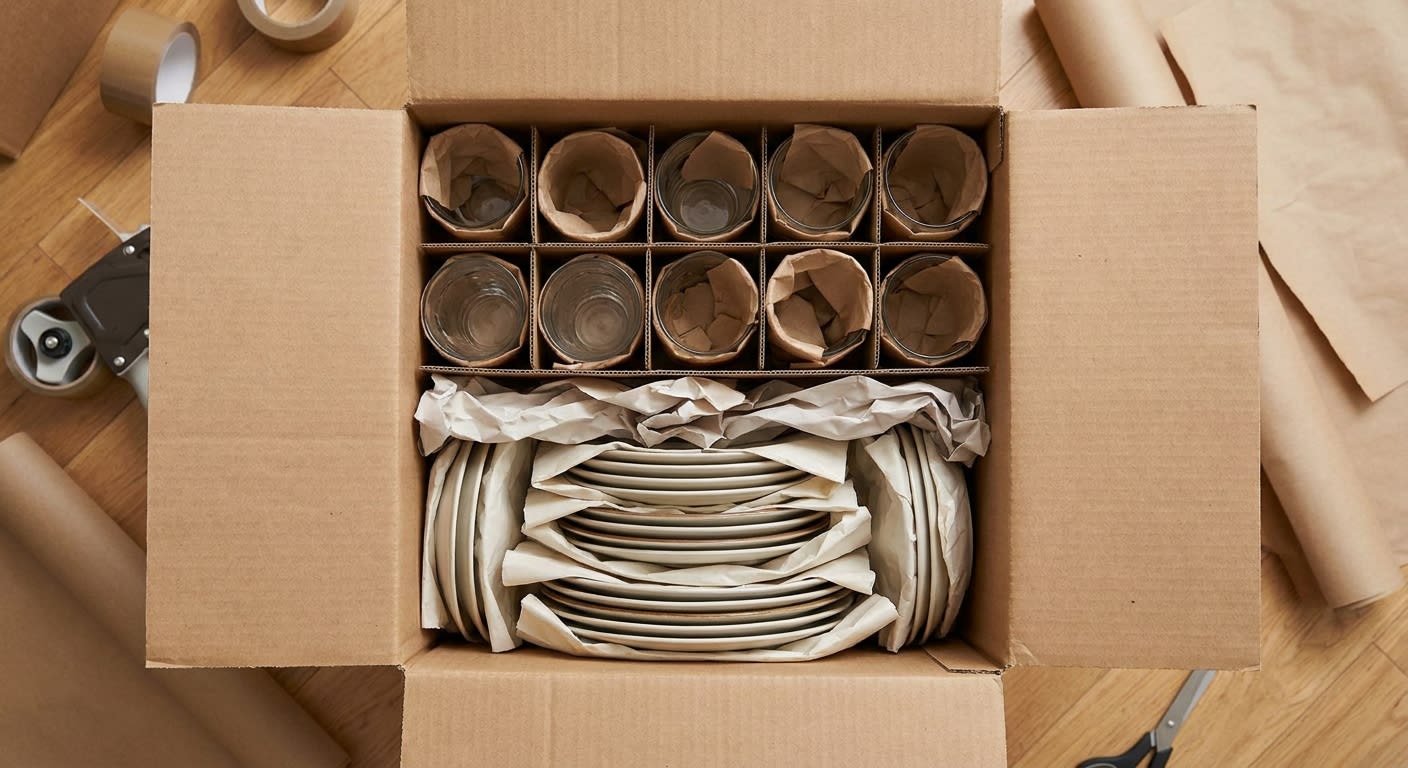
Cell dividers: These are cardboard inserts that create individual compartments for glasses and stemware. You can buy them pre-made or have your moving company provide them. One divider set fits inside a dish box and holds 12-24 glasses depending on size.
Packing paper: I use plain newsprint paper, not newspaper. Newspaper ink transfers to dishes and requires washing everything at the destination. A 25-pound bundle of packing paper costs roughly $30-40 as of 2026 and will pack an entire kitchen.
Bubble wrap: I reserve this for specialty items—crystal, extremely thin glassware, or items with delicate handles. For standard dishes and everyday glasses, packing paper works better because it conforms to shapes and doesn't slip.
Tape: 2-inch packing tape, not masking tape or duct tape. I tape the bottom of every dish box in an "H" pattern—one strip lengthwise, two strips across. This prevents blowouts when lifting.
My 90-Second Wine Glass Wrapping Method
Here's my exact technique for wrapping wine glasses. I've timed it—90 seconds per glass—and I've never had one break using this method.
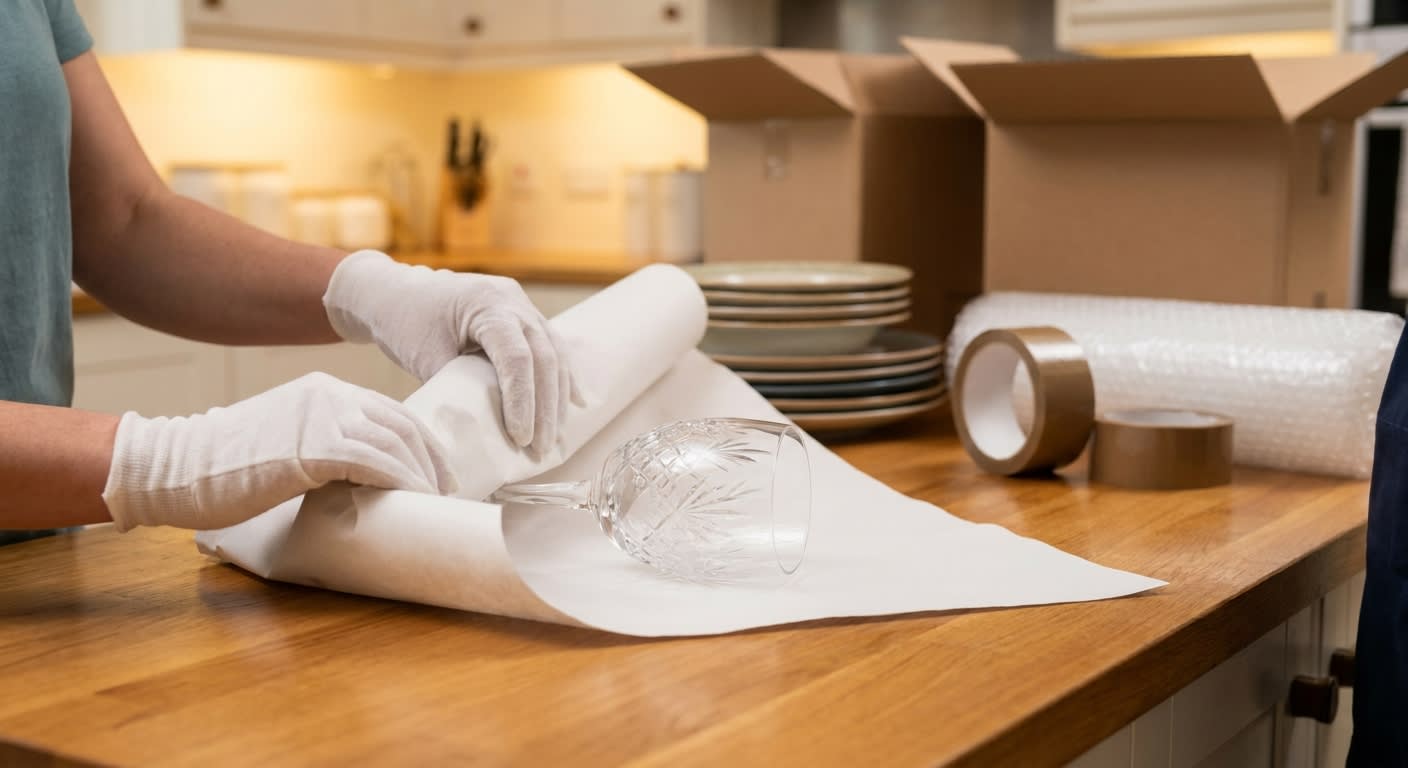
Start with two sheets of packing paper laid flat on your work surface, overlapping slightly. Place the wine glass on its side at one corner, with the rim facing toward you. Stuff a small wad of paper inside the bowl of the glass—this provides internal support.
Now roll the glass away from you, tucking the paper into the bowl as you go. When you've rolled about halfway across the paper, fold the sides in like you're wrapping a burrito. Continue rolling until the glass is completely wrapped. Secure with a small piece of tape.
The key is that rolled paper creates multiple cushioning layers. I count at least four layers of paper around the bowl of the glass when I'm done. The stem gets extra protection from the folded sides. The base, which is the heaviest part and most likely to cause damage if it shifts, is now padded.
Place wrapped glasses in the cell divider with the base facing up. I know this seems counterintuitive, but here's why: the base is the strongest part of the glass. When the box experiences downward pressure from stacking, you want that strength on top.
Dishes and Plates: The Vertical Stacking Secret
This is where most people go wrong. They stack plates horizontally like they sit in a cabinet. That's actually the worst way to pack them.
Think about the physics. When plates are stacked flat, the bottom plate bears the weight of every plate above it. During transport, when the box shifts and drops, that weight multiplies. I've seen stacks of eight dinner plates where only the bottom two broke—crushed by the accumulated pressure.
Instead, I pack plates vertically, on their edges, like records in a crate. Each plate is wrapped individually in two sheets of packing paper, then placed in the box standing upright. The box bottom has three inches of crumpled paper as cushioning. Plates go in snugly but not forced—they should stand without falling over.
Between every three or four plates, I add a piece of cardboard cut from spare boxes. This creates sections within the box and prevents the domino effect if something shifts.
Fill any remaining space with crumpled paper. When I close a dish box, I shake it gently. If I hear anything move, I add more paper. The goal is zero movement inside the sealed box.
📦 Need expert packing for your fragile items? Our packing services team uses these exact techniques on every move. Call (949) 266-9445 or get a free quote.
Bowls, Mugs, and Oddly Shaped Items
Bowls nest together, which seems convenient but is actually a trap. Nested bowls transfer impact directly from one to another. Instead, I wrap each bowl individually and stack them in pairs—two wrapped bowls together, then a layer of paper, then two more.
Mugs require special attention because of their handles. I've broken more mug handles than any other single item type in my early days, before I developed my current system. Now I stuff paper inside the mug, then wrap paper around the handle separately before wrapping the whole mug. The handle gets three layers of protection.
For odd shapes—gravy boats, pitchers with spouts, teapots with lids—I pack the lid separately and wrap protrusions with extra bubble wrap. These items go in a box by themselves or with substantial cushioning separating them from other items.
The Box Loading Sequence That Prevents Crushing
Once your boxes are packed, how you load them matters enormously. I've seen perfectly packed boxes destroyed by improper truck loading.
Dish boxes go on the floor of the truck, never stacked more than two high. I place them against the wall of the truck, not in the middle where they might tip. Heavier boxes (books, tools) go on the floor but never on top of dish boxes.
I label every dish box on multiple sides: "FRAGILE - DISHES - THIS SIDE UP" with an arrow. Some movers think these labels are ignored, but professional crews—like my colleagues at Green Moving—take them seriously. We're licensed (CAL-T 201327) and trained to handle fragile items properly.
Temperature matters too. If you're doing a summer move, I recommend requesting early morning or evening loading times. A truck that's been sitting in a Burbank driveway at 2 PM in August becomes an oven. I've written extensively about material protection in my guide to packing materials that covers both sustainability and performance.
Special Cases: Crystal, Antique China, and Heirloom Pieces
For items with significant monetary or sentimental value, I elevate my approach. Last month I packed a set of Meissen porcelain for a client moving from Hancock Park to Newport Beach. The set was appraised at $45,000. Here's how I handled it.
First, I documented everything with photographs before packing—front, back, any existing damage. This protects both the client and the company if questions arise later.
Each piece was wrapped in acid-free tissue paper first (prevents any chemical reaction with the glaze), then bubble wrap, then packing paper. I used small boxes for these items—one or two pieces per box maximum. The boxes were then placed inside larger boxes with foam peanuts filling the gap.
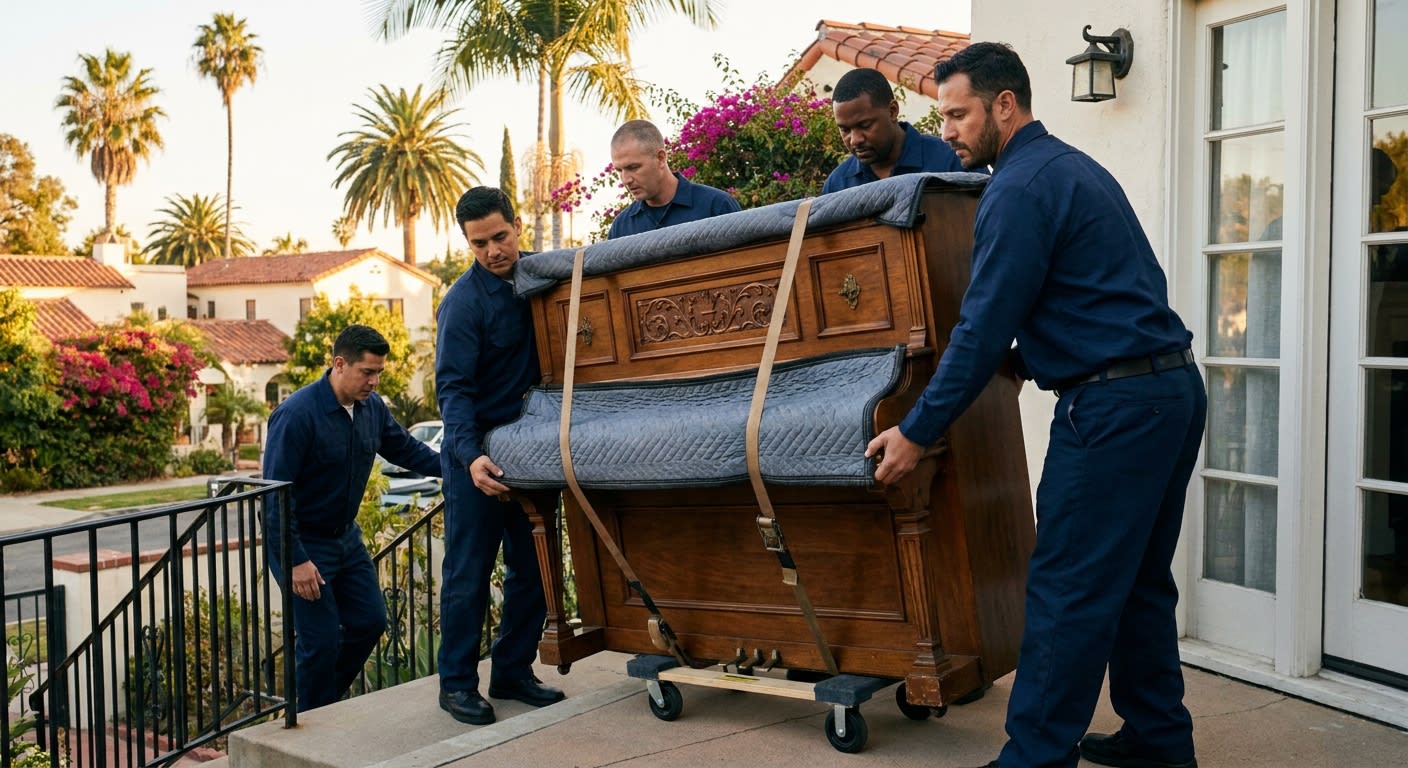
These double-boxed items traveled in the cab of the truck, not the cargo area. For our white glove service, this kind of treatment is standard for high-value items.
At Green Moving, we commit 1% of every move to California environmental causes, which means I'm always looking for sustainable packing options. For heirloom pieces, though, protection trumps everything else. I'll use conventional materials when the item demands it.
The Unpacking Process (Don't Rush It)
I tell every client: the care you took packing needs to continue when unpacking. I've seen people tear through boxes on move-in day, tossing paper aside, and break items that survived the entire journey.
Unpack dish boxes onto a padded surface—a towel on the counter works. Unwrap each item over the box so any broken glass falls into paper, not onto your floor. Check each piece for chips before putting it away.
If you used cell dividers, save them. They're reusable for years if stored flat. Same with dish boxes—collapse them and store them for your next move. This aligns with what I recommend in terms of reducing waste, and my colleague Julia explores the economics in her comparison of reusable vs. cardboard supplies.
Common Mistakes I See Every Week
After packing hundreds of kitchens across Los Angeles and Orange County, I've compiled a list of the errors I encounter most frequently.
Using boxes that are too large: A big box packed with dishes becomes impossibly heavy. It gets dropped. Keep dish boxes under 50 pounds—this usually means packing them half-full with dishes and filling the rest with lightweight items like linens or paper goods.
Not labeling boxes as fragile: I don't care if you think it's obvious. Label it. Multiple times. On every side.
Wrapping dishes in towels or linens: This seems eco-friendly and clever, but towels don't provide consistent cushioning. They bunch up, leave gaps, and can trap moisture. Use proper packing paper.
Packing too early: Dishes you'll need during your final days shouldn't be packed first. I recommend packing glassware and dishes two to three days before move day, keeping one set of essentials out—two plates, two bowls, two glasses, two mugs—for those last meals.
Forgetting about the weight distribution: Heavy items at the bottom, lighter items on top. Seems obvious, but I've opened boxes where someone placed a cast iron skillet on top of wrapped wine glasses.
A Quick Reference Checklist
Here's my packing sequence for a typical kitchen, assuming a family of four:
Week before move: Gather materials. You'll need approximately 3-4 dish boxes, 2 bundles of packing paper, 1 roll of bubble wrap, cell dividers, and plenty of tape.
Three days before: Pack items you don't use daily—holiday dishes, specialty glassware, serving pieces. Label boxes by contents: "FRAGILE - Crystal wine glasses - Guest bedroom closet" tells movers both how to handle it and where it goes.
Day before move: Pack everyday dishes, leaving out your essentials kit. Wrap and box remaining glasses.
Move day morning: Pack final items, do a walk-through of kitchen to catch anything forgotten.
For a comprehensive timeline that integrates kitchen packing with everything else, check out my colleague Julia's 8-week moving checklist.
FAQ
Can I use newspaper instead of packing paper?
I don't recommend it. Newspaper ink transfers to dishes, especially in warm conditions. You'll spend hours washing everything at your new place. Packing paper costs roughly $30 per bundle as of 2026, and one bundle handles most kitchen items. It's worth the investment.
How do I pack glassware without breaking it if I'm doing a DIY move?
Follow the techniques I've outlined above, and take your time. The 90-second wine glass wrap isn't negotiable—rushing leads to breakage. If you're unsure about any item, add more padding. You literally cannot over-cushion glassware.
Should I buy specialty boxes or can I use regular moving boxes?
Dish boxes (double-walled, 18x18x28) are specifically designed for fragile items. Regular single-wall boxes can work for wrapped dishes but provide less protection against crushing. If budget is tight, use dish boxes for glassware and stemware at minimum.
How many dishes can I fit in one box?
This depends on plate size, but a typical dish box holds 12-15 dinner plates packed vertically, or 20-25 smaller plates. For glasses with cell dividers, expect 12-24 per box. Always prioritize protection over capacity—a half-full properly packed box beats a stuffed box every time.
What's the best way to pack glassware for long distance moving?
For moves beyond local area—say, Los Angeles to San Francisco or out of state—I increase cushioning by 50%. That means extra paper between items, additional layers on each wrap, and more crumpled paper filling gaps. Long distance moves involve more truck vibration and more chances for shifting. Our long distance moving service includes specialized packing protocols for exactly this reason.
My grandmother's china is irregular and doesn't stack well. What do I do?
Antique and hand-crafted dishes often have uneven shapes that don't nest. Wrap each piece individually with extra attention to rims and any raised patterns. Pack these pieces in smaller boxes—a medium box works better than a dish box for oddly shaped items. Consider double-boxing valuable pieces: wrapped item in small box, small box cushioned inside larger box.
Ready to protect your fragile items with professional packing? Green Moving serves Los Angeles and Orange County with trained packing specialists who use these exact techniques. Call (949) 266-9445, email sales@greenmovingla.com, or get your free quote. Licensed and insured—CAL-T 201327.