Moving Home Gym Equipment LA: Pack & Transport Guide
- Start With an Inventory and a Disassembly Plan
- Packing Weight Plates Without Destroying Boxes or Backs
- Disassembling Power Racks and Squat Stands
- Treadmills, Rowers, and Cardio Equipment
- Protecting Floors, Walls, and Doorways During the Move
- Loading Order on the Truck
- What This Costs and Why Eco-Conscious Packing Matters
- Frequently Asked Questions
Last month I packed a full home gym out of a Spanish-style house in Mar Vista — Olympic barbell, two power racks, 580 pounds of bumper plates, a Concept2 rower, an assault bike, and a Sole F85 treadmill that the client had wedged into a converted sunroom. The previous quote he got didn't account for the cast-iron plates being stacked on hardwood floors that needed protection, or the fact that his rack was bolted into a stud wall. We took six hours, used 14 furniture blankets and four dollies, and the only mark left behind was the ghost of where the rack used to stand.
I'm Sarah Chen, a Packing Specialist at Green Moving, and home gyms are one of the trickiest packing jobs in this city. The equipment is heavy, awkwardly shaped, and almost always lives in a garage or spare room with tight clearances. Done wrong, you crack drywall, scratch floors, or strip threads on a $1,500 rack. Done right, it's just careful disassembly and smart load order. Here's exactly how I approach moving home gym equipment LA clients have built up over years.
Start With an Inventory and a Disassembly Plan
Before I touch a single dumbbell, I walk the gym with a clipboard and write down every piece. Rack make and model, treadmill model number, plate count by weight (10s, 25s, 35s, 45s), bar count, bench type, cable attachments, flooring type. This matters because each item has its own packing protocol and weight class. A 45-pound bumper plate moves differently than a 45-pound steel plate — bumpers can stack 10 high on a dolly, steel plates I cap at 6 because the edges concentrate weight.
I also pull up assembly manuals on my phone for racks and cardio equipment. A Rogue RML-490 has 14 main bolts; a Rep PR-5000 has different hardware. I bag every bolt, washer, and J-cup pin in labeled zip-top bags taped directly to the frame piece they came from. That single habit saves clients an hour of swearing on the unpacking end. Treadmills almost always fold and lock — but the lock pin is what fails in transit, so I add a ratchet strap as backup. For cable machines, I photograph the cable routing before I disconnect anything, because re-threading a guessed cable path takes forever.
Packing Weight Plates Without Destroying Boxes or Backs
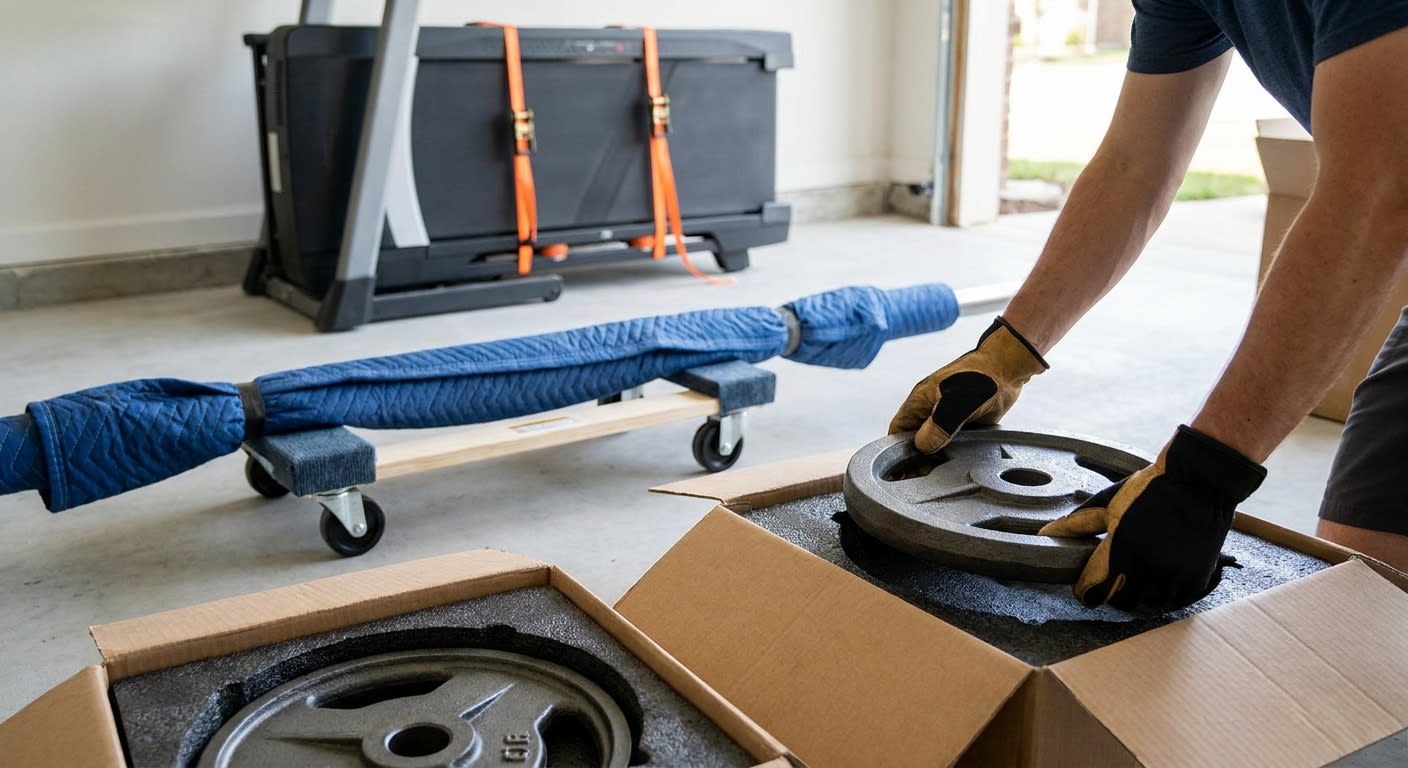
Weight plates are where most movers hurt themselves or hurt the floor. My rule: small boxes only, and never more than 60 pounds per box. I use 1.5 cubic foot small book boxes, double-walled, lined with a single layer of foam sheet on the bottom. Four 45-pound plates per box maxes out at 180 pounds, which is too heavy — so I do two 45s plus a 25, or three 35s. I write the actual weight on every box in marker so the crew knows what they're picking up.
For bumper plates, I stack them on a four-wheel dolly in a column, strap them with two ratchet straps, and roll them straight to the truck. No box needed. For competition steel plates with sharp edges, I wrap each plate individually in a furniture blanket before boxing — the edges will saw through cardboard in 20 minutes of truck vibration otherwise. Dumbbells get the same small-box treatment, paired up by weight, with foam between each pair so the heads don't chip. My colleague Marcus Rivera covers heavy-object logistics in detail in our guide on moving heavy furniture up stairs in LA apartments, and a lot of those principles apply directly to plate transport.
Disassembling Power Racks and Squat Stands
Most full-size power racks are 7 to 8 feet tall and won't fit through standard doorways assembled. I always disassemble. The order matters: pull safety arms and J-cups first, then the pull-up bar (this is structural — once it's off, the rack will rack side-to-side, so brace it), then the cross-members, then the uprights. Uprights are usually 80 to 110 pounds each in 3x3 11-gauge steel. Two people, one upright at a time, walked out flat.
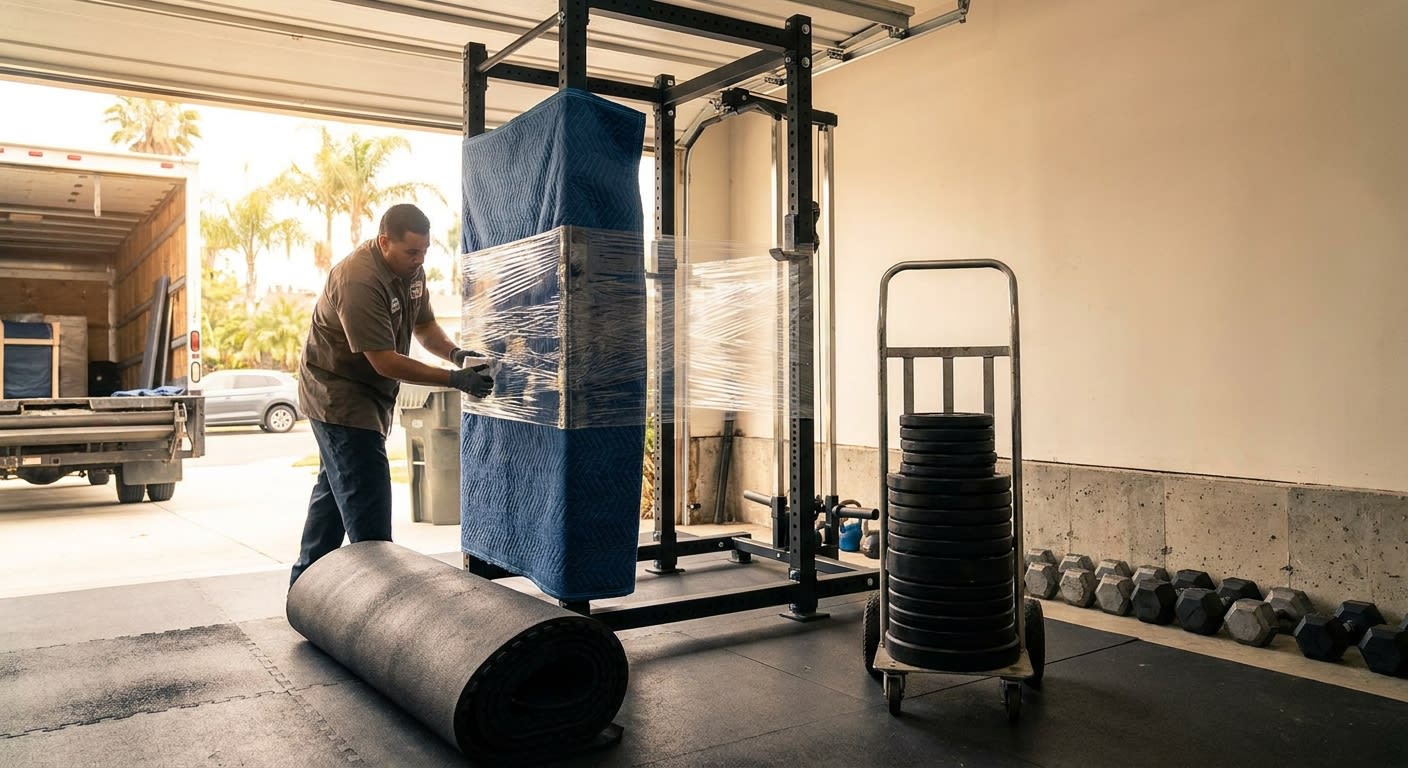
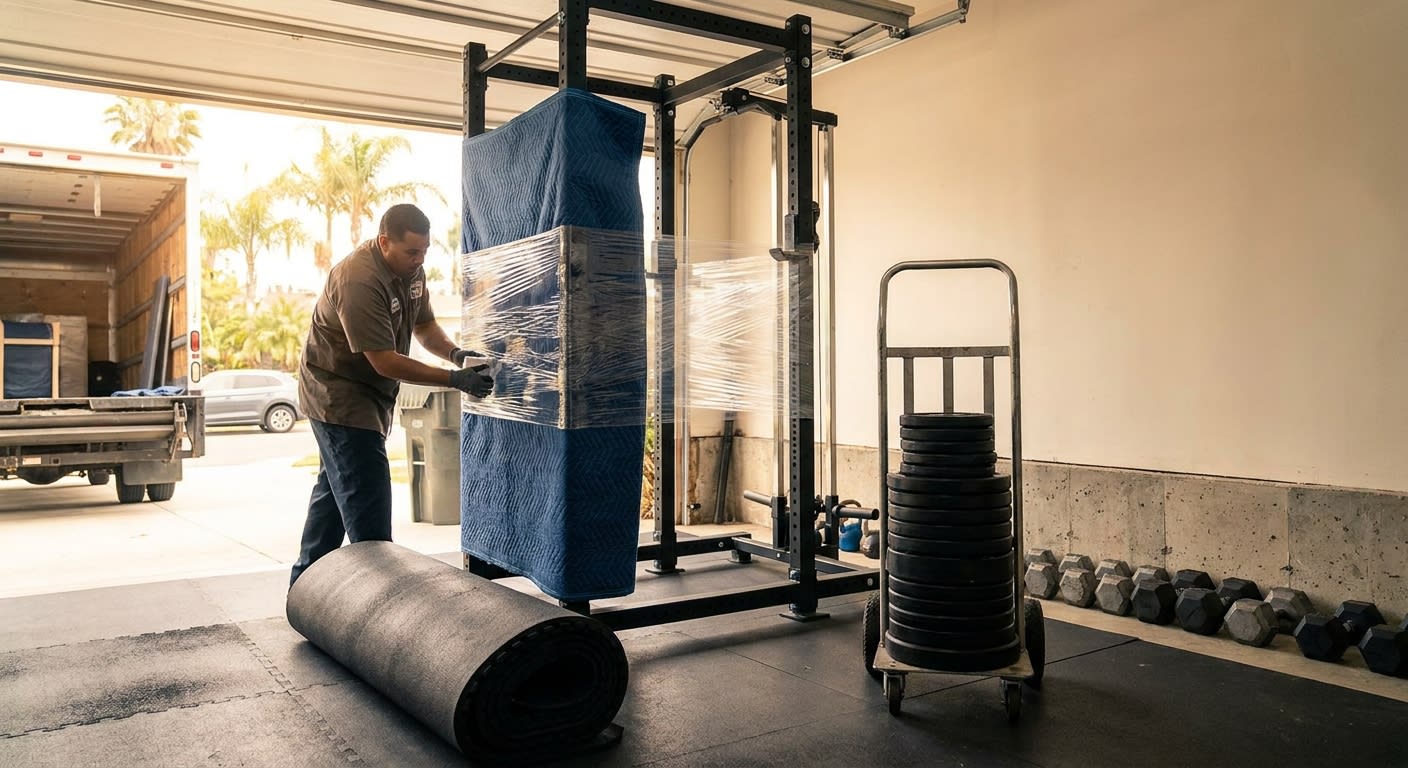
I bundle all the small hardware in a labeled bag and tape it to one of the uprights. Long bolts and J-cup pins go in a separate bag because they like to puncture cardboard. The rack pieces themselves I wrap in two furniture blankets each and secure with stretch wrap — not tape, because tape residue on powder-coated steel is a nightmare to clean. Loaded into the truck, uprights lay flat on the deck along the wall, never stacked on top of soft items.
Treadmills, Rowers, and Cardio Equipment
Treadmills are deceptively heavy — a Sole F85 is 280 pounds, a NordicTrack commercial is 340. Most fold, but the deck and motor housing are still bulky. I unplug, coil the power cord and tape it to the frame, fold the deck, engage the lock pin, then add a ratchet strap from deck to upright as redundancy. I move treadmills with a four-wheel appliance dolly, never a two-wheeler — the weight distribution is wrong for hand trucks and you'll tip it.
Rowers like the Concept2 separate into two pieces with a single pull pin. I separate them every time because the assembled length is 96 inches and that doesn't navigate hallways. Assault bikes and Echo bikes I leave assembled but remove the seat post and pedals (pedals scratch everything). Pelotons get the screen detached and packed separately in a small TV box with foam corners — the screen is the expensive part and the failure point in transit.
📦 Need professional packing for heavy or specialty equipment? My packing services team handles home gyms, fragile items, and full households with custom materials. Call (949) 266-9445 for a free packing estimate.
Protecting Floors, Walls, and Doorways During the Move
This is where home gym moves go sideways even when the packing is perfect. A 45-pound plate dropped from waist height puts a divot in hardwood that no buffing fixes. I lay down 4-foot wide rubber runners from the gym to the front door — Ram Board for hardwood and tile, moving blankets layered for carpet. Door frames get corner protectors (the foam ones with elastic straps) on every threshold the rack pieces pass through. I've seen one bad bump take a chunk of plaster out of a 1920s Hancock Park doorway, and the repair was $400.
For garage gyms with rubber flooring tiles, decide ahead of time whether the tiles come or stay. If they come, I roll them, bundle 4 to 6 per roll with stretch wrap, and load them last so they unload first at the new place — clients want their floor down before plates come off the truck. Stall mats are 4x6 feet and 100 pounds each; two people, edge-up, walked out. I cover this principle of staging and floor protection more in my colleague's apartment moving checklist for LA, especially for upper-floor units where elevator pads matter.
Loading Order on the Truck
Heavy and dense goes against the cab wall, low to the deck. Plate boxes get stacked no higher than three boxes (so roughly 540 pounds of stacked weight on the bottom box, which double-walled cardboard handles) and strapped to the wall with E-track straps. Rack uprights lay flat along the deck on the opposite wall. Treadmills and rowers sit upright (treadmill folded) and get strapped at two points to E-track. Bench, bars, and cable attachments fill the gaps.
I never put gym equipment on top of furniture or boxes. The vibration of a moving truck is constant, and dense steel will work its way through anything below it. Bars get their own dedicated spot — I lay barbells on the deck along the wall, wrapped in two blankets, and never stack anything on them because a bent bar (even slightly) is ruined. For long-distance moves, this loading discipline matters even more — my colleague Daniel Foster covers cross-country logistics in our long distance moving from LA guide.
What This Costs and Why Eco-Conscious Packing Matters
A typical home gym pack-and-move in LA — meaning a rack, bench, treadmill or cardio piece, 400 to 800 pounds of plates, dumbbells, and accessories — runs roughly 4 to 7 hours of crew time as of 2026. With Green Moving's "Eco-friendly moving, 1% environmental commitment, from $129/hour" pricing structure, that puts most home gym moves in the $700 to $1,400 range for the labor portion, plus materials. Materials for a home gym typically run $80 to $150 — small boxes, foam sheet, stretch wrap, blanket rentals. We use reusable moving blankets and recycled cardboard whenever possible, and we pull back used materials at the end so they don't end up in a landfill.
If you want to see the full materials math, my own analysis of reusable supplies vs cardboard walks through the cost and environmental tradeoffs. For moving home gym equipment LA homeowners have invested thousands in, the small upcharge for proper materials and time is the cheapest insurance you can buy.
Frequently Asked Questions
Can I leave weight plates loaded on the barbell during the move?
No. Always strip the bar. A loaded bar concentrates 200+ pounds on the sleeves, and truck vibration will bend the bar or strip the bearings. It also makes the bar uncarryable safely. Stripping a bar takes 90 seconds and saves the bar.
Should I disassemble my treadmill or move it whole?
Move it folded but assembled. Modern treadmills are designed to fold for storage, and full disassembly voids most warranties and creates electrical reconnection risk. Just engage the fold lock, add a ratchet strap, and use an appliance dolly.
How do you handle a wall-mounted rack or pull-up bar?
I unbolt it carefully, photograph the mounting pattern and stud locations, and bag the lag bolts with the rack. At the new home, you'll need to locate studs again — same hardware will reinstall cleanly if the new wall has comparable framing.
What's the heaviest single item in a typical home gym move?
Usually the treadmill at 250 to 350 pounds, or a fully assembled power rack before disassembly at 400+ pounds. Cast-iron plate stacks can also exceed 400 pounds collectively. Everything heavy gets a dolly and two crew members minimum.
Can you store gym equipment temporarily during a move?
Yes — climate control isn't critical for steel and cast iron, but humidity will rust unprotected bars and plates. If you're storing more than two weeks, oil the bar and wrap plates in plastic. We arrange short-term storage for clients regularly.
How early should I book a home gym move?
Three to four weeks ahead for weekends, two weeks for a weekday. Home gyms add complexity to crew scheduling because we send a crew sized for the weight, and last-minute requests sometimes mean we can't dedicate the right team.
Ready to move your home gym without a single dent or stripped bolt? Green Moving serves Los Angeles and Orange County. Call (949) 266-9445, email sales@greenmovingla.com, or get a free quote. Licensed & insured — CAL-T 201327.