Moving Heavy Furniture Up Stairs in LA Apartments: 2026 Guide
- Why LA Stair Moves Are Their Own Animal
- The Measurements You Need Before Anyone Lifts a Thing
- The Gear That Actually Makes a Difference
- Crew Sizing for Stair-Heavy Moves
- Disassembly: The Step Most People Skip
- The LA Buildings That Make Me Nervous
- Protecting the Building (and Your Deposit)
- Settling In: Your First Week After the Stairs
- FAQ
Last month I helped coordinate a move for a screenwriter relocating from a third-floor walk-up off Franklin Avenue in Los Feliz to a second-floor unit in a 1962 dingbat building in Mid-City. She had a Restoration Hardware Cloud sectional — three pieces, the largest weighing close to 240 pounds — plus a cast iron tub-style soaking chair her grandmother had shipped from Chicago. Both buildings had narrow exterior staircases with iron railings and a hard 90-degree turn at the landing. No elevator. No loading dock. Just stairs, stucco, and a tight parking situation on Burns Avenue.
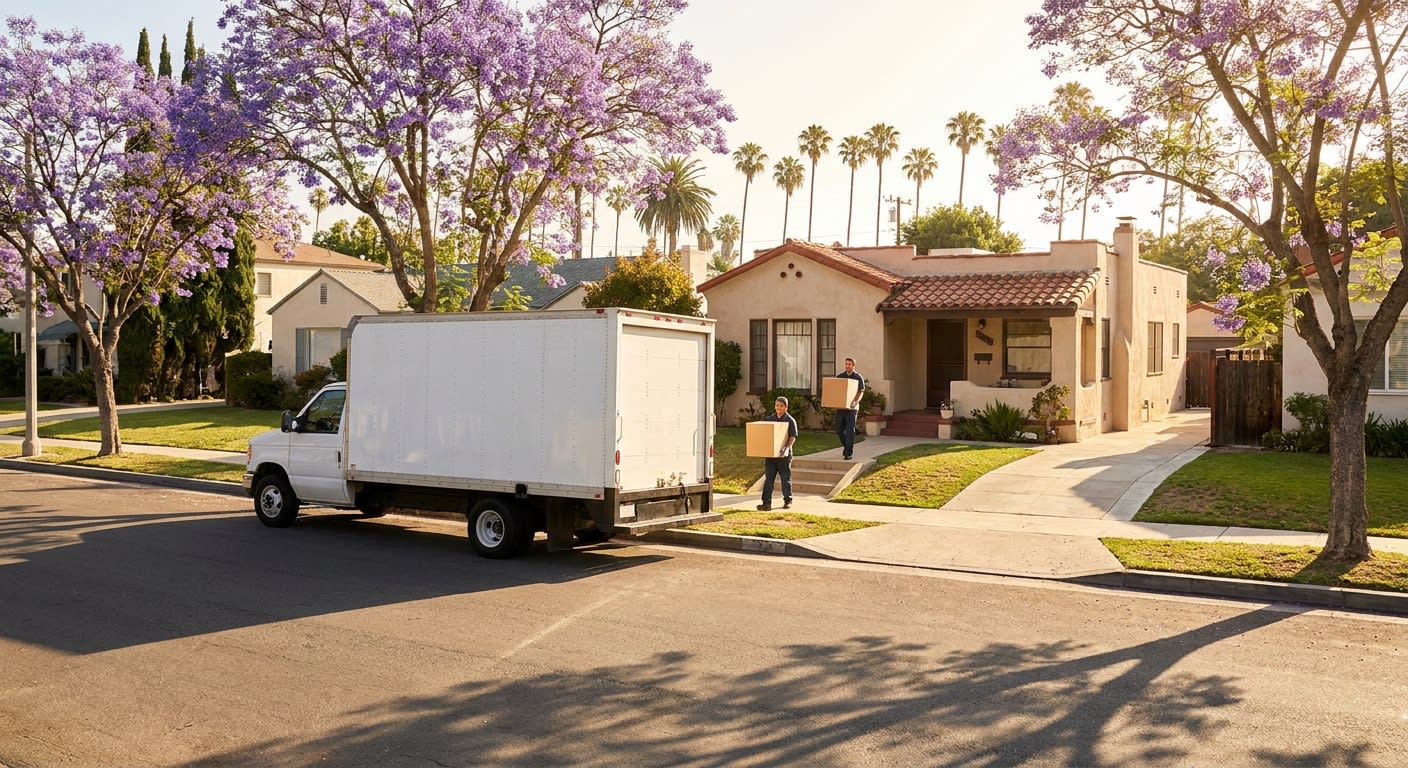
I'm Daniel Foster, a Relocation Advisor at Green Moving, and stair moves like this one are the bread and butter of LA apartment life. We're a city of 2-to-4-story walk-ups, courtyard buildings, and hillside duplexes where the front door sits 18 steps above the sidewalk. If you're tackling moving heavy furniture up stairs LA-style, the playbook is different from anywhere else — and I want to walk you through how my crews actually do it.
Why LA Stair Moves Are Their Own Animal
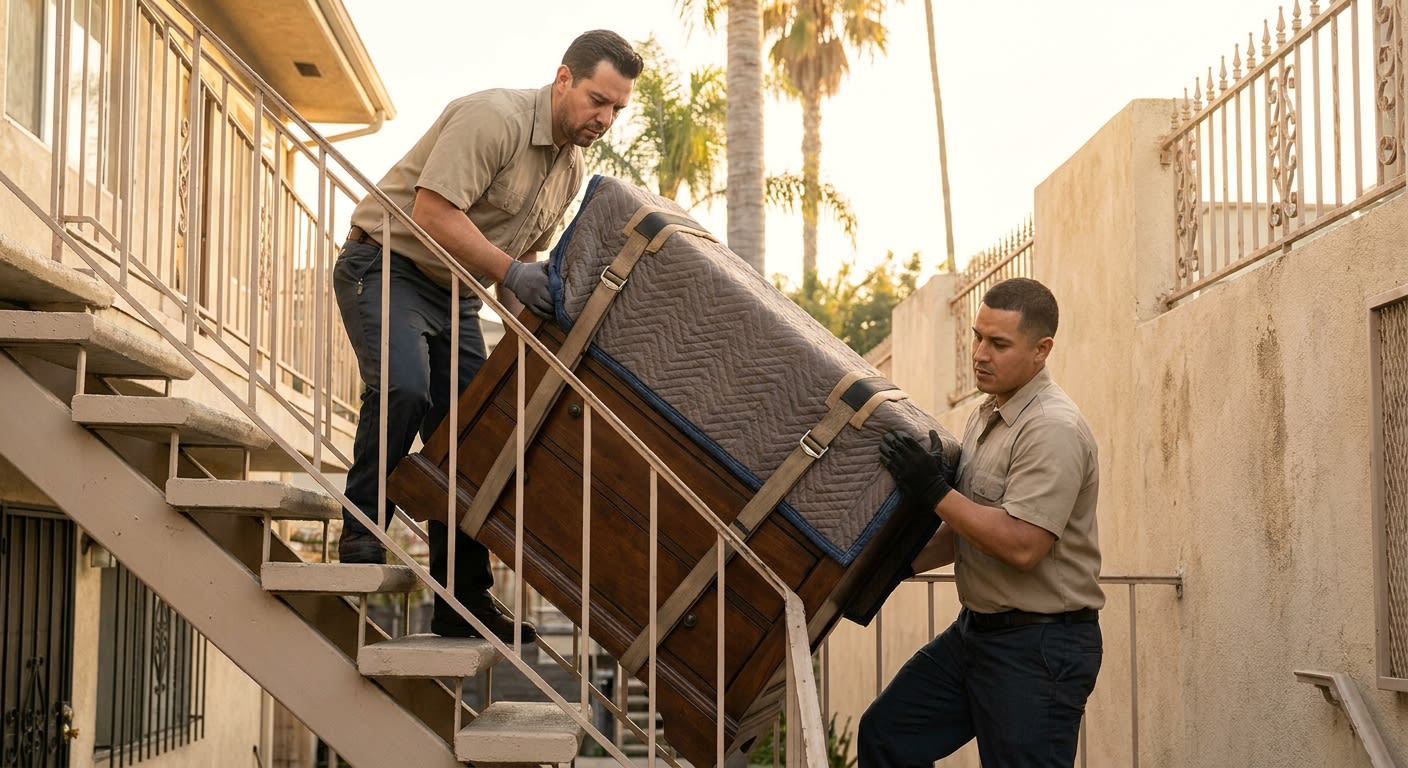
Most of LA's rental housing stock was built between 1955 and 1975, and that era loved one thing: the exterior staircase. Drive through Koreatown, Mid-City, North Hollywood, or East Hollywood and you'll see the same pattern — a stucco box on stilts with carports underneath and a single open-air staircase climbing the side. These stairs were designed for foot traffic, not 84-inch armoires. The treads are usually 9 to 10 inches deep, the risers 7.5 inches, and the landings rarely give you more than 36 inches of pivot room.
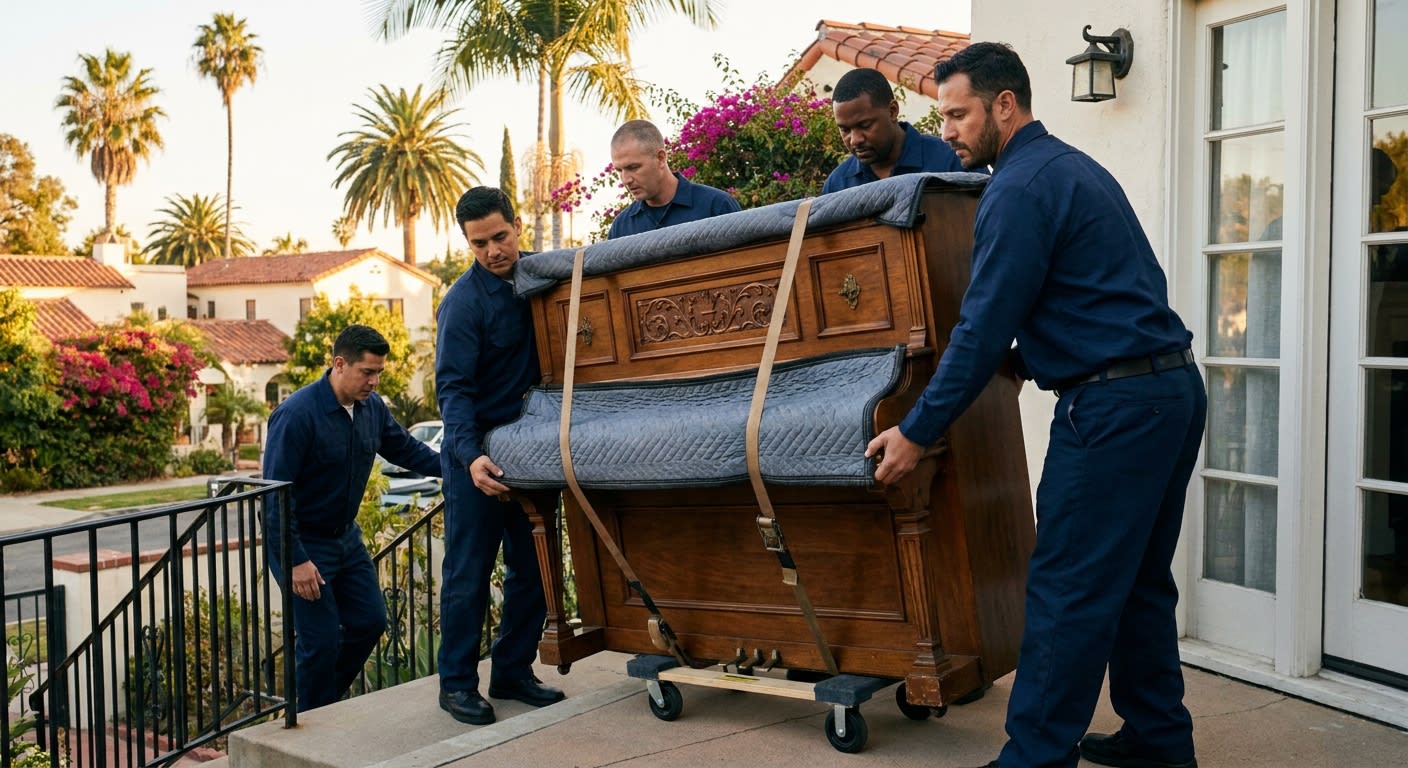
Add California's hillside neighborhoods — Silver Lake, Echo Park, parts of Highland Park — and you get exterior stairs from the street to the front door, sometimes 40 or 50 steps with no flat rest area. I had a piano move in Beachwood Canyon last year where the crew climbed 62 exterior steps before they even reached the unit's interior staircase. That's why I always tell clients: a stair move in LA isn't one obstacle, it's a chain of them. Sidewalk grade, parkway tree branches, gate width, stair width, landing pivot, doorway clearance, and finally the interior turn into the room. Miss any one of those measurements and you've got a $4,000 sectional sitting in the hallway.
The Measurements You Need Before Anyone Lifts a Thing
Before my crew quotes a stair-heavy job, I send the client a measurement sheet. Here's what we need: the diagonal dimension of every large piece (height, width, depth — and the hypotenuse, because that's what actually fits through doors), the width of the narrowest stair point (usually between the wall and the railing), the height of the lowest overhang on the staircase, and the width of the landing measured corner-to-corner.
For doorways, you want minimum 32 inches of clear opening — and "clear" means with the door removed if necessary. A standard interior door eats 1.5 inches when open. Apartment front doors in older LA buildings often measure 30 inches, which means a 33-inch-deep dresser will not fit no matter how you angle it. I've seen people try for 45 minutes before accepting they need to disassemble.
The single most useful measurement is the diagonal of the landing. Take the width plus the depth, then calculate the diagonal — that's the longest piece that can pivot through. If your sofa is 88 inches long and your landing diagonal is 76 inches, the sofa is going on its end, vertical, with two people steering and one spotting from below. Knowing that before move day saves you an hour of trial and error.
The Gear That Actually Makes a Difference
I get asked constantly whether forearm straps or shoulder straps are better for stairs. For LA exterior staircases with railings on both sides, my crews almost always use shoulder harness straps — the kind that loop under the piece and across both shoulders, distributing weight to your legs instead of your forearms. Forearm straps are great on flat ground but become dangerous on stairs because if the lower mover slips, the upper mover can't release fast enough.
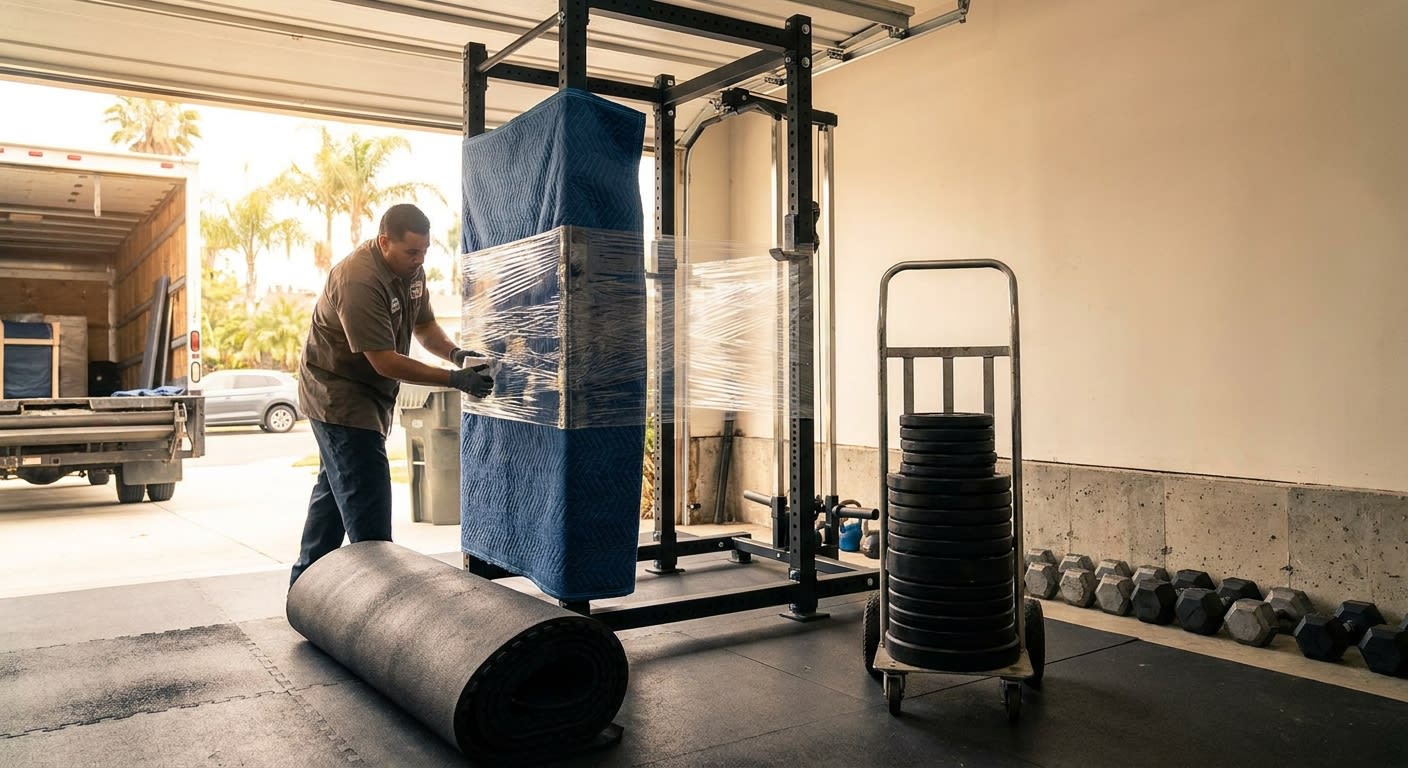
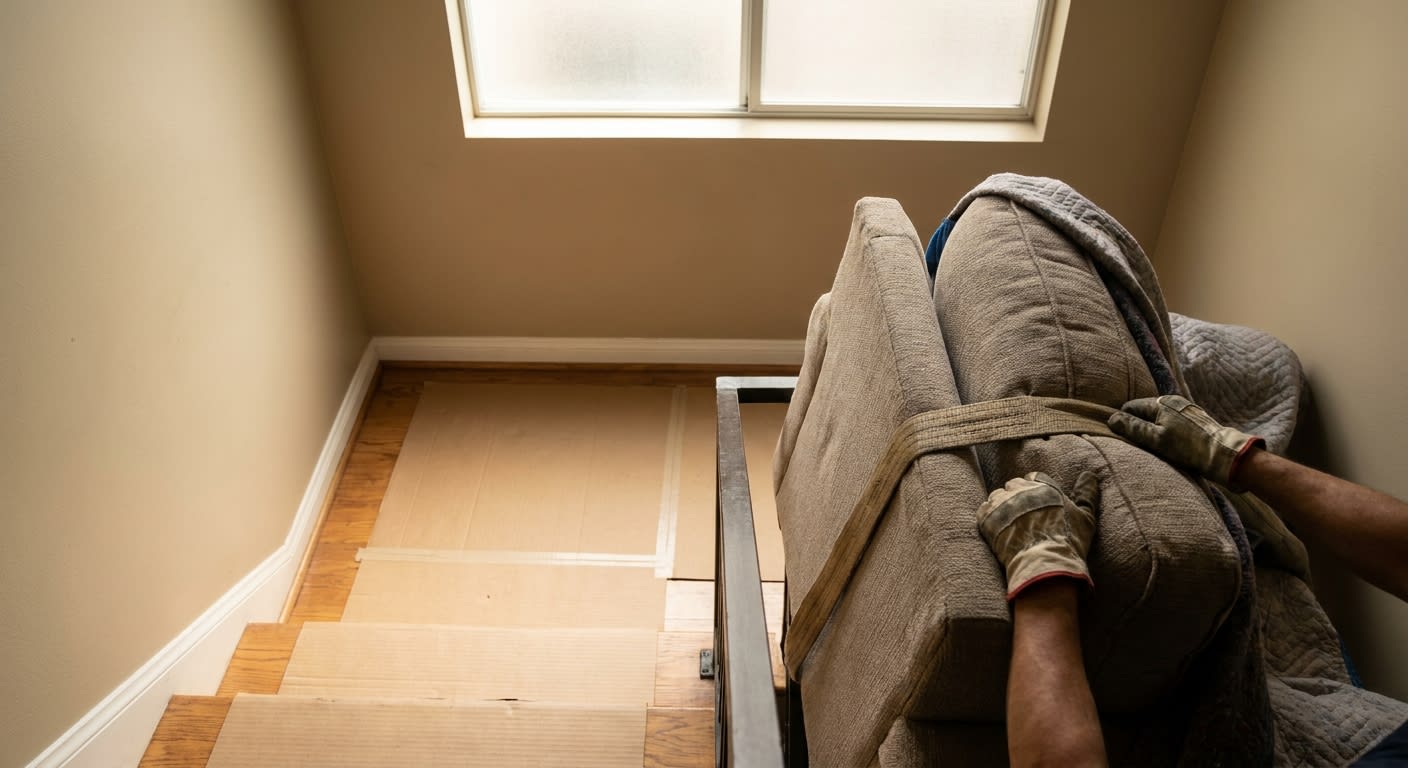
Other gear that earns its keep: 4-wheel furniture dollies for the sidewalk-to-stair-base run, stair-climbing hand trucks (we use Magliner Gemini Senior models with stair-climber attachments) for boxes and smaller dressers, thick moving blankets secured with shrink wrap rather than tape (tape pulls finish off antiques), and corner protectors for railings and walls. For hardwood treads inside the unit, I lay down 36-inch cardboard runners taped at the edges. Stucco corners on exterior staircases get padded with foam corner guards because one bumped corner means a $300 patch-and-paint charge from the landlord.
Crew Sizing for Stair-Heavy Moves
For a standard 2-bedroom apartment with one flight of exterior stairs and no oversized pieces, my baseline is a 3-person crew. Add a fourth mover when you have any of these: more than 12 stairs, a sectional sofa, a queen or king mattress that won't bend (memory foam and hybrid mattresses are stiffer than they look), an upright piano, a gun safe, a large armoire, or a treadmill. Add a fifth when you've got two or more of those items, or when the stair run exceeds 25 steps.
📦 Need a careful crew for a stair-heavy LA apartment move? Our local moving team handles walk-ups across LA and OC starting at $129/hour. Call (949) 266-9445 or request a free quote.
Disassembly: The Step Most People Skip
Here's the truth I tell every client: 80% of stair-move damage happens because someone tried to carry a piece intact that should have come apart. Bed frames, sectional sofas, dining tables, modular shelving, IKEA wardrobes — all of these are designed to disassemble, and the manufacturer expected you to do it for transport.
For sectionals, the connector clips are usually metal hooks that pop apart with a firm upward lift on one cushion bracket. For platform beds, the side rails come off with 4 to 6 bolts using a 13mm or 14mm socket. For dining tables, flip the table, unscrew the legs, wrap each leg separately. I keep a labeled ziplock for each piece's hardware and tape it to a non-finished surface — never to the wood directly.
The exception is solid antique furniture. Older armoires and dressers from the 1920s and earlier were often built as single solid units with hand-cut joinery, and disassembling them risks more than carrying. For those pieces, my colleague Marcus Rivera goes deep on the technique in our team's guide on moving antique furniture in LA. Read it before you touch grandma's mahogany highboy.
The LA Buildings That Make Me Nervous
After four years moving people across LA and OC, I've developed a mental list of building types that demand extra planning. Spanish Revival fourplexes from the 1920s and 1930s — common in Hancock Park and parts of Larchmont — have gorgeous arched stairwells that are also nightmares for furniture. The arches limit vertical clearance to about 78 inches at the apex, which means anything taller has to tilt at exactly the right angle.
Mid-century courtyard buildings around Park La Brea and along La Brea Avenue often have central courtyard staircases shared by 8 or more units. Those stairs are usually wider, but the catwalk landings outside each apartment are narrow and run along iron railings — a 90-inch sofa cannot make the turn from catwalk into door without going on its end.
Hillside duplexes in Mt. Washington, Echo Park, and Silver Lake often have exterior staircases that double as the only access route. I always do a pre-move walkthrough on these. If the truck can't park within 100 feet of the staircase base, I add a long-carry fee and an extra mover. My colleague Julia C. wrote a great companion piece on apartment-specific logistics in her complete checklist for apartment moving in LA that I send to every walk-up client.
Protecting the Building (and Your Deposit)
LA landlords are aggressive about deposit deductions for move-in and move-out damage. Scuffed walls, chipped stair nosings, scratched railings, gouged doorframes — I've seen tenants lose $800 to $1,500 because a friend's couch took a chunk out of a stairwell wall. Before my crews carry anything up, we lay down ram board or cardboard on every hardwood and tile surface, hang moving blankets on the walls of any tight corridor using painter's tape (never duct tape — it pulls paint), and pad railings with foam corner guards.
For buildings that require a Certificate of Insurance — and that's increasingly common in newer LA mid-rises and any HOA-governed building — I file the COI 5 to 7 days before the move. The cost is built into our hourly rate, and as a fully licensed California carrier (CAL-T 201327), we carry the limits most buildings require without needing a special endorsement. As part of every move, we donate 1% of your move to California environmental causes — so the protection runners and packing materials we use also fund native habitat restoration across the state. It's a small thing, but it matters to me that careful work and ecological care travel together.
Settling In: Your First Week After the Stairs
Once the furniture is up the stairs and in the unit, the work isn't quite done. A few LA-specific things I tell every client during their first week:
First, walk your stair route 24 hours after the move and photograph any new scuffs or dings. Send those photos to your landlord immediately, time-stamped, with a note that they were caused during professional move-in. This protects your deposit.
Second, if you're in a walk-up, register with your local Buy Nothing Facebook group within the first few days. Once you've hauled furniture up two flights, you'll think hard before buying anything else heavy — and Buy Nothing groups are how my clients in Silver Lake, Highland Park, and Atwater Village source plant stands, side tables, and bookshelves from neighbors who'll deliver to your door.
Third, find your nearest weekend farmers market. Hollywood Sunday market on Ivar, the Atwater Village Sunday market on Glendale Boulevard, and the Larchmont Sunday market are walking distance from huge swaths of LA's apartment stock. Walking groceries home beats hauling them up your new staircase in giant trips.
Fourth, introduce yourself to the upstairs and downstairs neighbors within the first week. In LA stucco walk-ups, sound travels through the staircase like a megaphone. A 30-second hello buys you months of grace on the occasional late-night TV.
FAQ
How many movers do I need for a 2-bedroom walk-up in LA?
For a typical 2-bedroom apartment with one flight of stairs and no oversized items, I recommend a 3-person crew. If you have a sectional sofa, king mattress, treadmill, or more than 12 stairs, bump it to 4 movers. Five movers come into play for hillside units or piano moves.
Can my mattress make a tight stair turn without bending?
Memory foam and hybrid mattresses are much stiffer than traditional spring mattresses and often won't fold around a tight 90-degree landing. We carry mattresses on their side, vertical, which usually solves it — but if the landing diagonal is under 80 inches and your mattress is a king, plan for a hoist or measure twice.
Do I need a Certificate of Insurance for my LA apartment move?
Most older walk-ups don't require one, but newer mid-rises, HOA-governed buildings, and most buildings west of La Cienega do. Ask your building manager 7 to 10 days before the move. We file COIs as part of our standard service at no additional charge.
What's the cost difference between a stair move and a ground-floor move?
In my experience, a stair-heavy job runs 20% to 35% longer than the equivalent ground-floor move because of the extra carry time and the need for a larger crew. Some companies add stair fees per flight; we just bill our standard hourly rate with the right crew size, which usually works out fairer.
Should I disassemble furniture before the movers arrive?
You can, and it'll save you money on hourly billing — but only if you're confident you can reassemble it. My crews disassemble and reassemble as part of the job, and we keep all the hardware organized so nothing gets lost. For complex pieces like Murphy beds or modular wardrobes, let us handle it.
Ready to move heavy furniture up your LA staircase without scratching a wall or pulling your back? Green Moving serves all of Los Angeles and Orange County with experienced walk-up crews, full-service packing, and transparent hourly pricing from $129/hour. Call me at (949) 266-9445, email sales@greenmovingla.com, or get your free quote here. Licensed and insured — CAL-T 201327.