The Color-Coding System That Makes Unpacking Easy

Last month a family in Culver City called me two days after their move, completely overwhelmed. They had 65 boxes scattered across a 3-bedroom house, and not one of them was labeled beyond "stuff" or "misc." They spent the entire first weekend opening box after box just to find their kids' school uniforms, the coffee maker, and a single set of sheets. That's three days of stress that didn't need to happen.
I talk to clients in situations like this every week, and the fix is always the same: a simple color-coding system. It takes about 30 minutes to set up, costs under $35, and consistently shaves hours off both moving day and unpacking. Here's the exact method I walk Green Moving clients through — the same one our crews use on every job.
Why Colors Beat Written Labels
When movers carry boxes from the truck into your home, they're making placement decisions every few seconds. Reading a handwritten label — squinting at "master bedroom closet — winter clothes" — takes time. Matching a blue stripe to a blue sign on the door? Under one second.
In my experience working with our crews, color-coded moves unload 15–20% faster than label-only moves. On a 3-bedroom home with 50–80 boxes, that speed difference adds up quickly. Every box that lands in the right room on the first try is a box you don't need to drag down the hall later.
There's a psychological benefit too. Walking into your new home and seeing all the kitchen boxes already gathered in the kitchen — instead of sprinkled across three rooms — makes the whole process feel manageable instead of chaotic.
How to Set Up Your Color System
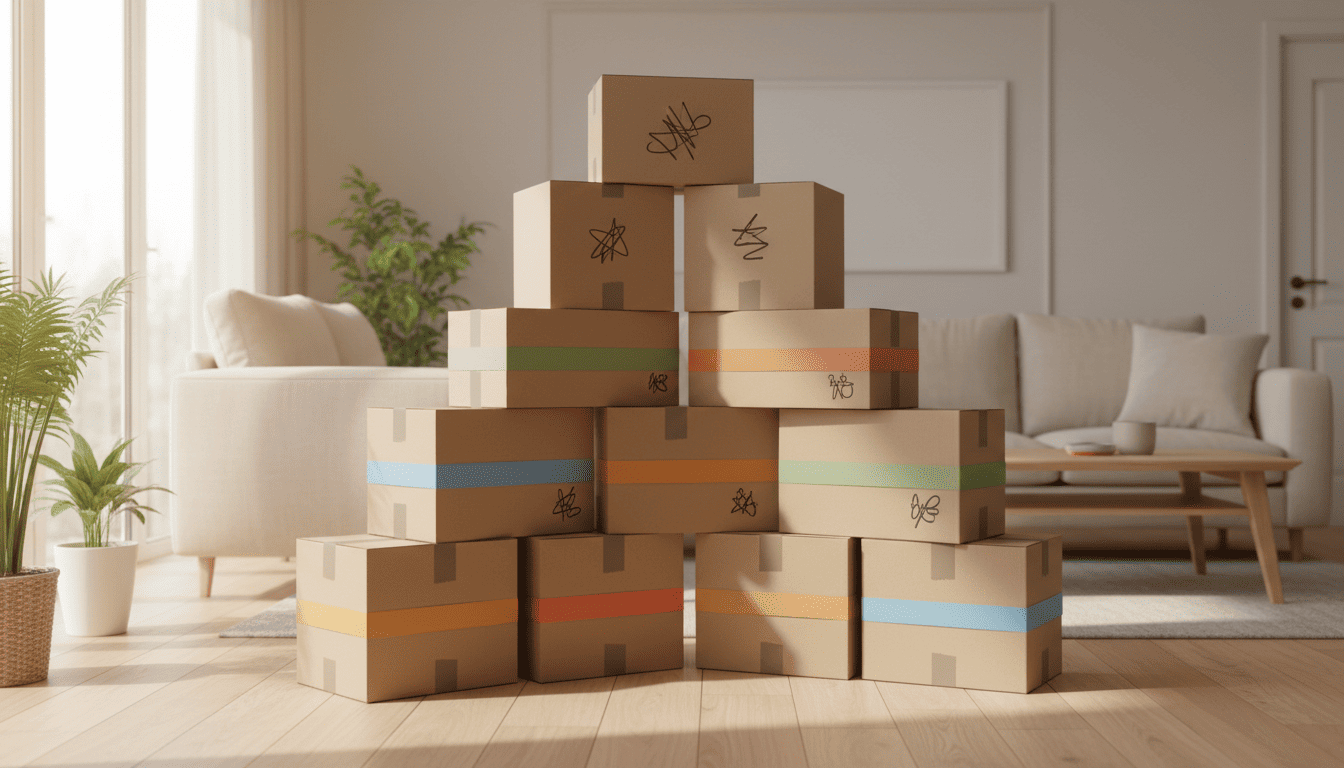
Choose one color per room. Here's the standard assignment our Green Moving crews recognize instantly:
- Red — Kitchen
- Blue — Master Bedroom
- Green — Living Room
- Yellow — Bathroom(s)
- Orange — Kids' Rooms
- Purple — Office or Study
- Pink — Dining Room
- Brown — Garage or Storage
Stick to 8 colors maximum. More than that creates confusion — if you have a guest room and a kids' room, they can share orange with a number to differentiate (Orange-1, Orange-2).
Materials you'll need: colored packing tape rolls ($3–$5 each at any hardware store), a black marker, and two copies of your room assignment list. Total investment: $25–$35. That's it.
Applying the System: Four Steps
Step 1 — Write your room assignment sheet. List every room with its assigned color. Print or write two copies: one stays with you, one goes to the crew leader when the movers arrive. Here's what I always tell clients: tape one copy to the inside of your front door at the new place so it's impossible to miss.
Step 2 — Mark every box on the top AND one side. This is where most people slip up. They tape the top only, and then boxes get stacked. Guess what disappears? The top. A colored stripe running down one side stays visible no matter how boxes are arranged on the truck or in a room.
Step 3 — Label contents in black marker. The color tells movers where the box goes. The written label tells youwhat's inside when you unpack. "Blue — sheets and pillows" means master bedroom, bedding. Both pieces of information matter, but they serve different audiences.
Step 4 — Post colored signs in your new home before the truck arrives. Tape a sheet of colored paper or cardstock on the door frame or wall of each room. When movers walk in carrying a green-striped box, they scan for the green sign and place it there — no questions, no hesitation, no verbal directions repeated sixty times.
Even 10 minutes of setup at the new place eliminates hundreds of "where does this go?" exchanges throughout the day.
Pro-Level Techniques That Make a Real Difference
After coordinating thousands of moves across Los Angeles, I've picked up a few tricks that go beyond the basics.
Priority numbering within colors. Add a number 1, 2, or 3 to each box alongside the color stripe. "Blue-1" means master bedroom, unpack first night (sheets, pillows, alarm clock). "Blue-3" means master bedroom, unpack whenever (seasonal clothes, decorative pillows). This prevents the classic problem of tearing through ten boxes at midnight looking for your bedding.
The essentials box. Pack one clearly marked box per family member with everything they need for the first 24 hours — toiletries, phone charger, medications, change of clothes, a snack, basic tools. Use a unique color that's not assigned to any room — bright white tape with "OPEN FIRST" in large letters works well. This box rides in your car, never on the truck.
Fragile overlay. Add a white tape X across any fragile box regardless of its room color. This creates a universal signal every mover recognizes without reading a word. Our Green Moving crews specifically look for this pattern during loading and prioritize those boxes for careful placement.
Have questions about organizing your move? I'm here to help — call (949) 266-9445 or get in touch.
What About Storage and Multi-Stop Moves?
If part of your belongings are heading to a storage unit before moving into your new place, add a second signal — a black stripe across the box. Boxes with black plus their room color go to storage. Boxes with room color only go straight to the new home.
This matters for loading sequence. Our crews load storage-bound boxes last on the truck so they come off first at the storage facility. Your home boxes load first and come off last — directly at your front door. One simple stripe eliminates the sorting nightmare of pulling boxes on and off mid-route.
For families moving locally across Los Angeles, multi-stop moves are common — a quick storage drop before heading to the new address. The black-stripe system keeps everything organized even when the truck makes two or three stops in a single day.
A Real Client Story
A family of four we moved from a 4-bedroom in Culver City to Pasadena had 72 boxes. The homeowner — a mom with two kids under seven — set up her color system the weekend before the move. She spent about 40 minutes total assigning colors, buying tape, and briefing her husband on the plan.
On moving day, our crew arrived to find every box color-striped on top and one side. At the Pasadena house, colored signs were already taped to each room's door frame. The crew unloaded and placed all 72 boxes in roughly 10 minutes — compared to the 45–55 minutes a typical unlabeled unload takes.
The savings? About 40 minutes of labor at $169/hour for a 3-mover crew — roughly $115 in direct cost reduction. But the bigger win was unpacking. The family had their kitchen fully set up by dinner and the kids' rooms functional by bedtime. No box hunting, no shuffling heavy containers between rooms, no chaos.
That's the result I see consistently. The 30-minute investment in setup pays for itself several times over.
Six Mistakes That Break the System
The color-coding method is simple, but I've watched it fail when clients skip key steps.
Marking only the top of boxes. Stacked boxes hide their lids completely. Without a side stripe, movers default to guessing or asking — which defeats the purpose. Always mark at least one side.
Using too many colors. Twelve different shades might feel precise, but movers can't distinguish teal from turquoise in a dim hallway. Stick to 8 bold, distinct colors maximum.
Skipping the signs at the new home. You've done all the packing work, but without matching signs on each room's door, the crew has no reference point. Half the system is at the origin, half is at the destination — both halves matter equally.
Switching colors halfway through packing. Decide every assignment before you tape a single box. Changing blue from "master bedroom" to "bathroom" on day two of packing means half your blue boxes end up in the wrong room.
Using painter's tape. It peels off during handling and transit. Use colored packing tape or duct tape — they grip reliably through loading, driving, and stacking.
Forgetting to brief the crew. Hand your room assignment sheet to the lead mover and take 30 seconds to explain the system. Most professional crews, including ours, already know color-coding protocols — but confirming your specific assignments prevents any mismatch. Our packing and unpacking team can also implement the system for you if you'd rather hand off the process entirely.
Frequently Asked Questions
Does color-coding actually save money on a move?
Yes. Faster unloading means fewer labor hours billed. Based on Green Moving's data, color-coded moves run 15–20% faster during the unloading phase. On a typical $1,200 local move, that translates to $180–$240 in potential savings — well beyond the $25–$35 you'll spend on tape.
What if my new apartment has an open layout with fewer distinct rooms?
Assign colors by zone or function instead. "Red" for the kitchen area, "green" for the living space, "blue" for the bedroom corner. The principle is identical — you're grouping boxes by destination so they land in the right spot without discussion.
Can professional packers use my color system?
Absolutely. If you book Green Moving's full-service packing, just hand our packing crew your room assignment sheet before they start. They'll apply the right colored tape to every box as they pack it. The system works whether you pack yourself or have professionals handle it.
How do I handle items that belong in more than one room?
Pick the room where you'll most likely use or unpack the item first. A blender could be "kitchen" or "dining room" — assign it to kitchen and move on. The goal is speed and consistency, not perfect categorization. One firm decision is always better than hesitating over every ambiguous box.
Is color-coding worth the effort for a small studio move?
For a studio with 10–15 boxes, full color-coding is overkill. But even then, I recommend marking an essentials box and separating kitchen items from everything else — two colors, two minutes. For apartments with two or more rooms, the full system pays off every time.
Get Started
The best part of color-coding is how little effort it takes compared to how much frustration it prevents. Thirty minutes of setup, $30 in tape, and you've eliminated the single biggest source of moving-day confusion — misplaced boxes.
Schedule Your Free Consultation:
- Call: (949) 266-9445
- Email: sales@greenmovingla.com
- Online: greenmovingla.com/contacts
Green Moving — Licensed (CAL-T 201327) & Insured. 1% of every move supports California environmental causes.