Moving to Newport Beach: Costs & Tips
- What Makes Newport Beach Different From Everywhere Else in OC
- Newport Beach Neighborhoods: Where You'll Actually Live
- Real Moving Costs for Newport Beach in 2026
- Coastal Climate and Your Belongings
- Parking, Access, and the Peninsula Problem
- HOA and Gate Community Logistics
- What to Know Before You Sign a Lease or Close
- The Green Moving Advantage in Newport Beach
- FAQ
Last November I coordinated a move for a retired couple downsizing from a five-bedroom estate in Brentwood to a three-bedroom waterfront home on Balboa Island. On paper it was simple — fewer rooms, less stuff, shorter distance. In reality, it was one of the most logistically complex moves I've handled all year. The truck couldn't fit on the island's narrow streets, the bridge had a weight limit, the ferry was out of the question for a loaded moving vehicle, and the only viable approach was to stage everything in a smaller shuttle truck on the mainland side and relay loads across the bridge in batches. It took twice as long as a standard move of that size — and the clients had no idea any of this was coming until I flagged it during the pre-move walkthrough.
That's Newport Beach. It's one of the most beautiful places to live in Southern California, but it has moving logistics that will catch you completely off guard if you don't know the terrain. I'm Daniel, a Relocation Advisor at Green Moving, and I've moved families into and out of every corner of Newport — from the wide driveways of Newport Coast to the impossibly tight alleys of the Balboa Peninsula. This guide covers the neighborhoods, the real costs, and the coastal quirks that make Newport Beach moves different from anywhere else in OC.
What Makes Newport Beach Different From Everywhere Else in OC
Newport Beach isn't a typical Orange County suburb. It's a coastal city of about 85,000 people spread across dramatically different geography — steep hillside communities, flat peninsula streets barely wide enough for one car, harbor islands connected by single-lane bridges, and gated hillside enclaves overlooking the Pacific.
This geography directly impacts your move. A home in Newport Coast has a three-car garage and a wide cul-de-sac — your moving truck parks in the driveway and the crew works comfortably. A home on the Balboa Peninsula has no garage, street parking only, and a front door that opens directly onto a sidewalk six feet from the road. Same city, completely different moving experience and cost.
The other factor is wealth concentration. Newport Beach is one of the wealthiest cities in California, which means a higher proportion of moves involve high-value items — artwork, wine collections, antique furniture, designer fixtures — that require specialty handling. A "standard" move in Newport often includes items that would be considered White Glove territory in most other cities.
Newport Beach Neighborhoods: Where You'll Actually Live
Corona del Mar (CdM) sits on the eastern bluff overlooking the ocean and Crystal Cove State Park. It has its own village feel — boutique shops along East Coast Highway, the Flower Streets neighborhood (Carnation, Dahlia, Iris, Poppy) where homes sit on compact lots with ocean views, and the larger estate properties up on the ridgeline. Homes in the Flower Streets run $2.5M–$5M; ridgeline estates go $5M–$15M+. Moving logistics here are moderate — most streets are accessible, parking is tight but manageable, and the main challenge is the steep driveways on some hillside properties.
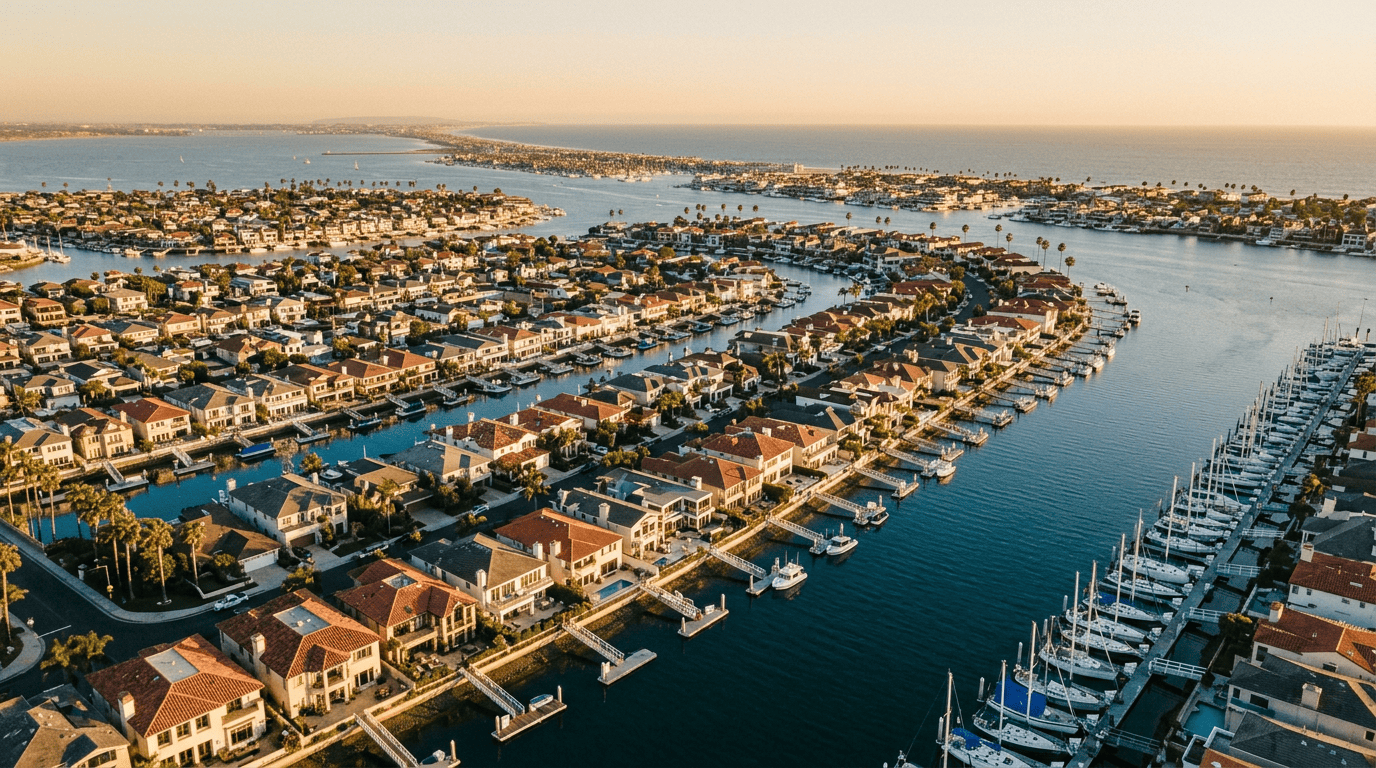
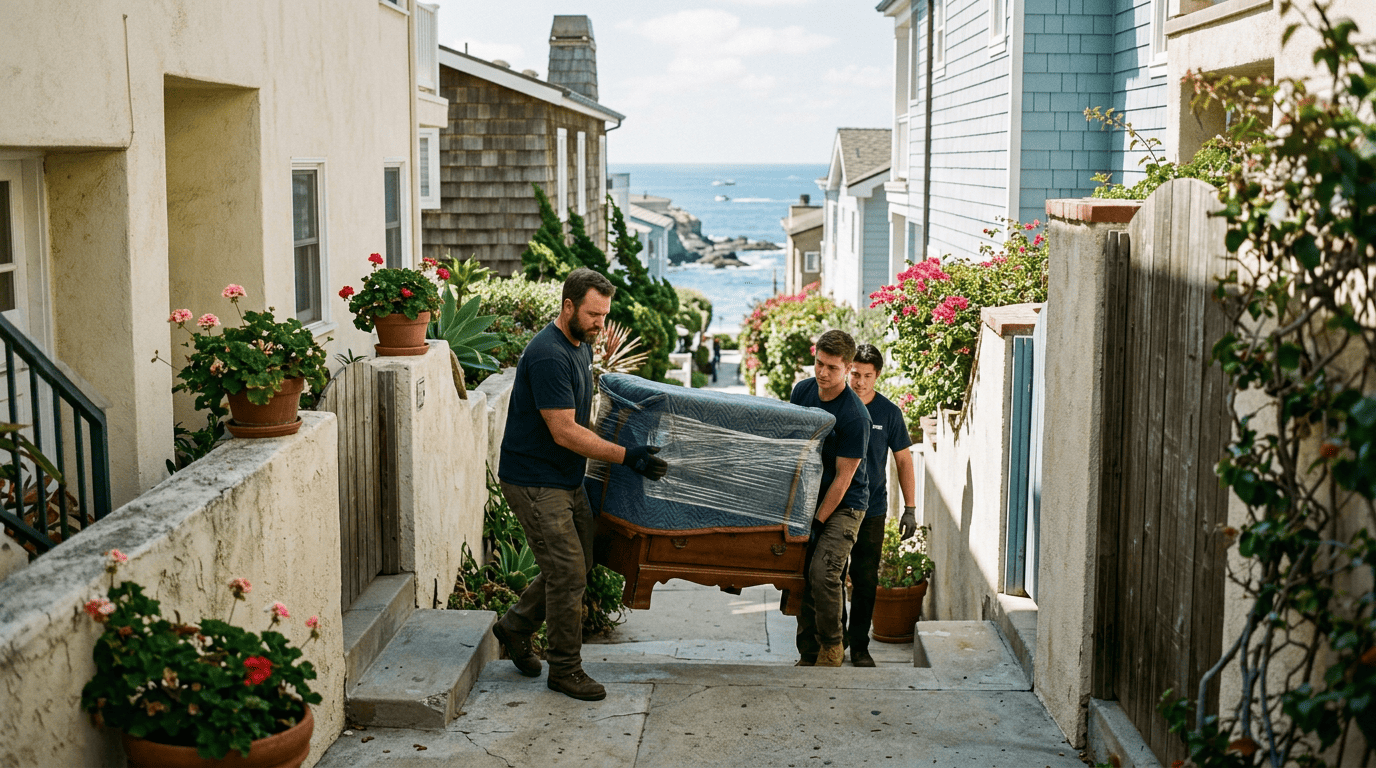
Balboa Peninsula is the narrow strip of land between the harbor and the ocean, stretching from the Wedge down to the Newport Pier area. This is classic beach living — walk to the sand, bike to the pier, kayak in the harbor from your back door. But the housing stock is dense. Lots are narrow (25–30 feet wide is common), many homes are two or three stories built straight up, and street parking is the only option. Moving here requires advance parking permits, smaller trucks or shuttle vehicles, and a crew that knows how to navigate tight stairways with bulky furniture. Prices range from $1.5M for a small cottage to $8M+ for bayfront properties.
Balboa Island is a small, flat island in the harbor connected to the mainland by a single bridge and the Balboa Island Ferry. Everything about the island is compact — tiny lots, narrow sidewalks, almost zero parking. Moving onto Balboa Island is a specialty job. Full-size trucks cannot navigate most island streets, and the bridge has vehicle restrictions. We use shuttle vans and relay operations for island moves. Homes range from $2M for a small interior lot to $6M+ for bayfront. Despite the logistics, people adore living here — it's one of the most charming communities in all of Southern California.
Newport Coast is the hilltop enclave overlooking Crystal Cove and the Pacific. Gated communities like Pelican Hill, Crystal Cove, and Pelican Crest offer large estate homes with sweeping ocean views, resort-style amenities, and total privacy. This is where Newport's most expensive properties sit — $5M–$25M+. Moving logistics are actually easier here than on the peninsula: wide streets, large garages, gated access with advance coordination. The main considerations are long carry distances from truck to front door (some driveways are 100+ feet) and the gate/COI requirements.
Eastbluff and Dover Shores are the more "accessible" Newport Beach neighborhoods — still expensive by national standards ($1.5M–$3.5M) but more moderately priced within Newport. Eastbluff sits on a bluff above Upper Newport Bay with nature preserve views and mid-century homes that have been extensively remodeled. Dover Shores is a family-friendly waterfront community on the harbor's edge. Both have reasonable street access and standard moving logistics.
🌊 Moving to Newport Beach? Every neighborhood here has unique access challenges — our crews know them all. Call (949) 266-9445 or request a free quote. Green Moving serves all of Orange County including every corner of Newport Beach.
Real Moving Costs for Newport Beach in 2026
Newport Beach moves carry higher costs than typical OC moves for specific, legitimate reasons. Here's what to actually expect:
From another OC city to Newport Beach (standard home, accessible street): Crew: 2–3 movers + truck. Time: 4–6 hours. Cost: $700–$1,200. This covers moves into Newport Coast, Eastbluff, Dover Shores, and Corona del Mar homes with driveway access. Comparable to any standard OC local move.
From LA to Newport Beach: Distance: 45–60 miles. Crew: 3 movers + truck. Time: 6–8 hours. Cost: $1,100–$1,800. The drive adds about 90 minutes each way in typical traffic, plus loading and unloading time. PCH routing during summer adds additional time — I always recommend the 73 toll road instead.
Peninsula or Balboa Island move (any origin): Add $200–$500 to any estimate above. The premium covers shuttle truck operations, parking permits ($30–$50/day from the city), extended carry distances, and the additional labor time required for narrow-access work. A 2-bedroom peninsula move that would cost $800 in Eastbluff will cost $1,000–$1,300 on the peninsula.
Large estate move (Newport Coast, CdM ridgeline): Crew: 4 movers + large truck. Time: 8–12 hours. Cost: $2,500–$4,500. These homes have more furniture, more specialty items, and longer carry distances. If the move includes a piano, wine collection, or oversized artwork, specialty handling fees add $150–$500 per item. Check our piano moving guide for detailed specialty pricing.
The hidden cost nobody budgets for: Parking permits on the peninsula and near the pier. The City of Newport Beach requires moving truck permits for any vehicle over 10,000 lbs parked on residential streets. You need to apply through the city — plan at least 5 business days lead time. If you skip this step, your truck gets ticketed or towed, and your move stops cold.
Coastal Climate and Your Belongings
Newport's marine climate is gorgeous for living but presents specific challenges for a move that inland residents never think about:
Salt air corrosion. If your move involves any outdoor staging time (items sitting on the driveway or sidewalk while the truck is being loaded), salt air exposure can start affecting unprotected metal surfaces within hours. Chrome fixtures, iron furniture frames, and steel tool sets should be wrapped, not left exposed. Our crews use protective blankets on all metal items during coastal moves as standard practice.
Morning fog and moisture. Newport Beach — especially the peninsula and Balboa Island — regularly has marine layer fog until 10–11 AM. Cardboard boxes left outside in fog absorb moisture and weaken. I've seen boxes collapse from the bottom during an 8 AM peninsula load. If you're starting early (which I recommend), keep boxes inside until the crew is ready to carry them directly to the truck.
UV exposure on furniture. Full sun hits the peninsula by noon with zero shade on most streets. Leather furniture, wood finishes, and fabric upholstery can fade or heat-damage with extended sun exposure during loading. Speed matters — and so does keeping the truck doors closed between loads to maintain lower temperatures inside.
Parking, Access, and the Peninsula Problem
Let me be direct: if you're moving to or from the Balboa Peninsula, parking and access will be the single biggest factor in your move's cost and timeline.
Most peninsula streets are one lane in each direction with parallel parking on both sides. A standard 26-foot moving truck takes up two or three parking spaces and partially blocks the traffic lane. During summer and weekends, this creates immediate problems with neighbors, cyclists, and city enforcement.
What you need to do:
Get a city parking permit for the moving truck — apply through Newport Beach Public Works at least a week in advance. Specify the street, date, and estimated time window.
Notify your immediate neighbors. Peninsula living is tight, and a truck blocking the street for four hours without warning creates bad will on day one. A quick note on their doors a few days before goes a long way.
Confirm with your moving company that they've done peninsula moves before. This isn't a scare tactic — it's a genuine operational concern. Crews that have never worked the peninsula will be slower, more frustrated, and more likely to damage items navigating the tight turns inside narrow stairwells. Green Moving's crews have run peninsula jobs regularly, and we know which streets require shuttle trucks versus which can handle a full-size vehicle.
For Balboa Island specifically, we always do a pre-move site visit. There's no substitute for physically confirming that the truck (or shuttle van) can reach the property, turn around, and park without blocking the bridge approach.
HOA and Gate Community Logistics
Newport Coast communities all have gate access requirements. Here's the typical protocol:
Contact your property management company or HOA 2 weeks before your move. Provide the moving company name, truck license plate number, crew member count, and estimated arrival time. Request a COI (Certificate of Insurance) from your mover — we provide these same-day at Green Moving. Some communities also require a refundable deposit ($500–$1,000) in case of common area damage during the move.
Moving hours in gated Newport communities are typically 8 AM–5 PM Monday through Friday, 9 AM–4 PM Saturday. Most prohibit Sunday and holiday moves entirely. Pelican Hill and Crystal Cove have particularly strict enforcement — if your crew arrives at 8:05, the guard may turn them away until the next scheduled entry window.
What to Know Before You Sign a Lease or Close
A few things I wish every Newport Beach newcomer knew:
Flood insurance may be required for peninsula and island properties. Standard homeowner's insurance doesn't cover flood damage, and FEMA flood maps put much of the waterfront in high-risk zones. Budget $1,500–$3,000/year for flood insurance on bayfront or oceanfront properties.
The 73 toll road is your lifeline. If you commute to Irvine, Mission Viejo, or anywhere inland, the 73 saves 20–30 minutes each way versus surface streets or PCH. Budget $150–$200/month for tolls with a FasTrak transponder.
Summer transforms the city. Newport Beach's population effectively doubles from June through August with tourists, beach visitors, and day-trippers. Parking disappears, restaurant wait times triple, and traffic on Balboa Boulevard becomes gridlock. If you're moving in summer, plan accordingly — our summer moving guide has detailed heat and traffic strategies that apply directly to Newport.
The dining scene is excellent but expensive. Lido Marina Village, Mariner's Mile, and Corona del Mar's village all have outstanding restaurants, but expect $80–$150 per person at the nicer spots. For everyday dining, Costa Mesa's 17th Street and The Camp/The Lab provide more affordable options just 10 minutes away.
The Green Moving Advantage in Newport Beach
We're based in Irvine at 3110 Spectrum — literally 15 minutes from Newport Beach. Our crews move families into and out of Newport every week, and we know the specific challenges: the peninsula access, the island shuttle logistics, the Newport Coast gate protocols, the coastal weather considerations.
Green Moving also commits 1% of every move to California environmental causes. In a city that values its natural coastline and marine environment, moving with a company that invests in environmental protection feels like the right fit.
FAQ
How much does it cost to move to Newport Beach? A standard local move into Newport Beach from elsewhere in OC runs $700–$1,200 for a 2-bedroom home in an accessible neighborhood. Peninsula and Balboa Island moves add $200–$500 due to shuttle operations and parking permits. Large estate moves in Newport Coast range from $2,500 to $4,500 or more depending on home size and specialty items.
Do I need a parking permit for a moving truck in Newport Beach? Yes, for the Balboa Peninsula and other street-parking-only areas. The City of Newport Beach requires permits for commercial vehicles over 10,000 lbs. Apply through Public Works at least 5 business days before your move date. Permits typically cost $30–$50 per day.
Can a full-size moving truck fit on Balboa Island? In most cases, no. Balboa Island streets are too narrow for standard 26-foot trucks, and the bridge has vehicle restrictions. Professional movers use smaller shuttle trucks or cargo vans and relay loads from a staging point on the mainland. This adds time and cost but is the only reliable approach.
What is the best neighborhood in Newport Beach for families? Eastbluff and Dover Shores offer the best combination of family-friendly community, reasonable pricing by Newport standards, good school access, and harbor or nature preserve proximity. Corona del Mar is excellent if budget allows. Newport Coast provides gated security and resort amenities but at a significantly higher price point.
Is Newport Beach worth the cost of living? For people who prioritize coastal lifestyle, outdoor access, safety, and excellent schools, Newport Beach delivers. The trade-offs are higher housing costs, tourist-season congestion, and a 45–60 minute commute to LA. Many residents find the quality of daily life — walking to the beach, harbor access, year-round mild weather — outweighs the premium.
Planning your Newport Beach move? Green Moving handles every neighborhood in Newport — from peninsula shuttles to Newport Coast estates. Call (949) 266-9445, email sales@greenmovingla.com, or get your free quote. Licensed & insured — CAL-T 201327.