Moving With Kids: LA Family Guide
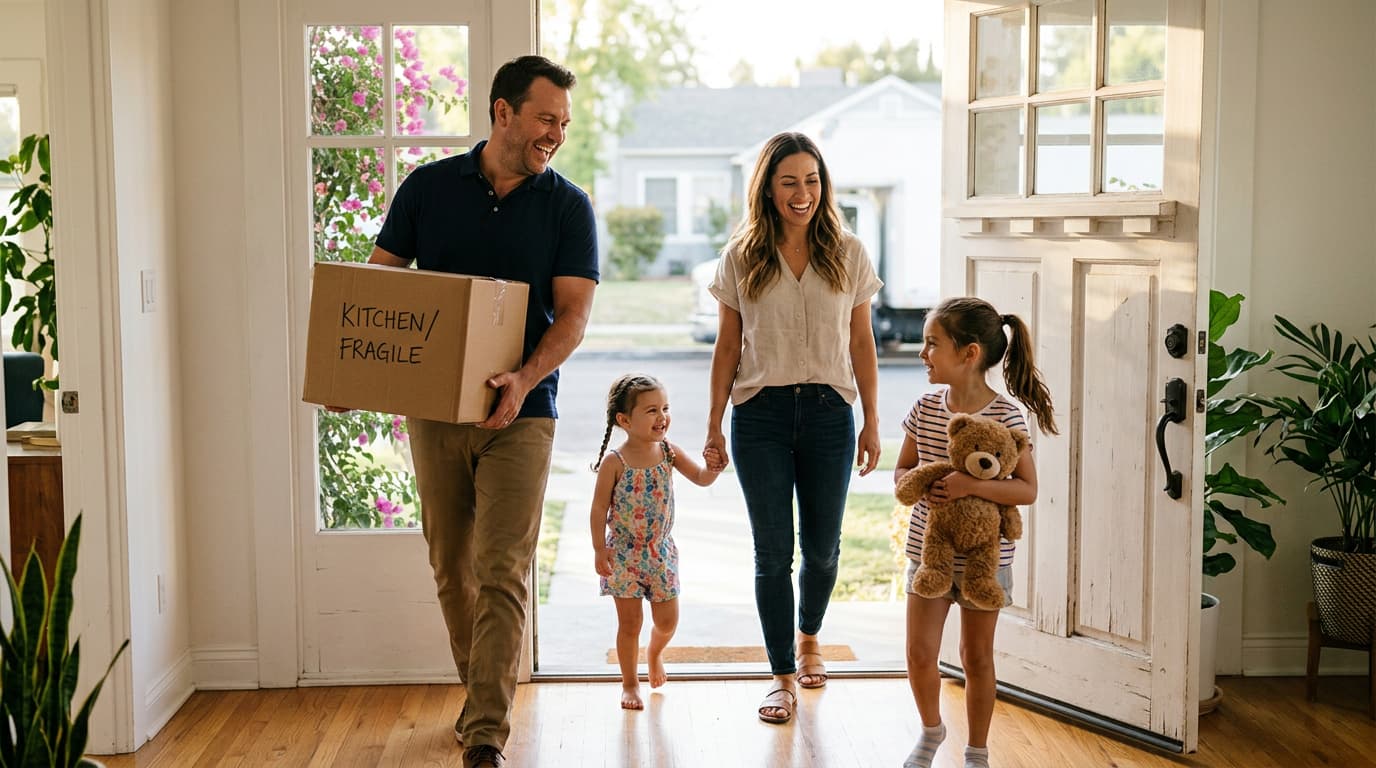
A few weeks ago I worked with a family moving from a 2-bedroom apartment in Westchester to a 4-bedroom house in Torrance. Mom, Dad, a 4-year-old, a 7-year-old, and a 3-month-old baby. When I arrived for the pre-move walkthrough, the apartment looked like a tornado had hit a toy store. Half-packed boxes mixed with Lego landmines, a sippy cup balanced on a roll of packing tape, and the 4-year-old explaining to me very seriously that we could not move the couch because that was where his dinosaurs lived. Mom was standing in the kitchen holding the baby with one arm and trying to wrap plates with the other. Dad was on a work call in the bathroom — the only quiet room left. She looked at me and said, "Please tell me you've seen worse." I had. And I told her the same thing I'm going to tell you: moving with kids is hard, but it doesn't have to be chaos. It just needs a different kind of planning.
I'm Julia, a Personal Moving Consultant at Green Moving, and a significant portion of my clients are LA families with children. Every age group brings different challenges — a toddler who won't stop "helping" by unpacking boxes you just sealed, a 10-year-old devastated about leaving friends, a teenager furious about switching schools. This guide breaks it down by age, by phase, and by the specific moving-day strategies that make it manageable for everyone, including you.
The Emotional Side: What Kids Actually Feel
Before we get into logistics, let's talk about what's happening inside your child's head. Because the emotional dimension of moving with kids is the part most parents underestimate — and the part that, if handled well, makes everything else easier.
For children, a home isn't an asset or a lease agreement. It's the entire world. Their bedroom is their sanctuary. The crack in the hallway ceiling is a landmark. The neighbor's dog that barks every morning is part of the soundtrack of their life. When you announce a move, you're telling them that the only world they know is about to disappear.
The response varies by age (I'll get specific below), but the universal truth is this: kids need to feel included, informed, and reassured. Not lied to — "Everything will be exactly the same!" won't work because they'll figure out it's not true within 24 hours. Instead, honest, age-appropriate communication works: "Our new house is in a different neighborhood. You'll have a new room and a new school. Some things will be different, and some things will be the same. We're doing this together."
Start this conversation as early as possible — ideally 4–6 weeks before the move. Give them time to process, ask questions, feel sad, and then gradually get excited.
Ages 0–2: Babies and Toddlers
The good news: They won't remember the move. There's no emotional processing required, no school transition to manage, no friendship drama.
The challenge: They need constant supervision during the most chaotic day of your year, and their schedule — naps, feeding, diaper changes — does not care about your moving timeline.
Pre-move strategy: Pack the nursery last. Keep the crib set up as long as possible so nap schedules stay intact during the packing weeks. One disrupted nap in a toddler can cascade into a full meltdown that ruins an afternoon of packing.
Moving day strategy: Get the baby or toddler out of the house entirely. This is non-negotiable. A family member, trusted friend, or regular babysitter should take your youngest to their home, a park, or any space that isn't a house full of movers carrying heavy objects through narrow doorways. A moving site is genuinely unsafe for toddlers — open doors, sharp box corners, heavy items being carried at eye level, dollies rolling across floors, and strangers (the crew) moving quickly through every room.
At the new house: Set up the nursery first. Before you unpack the kitchen, before you make the master bed, before you find the Wi-Fi password — get the crib assembled, get the familiar blankets and stuffed animals in place, and give your baby a nap in a room that smells and feels as close to home as possible. Everything else can wait. This is the room that matters on night one.
Essential toddler moving-day bag: Diapers (more than you think), wipes, 2 changes of clothes, familiar blanket, 2–3 favorite toys, snacks, bottles/sippy cups, pacifier (backup too), any medications. Carry this in your car — never in the truck.
Ages 3–5: Preschoolers
The challenge: Old enough to understand something is happening, too young to fully process it. Preschoolers express anxiety through behavior — clinginess, regression (potty-trained kids having accidents, thumb-sucking returning), tantrums, and sleep disruption.
Pre-move strategy: Read books about moving together — "The Berenstain Bears' Moving Day" is a classic, and there are dozens of age-appropriate titles at any LA library. Let them "help" pack their room by choosing which toys go in their special box. Give them a small, labeled box that is THEIRS — they pack it, they carry it, they open it first at the new house.
Talk about the new house in concrete terms. "You'll have a bigger room." "There's a park we can walk to." "The backyard has a tree." If possible, drive by the new house or visit before moving day so it's not a complete unknown. Show them photos of their new room and the neighborhood.
Moving day: Same as toddlers — ideally out of the house with a caregiver. If that's not possible, designate one room as the "kid zone" with a tablet, coloring books, snacks, and a gate or closed door separating them from the moving activity. Assign one adult exclusively to child duty — not helping movers AND watching kids. Those two jobs are each full-time on moving day.
👨👩👧👦 Moving with your family? Green Moving's crews work with LA families every day — we know how to navigate moving day around nap schedules, school pickups, and all the logistics that come with kids. Call (949) 266-9445 or request a free quote. Our residential moving service is built for families.
Ages 6–10: Elementary School Kids
The shift: These kids understand what's happening. They know they're leaving friends, changing schools, losing the familiar. Their anxiety is real and verbal — they'll ask "Why do we have to move?" repeatedly and may express anger, sadness, or both.
Pre-move strategy: Give them agency. Let them make choices about their new room — paint color, furniture arrangement, where their desk goes. If you're moving to a new LA neighborhood, explore it together before the move. Walk the new school, find the nearest park, locate the ice cream shop. These small familiarities build a mental map that reduces anxiety.
The school transition: If you're moving mid-year, this is the hardest part. Contact the new school 2–3 weeks before the move. Most LAUSD and independent schools have a transition process — some assign a buddy, some schedule a visit day. Ask about after-school programs and clubs that align with your child's interests. The fastest way a kid makes friends at a new school is through a shared activity.
If you're moving during summer, the transition is smoother — your child starts the new school year at the same time as everyone else, and the "new kid" spotlight fades quickly. Timing your move for June or July specifically to align with school calendars is a strategy I recommend to every family client.
Moving day: Elementary-age kids can be part of the process. Give them a job — carrying their own bags, labeling boxes for their room, being in charge of the family pet's gear. Involvement reduces anxiety because they feel useful rather than helpless. But keep them away from the heavy-lifting zones — a hallway with movers carrying a dresser is no place for a 7-year-old.
After the move: The first two weeks are critical. Maintain routines as much as possible — same bedtime, same morning routine, same after-school structure. If your child had activities at the old location (soccer, dance, piano), find replacements in the new neighborhood immediately. Don't take a "break" from activities post-move — continuity is the anchor.
Ages 11–14: Middle Schoolers
The intensity: Middle school is the peak of social identity formation. Your child's friend group, school social dynamics, and sense of belonging are not accessories — they're the core of their daily existence. Moving during middle school is, from the child's perspective, a catastrophe of the highest order.
Pre-move strategy: Acknowledge the difficulty directly. Don't minimize it. "I know this is hard. I know you're angry. Your feelings make sense." Avoid toxic positivity — "You'll make new friends in no time!" feels dismissive to a 12-year-old losing their entire social world.
Practical help: Set up their phone and social media so they can maintain friendships with old friends. Plan a sleepover or hangout at the new house within the first two weeks — even if the house is half-unpacked. A friend visiting the new space normalizes it.
The school factor: Middle school transitions in LA vary dramatically by school type. LAUSD schools generally accept mid-year transfers without issue. Charter and magnet schools may have waitlists. Private schools require application and interview processes that can take weeks. Start the enrollment process as early as possible — ideally 6–8 weeks before the move.
Moving day: Middle schoolers don't need supervision in the same way younger kids do, but they do need emotional management. Let them be sad. Let them be in their room with headphones. Don't force enthusiasm. Give them a job if they want one, and space if they don't.
Ages 15–18: Teenagers
The reality: Moving a teenager during high school is the toughest family moving scenario I encounter. Teens have established academic records, friend groups, sports teams, part-time jobs, and in some cases romantic relationships. A move disrupts all of it simultaneously.
Pre-move strategy: Involve them in the decision-making as much as genuinely possible. If there's flexibility in neighborhood choice, let them weigh in — proximity to their new school, public transit access (the Metro matters to LA teens), and distance from any friends who live nearby.
The school strategy for high schoolers: If your teen is a junior or senior, seriously evaluate whether they can finish at their current school. LA's geography means a cross-city move might only add 20–30 minutes to a commute — painful but manageable for 1–2 semesters. The social and academic disruption of changing high schools mid-junior year or during senior year can impact college applications, GPA stability, and mental health.
For freshmen and sophomores, a school transition is more manageable. Focus on athletics and extracurriculars as the social entry point — coaches and club advisors are usually the most welcoming adults in any school for a new student.
Moving day: Give them autonomy over their own room and space. Let them pack their room their way (even if it drives you crazy). At the new house, let them set up their room before the common areas. A teenager who has control of their personal space feels more stable, even if the rest of the house is chaos.
Moving Day Logistics With Kids: The Practical Playbook
Regardless of age, here are the family-specific logistics that apply to every move with children:
Hire professional packers for at least the kitchen. This frees up hours of your time — time you'll spend managing children, answering questions, handling school paperwork, and maintaining emotional stability for your family. Even partial packing services can transform your move from impossible to manageable.
Don't overlap kid responsibilities and mover management. Designate one parent as the "mover liaison" (walks the crew through the house, answers questions, directs traffic) and the other as the "kid anchor" (manages children, meals, naps, emotions, school logistics). Trying to do both simultaneously is how things get dropped — literally and figuratively.
Pack a family essentials bin — not just a bag. For families, a single backpack isn't enough. Use a clear plastic bin labeled "OPEN FIRST — FAMILY" containing: kids' medications, favorite bedtime stuffed animals, nightlights, phone chargers, toilet paper, paper towels, a box of cereal and paper bowls, and a change of clothes for each child. This bin goes in your car and comes into the new house first.
Feed the crew and the kids at the same time. Order pizza, set up a cooler with drinks, and create one centralized eating area. Movers who are fed and hydrated work happier and faster. Kids who are fed are calmer. One pizza order solves two problems.
Maintain bedtime at the new house on night one. The beds go up before anything else. Sheets go on, stuffed animals appear, nightlights plug in. Even if every other room is a maze of boxes, your children's bedrooms should feel like bedrooms by 8 PM on moving day. This is the single most important thing you can do for the first night.
Green Moving commits 1% of every move to California environmental causes, and family moves are where that commitment feels most personal. When you're building a new chapter for your children, doing it with a company that invests in the environment they'll grow up in adds a layer of meaning to the whole experience.
FAQ
How do I help my child adjust to a new school after moving in LA? Contact the new school 2–3 weeks before the move to arrange a visit or orientation. Ask about buddy programs, clubs, and after-school activities that match your child's interests. Maintain old friendships through video calls and plan visits. The first two weeks are the most critical — prioritize routine, social connections, and open communication.
What age is hardest to move with? Middle school (ages 11–14) is generally the most difficult because of intense social identity development and peer attachment. However, every child is different. A well-supported 12-year-old can transition better than an unsupported 8-year-old. Communication, agency, and routine maintenance matter more than age alone.
Should I let my kids skip school on moving day? Yes — one day off for moving day is reasonable and most schools will excuse it. However, don't extend the absence beyond one day unless absolutely necessary. Getting back into school routine quickly helps children regain a sense of normalcy. If you're changing schools, aim to start at the new school within 2–3 days of the move.
How do I keep young kids safe during a move? The safest option is removing children from the moving site entirely — send them to a family member, friend, or babysitter. If they must be present, designate one adult exclusively to childcare (not helping movers), create a kid-safe zone in one room away from moving activity, and keep doors gated or closed. Moving sites have real hazards — heavy items, open truck ramps, sharp box edges, and fast-moving crew.
Is it better to move during summer or during the school year? Summer is significantly easier for school-age children. They start the new school year alongside everyone else, avoiding the "new kid mid-year" dynamic. If a summer move isn't possible, target semester breaks (winter or spring) for a natural transition point. Mid-semester moves are hardest on kids academically and socially.
Moving your family in LA? Green Moving's residential team specializes in family moves — from packing to loading to making sure your kids' rooms are set up first. Call (949) 266-9445, email sales@greenmovingla.com, or get your free quote. Licensed & insured — CAL-T 201327.