Moving Gun Safes in Los Angeles: Expert Guide 2026 | Green Moving LA

Two weeks ago, my crew and I moved a 1,200-pound Liberty Presidential safe from a second-floor bonus room in a Brentwood home down to a reinforced garage space. The staircase had a 90-degree turn at the landing, the walls were freshly painted, and the homeowner's wife was convinced we'd put the safe through the floor. Four hours later, not a scratch on the walls, no damage to the hardwood, and the safe was bolted to its new concrete pad. That's what proper gun safe moving looks like in Los Angeles.
I'm Marcus, Head of Operations at Green Moving LA, and I've been moving heavy specialty items across Southern California for over eight years. Gun safes are among the most challenging items we transport—not because they're complicated, but because the margin for error is zero. One wrong move with 800 pounds of steel on a staircase, and you're looking at property damage, injuries, or worse.
Understanding Gun Safe Weights and Categories
The first question I ask every client is simple: what's your safe's weight rating? Most people don't know, so let me break down what we typically encounter in LA homes.
Entry-level gun safes, the kind you'd find at big-box stores, usually weigh between 200 and 400 pounds. These are manageable with a two-person crew and standard equipment. Mid-range safes—brands like Liberty, Browning, and Fort Knox in the 24 to 36-gun capacity range—typically run 600 to 900 pounds. These require specialized equipment and a minimum three-person crew.
Then there are the heavy hitters. High-security safes from manufacturers like Sturdy Safe,DERA, and American Security can weigh 1,500 pounds or more. I've moved safes that topped 2,000 pounds—basically a compact car's worth of steel, fire insulation, and concrete composite. These require a four-person crew minimum, sometimes five, and planning that starts weeks before moving day.
Here's what many people don't realize: the weight listed on your safe's spec sheet is empty weight. Add 50 long guns at roughly 8 pounds each, handguns, ammo, documents, and whatever else you've stored in there, and you could be looking at an additional 500 pounds or more. I always tell clients to empty the safe completely before we arrive—it's not negotiable.
Essential Equipment for Moving Gun Safes in Los Angeles
I won't move a gun safe without the right gear. Period. Here's what my crews use on every job.
The heavy-duty appliance dolly is our primary tool. I'm talking commercial-grade, rated for 1,200 pounds minimum, with pneumatic tires and a reinforced frame. The cheap dollies you rent from U-Haul won't cut it for anything over 400 pounds. We use Wesco and Magliner models that cost more than some people's furniture.
Stair-climbing dollies are essential for multi-story homes, which describes about half the residences in LA. Our Escalera StairCat can handle safes up to 1,200 pounds on stairs, but it requires two trained operators working in perfect coordination. For heavier safes, we use a combination of the stair climber and manual lifting with heavy-duty straps.
Speaking of straps, we use 4-inch ratchet straps rated for 5,000 pounds. I've seen crews try to move safes with furniture straps or even rope—that's how people get hurt. We also use moving blankets and corner protectors, not to protect the safe (it's steel, it'll be fine) but to protect your walls, doorframes, and floors.
For the really heavy moves, we bring out the shoulder dollies and lifting straps that distribute weight across multiple crew members' backs and legs. These aren't magic—they require training and proper lifting technique—but they let us safely handle weights that would be impossible otherwise.
Pre-Move Assessment: What I Look For
Every gun safe move in Los Angeles starts with an assessment, either in person or via detailed photos and measurements. Here's my checklist.
First, I measure every doorway between the safe's current location and the truck. Gun safes are typically 28 to 42 inches wide, and standard interior doors are 30 to 32 inches. If your safe is wider than your doors, we're talking about removal of door frames or, in some cases, the safe simply isn't leaving that room without a cutting torch.
Hallway width matters too. We need room to maneuver a dolly and crew around corners. I've encountered homes in older LA neighborhoods—Silver Lake, Echo Park, parts of Pasadena—where the hallways are barely 36 inches wide. A 40-inch safe on a dolly with crew members on either side needs about 48 inches of clearance. Something has to give.
Staircase assessment is critical. I'm measuring tread depth, riser height, width, and the angle of any turns. A straight staircase is manageable. A spiral staircase with an 800-pound safe? I'll tell you straight up—that safe is staying where it is, or you're hiring a crane company to lift it off a balcony.
Floor condition matters more than people think. Hardwood floors, tile, and concrete can usually handle the point-load pressure of a dolly wheel with a heavy safe. But I've seen laminate flooring crack under the weight, and vinyl plank will absolutely compress and deform. We use plywood sheets to distribute weight when necessary.

🔒 Moving a gun safe or other heavy specialty items? Our white glove services team has the equipment and expertise for safe, damage-free transport. Call (949) 266-9445 or request your free assessment.
The Actual Moving Process: Step by Step
Let me walk you through how we actually move a gun safe, using that Brentwood job as an example.
We started at 7 AM with a four-person crew. First step: confirming the safe was completely empty. The client had removed his firearms the night before and stored them in a temporary lockbox—smart move. We verified the safe's weight from the manufacturer plate inside the door: 1,180 pounds empty.
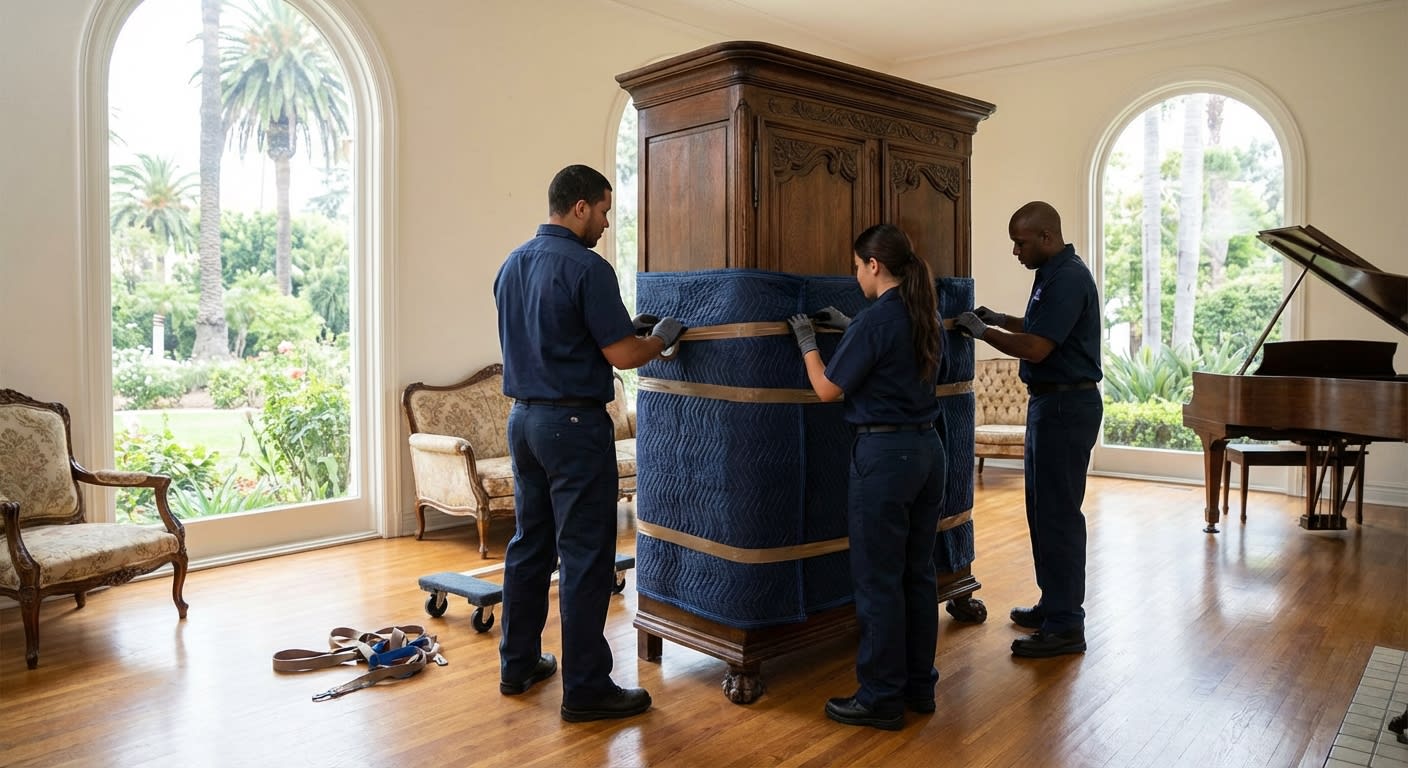
Next, we wrapped the entire safe in moving blankets, secured with shrink wrap. This isn't for the safe's protection—it's so the corners don't tear up doorframes and walls on the way out. We also taped cardboard corner protectors to every wall corner and doorframe along the exit path.
Getting the safe onto the dolly requires tilting it. With a safe this heavy, we use a pry bar to lift one side just enough to slide the dolly plate underneath, then slowly lower the safe onto it while keeping a strap around the top for control. Two guys on the dolly, one on the strap, one spotting.
The staircase descent took 45 minutes for 14 stairs with a landing. The stair climber grips one step at a time, and we control the descent with the brake system while one crew member guides from below and another manages the strap from above. Communication is constant—every step gets announced, every pause coordinated.
Loading into the truck uses our lift gate. The safe rides upright, strapped to the truck wall at multiple points. I've seen movers lay safes on their backs, which can damage the locking mechanism and void the warranty. Always transport safes upright.
Los Angeles-Specific Challenges
Moving gun safes in Los Angeles comes with challenges you won't find in other markets. Let me share what my crews deal with regularly.
Parking is the first headache. Many LA neighborhoods have narrow streets and no driveways. In areas like West Hollywood, Beverly Grove, and parts of Santa Monica, we often can't get our truck within 50 feet of the front door. That means a longer carry, which means more time and more crew fatigue. As my colleague Daniel covers in his Santa Monica parking survival guide, planning your parking situation in advance is critical.
Building access in condos and apartments adds another layer. HOAs often require certificates of insurance, elevator reservations, and designated moving hours. For gun safes, some buildings have weight limits on elevators—typically 2,500 to 3,500 pounds. With a 1,000-pound safe, four crew members, and a dolly, you're pushing 1,800 pounds. Usually fine, but I always verify before moving day.
LA's housing stock includes a lot of hillside homes with challenging terrain. A Benedict Canyon home I worked last year required carrying an 800-pound safe up 60 exterior stairs because there was no vehicle access to the upper level. We brought a six-person crew and rotated carriers every 15 steps. That move took twice as long and cost accordingly.
Then there's the California heat. Moving a gun safe in August in the San Fernando Valley, where it hits 105 degrees by noon, is genuinely dangerous work. We schedule heavy item moves for early morning whenever possible and build in mandatory rest breaks for the crew.
Liability and Insurance Considerations
Gun safe moves involve serious liability questions that every homeowner should understand before hiring movers.
First, verify your moving company's insurance. At Green Moving LA, we carry comprehensive cargo insurance and liability coverage. But here's what clients don't always realize: standard moving insurance covers the item being moved and property damage during the move. It doesn't typically cover what's inside the safe if you leave it loaded.
This is why I'm absolutely firm about emptying safes before we touch them. Beyond the weight issue, firearms require special handling, licensing, and in some cases ATF compliance for interstate transport. We're movers, not firearms dealers—we don't transport guns, period.
For the safe itself, I recommend documenting its condition before the move with dated photos. Note any existing scratches, dents, or paint chips. Professional movers should do the same. After delivery, inspect immediately and report any concerns before the crew leaves.
Property damage is the bigger risk with heavy item moves. A safe that tips on a staircase can punch through drywall, crack tile, or splinter hardwood. At Green Moving LA, our commitment to doing 1% of every move donated to California environmental causes extends to how we operate—we take zero shortcuts, because cutting corners leads to damage and waste that helps no one.
Cost Factors for Moving Gun Safes in Los Angeles
I get asked about pricing constantly, so let me give you the real factors that determine what you'll pay.
Weight is primary. A 300-pound safe might be included in your regular move cost or priced as a small specialty item. An 800-pound safe is a significant addition. Over 1,000 pounds, you're looking at dedicated crew time and equipment.
Access difficulty multiplies everything. Ground floor to ground floor, straight path, good parking? That's baseline. Second floor with a staircase turn? Add 50% or more. Hillside home with exterior stairs? Could double the time required.
Travel distance matters too. Moving a safe across town in LA could mean 30 minutes of drive time or two hours depending on where you're going and when. If you're relocating long-distance, check out our guide to long-distance moving from LA for what to expect.
Typical ranges I see for gun safe moves in Los Angeles: small safes under 400 pounds run $150 to $300 as add-ons to regular moves. Mid-size safes of 400 to 800 pounds typically cost $300 to $600. Large safes over 800 pounds start at $500 and can exceed $1,500 for complex jobs. These are rough estimates—every job is different, and I always recommend getting an in-home assessment for accurate pricing.
DIY vs. Professional: An Honest Assessment
Some gun safe moves can be done DIY. Most shouldn't be. Here's how to know the difference.
If your safe weighs under 300 pounds, sits on a ground floor with direct access to where a truck can park, and you have two or three strong friends plus a quality appliance dolly, you can probably handle it safely. Rent proper equipment—don't improvise with furniture dollies—and watch your back.
If any of these conditions exist, call professionals: the safe weighs over 500 pounds, stairs are involved, doorways are tight, you don't have experienced helpers, or the safe holds significant monetary or sentimental value. The risk equation just doesn't work in your favor.
I've responded to more than a few "rescue" calls where homeowners or general movers got a safe stuck on a staircase, damaged walls getting it there, or—in one memorable case in Tarzana—actually dropped it through a second-floor landing. The repair bill exceeded $15,000. Professional movers would have cost $800.
For a deeper breakdown of when DIY makes sense and when it doesn't, my colleague's DIY vs. hiring movers analysis covers the decision framework in detail.
Preparing Your Safe for Moving Day
Here's the checklist I give every client before we arrive to move their gun safe.
Empty the safe completely at least 24 hours before the move. Firearms should be secured in a temporary location—a rented safe deposit box at a bank works well for handguns. Long guns can go in hard cases in your vehicle, assuming you're transporting them yourself to the new location.
Remove shelves and interior components if possible. Some safes have removable shelving, door organizers, and pistol racks. These can shift during transport and damage the interior. Take them out, wrap them separately, and reinstall after the safe is in place.
Know your combination or have your key ready. We'll need the safe open for the weight verification check, and you'll want to test the lock immediately after delivery to ensure the locking mechanism wasn't affected by transport.
Clear the path completely. Move furniture, rugs, and anything breakable out of the route from the safe's current location to the front door. We'll bring our own floor protection, but a clear path prevents accidents.
Verify the new location can handle the weight. If you're placing the safe on an upper floor, consider whether the floor joists can support the concentrated load. Most modern construction handles up to about 40 pounds per square foot for live loads. A 1,000-pound safe on a 4-square-foot footprint generates 250 pounds per square foot—potentially a structural issue. Consult an engineer if you're unsure.
After Delivery: Installation and Anchoring
Getting the safe to its new location is only half the job. Proper installation matters for security and safety.
Anchoring is essential. An unbolted safe, no matter how heavy, can be tipped, pried, and potentially moved by determined thieves with enough time. Most quality safes come with pre-drilled holes in the bottom and/or back for anchoring. On concrete floors, we can anchor with 1/2-inch concrete anchors. Wood floors require through-bolting to the subfloor or joists.
We offer anchoring as part of our white glove service for gun safes. It takes about 30 minutes and makes an enormous difference in security. A properly anchored safe requires industrial equipment to remove—it's not going anywhere without a serious effort.
Climate considerations matter in Southern California more than people realize. While we don't get extreme cold, humidity swings can cause condensation inside safes, leading to rust on firearms. I recommend placing a dehumidifier rod or rechargeable desiccant inside the safe, especially if it's in a garage where temperature fluctuations are more dramatic.
Finally, test the lock mechanism thoroughly after installation. Open and close the safe multiple times, verify the combination or key works smoothly, and check that the bolts extend fully. If anything feels off, contact the manufacturer before reloading the safe with your firearms.
FAQ
How much does it cost to move a gun safe in Los Angeles?
Costs vary widely based on safe weight, access difficulty, and distance. Small safes under 400 pounds typically add $150 to $300 to a regular move. Mid-size safes of 400 to 800 pounds run $300 to $600. Large safes over 800 pounds start around $500 and can exceed $1,500 for complex moves involving stairs or difficult access.
Can I move my gun safe with my firearms still inside?
No. Professional movers won't transport loaded safes for liability and licensing reasons. The added weight also makes the move significantly more dangerous. Remove all firearms, ammunition, and valuables before moving day and transport them separately yourself.
Do I need to hire specialty movers for a gun safe?
For safes under 300 pounds on ground floors with easy access, experienced general movers can handle the job. For heavier safes or any moves involving stairs, hire movers with specific heavy-item experience and equipment. Ask about their dolly weight ratings and stair-climbing capability.
Will moving my gun safe void the warranty?
Most manufacturers don't void warranties for professional moves, but improper transport can cause damage that isn't covered. Transporting a safe on its back or side can damage the locking mechanism. Always move safes upright and document the safe's condition before and after the move.
How long does it take to move a gun safe?
A straightforward ground-floor move takes 30 to 60 minutes. Moves involving stairs typically take 1 to 2 hours. Complex jobs with multiple flights, tight turns, or hillside access can take 3 to 4 hours or more. I always build in extra time rather than rushing—that's when accidents happen.
Can any moving truck handle a gun safe?
The truck itself isn't usually the issue—it's the lift gate capacity and proper securing points. Most moving trucks have lift gates rated for 1,500 pounds, which handles most safes. The key is having proper tie-down points and straps to secure the safe upright during transport.
Ready to move your gun safe safely in Los Angeles or Orange County? Green Moving LA has the specialized equipment and trained crews for heavy item transport of any size. Call (949) 266-9445, email sales@greenmovingla.com, or get your free quote today. Licensed and insured—CAL-T 201327.
Booking early ensures you get your preferred date and often better rates.
Always ask for a detailed written estimate before signing.
3-bedroom house: $1,200–$2,200 (5–7 hours)
Prices include 2–3 movers, truck, and basic insurance.