Moving Antiques in Los Angeles: Expert Handling Guide | Green Moving LA
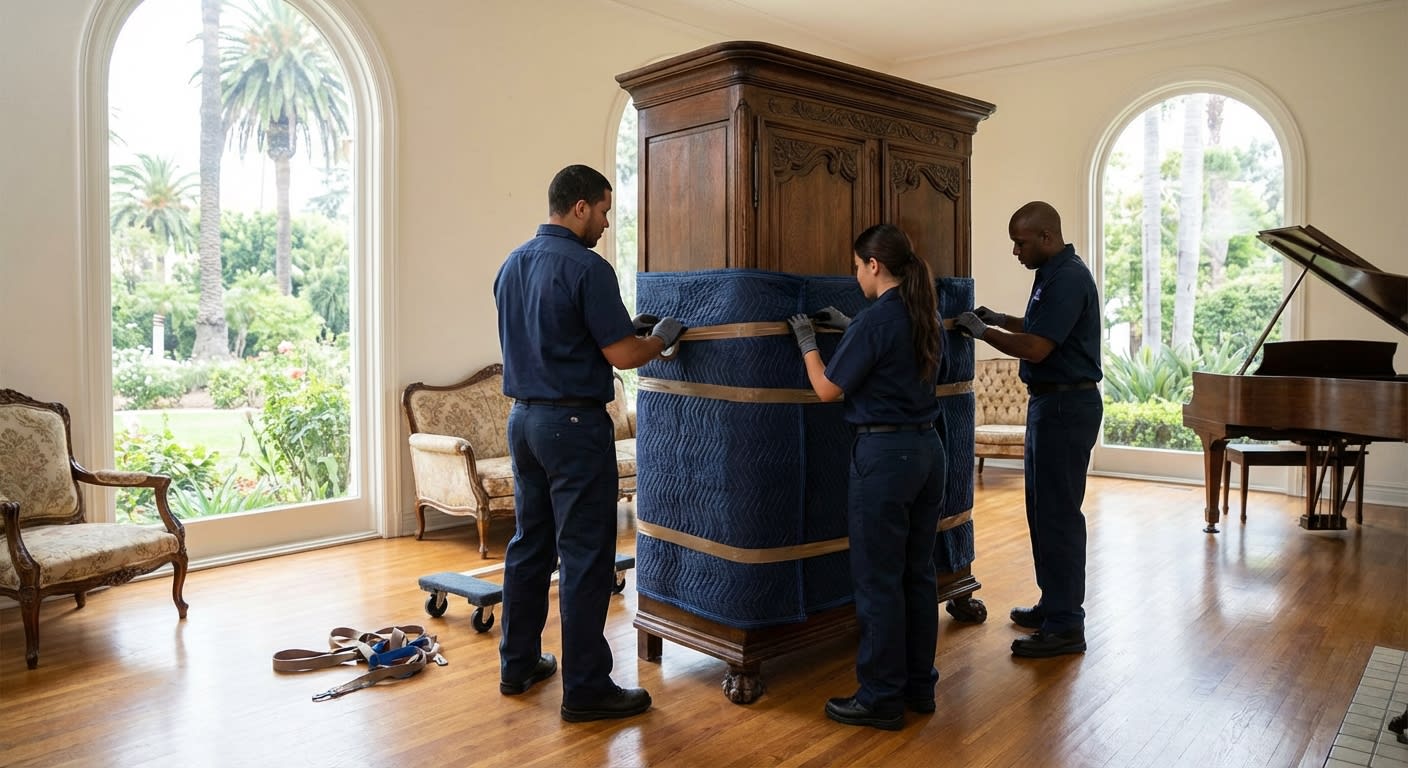
Three weeks ago, my crew and I moved an 1870s French Provincial bedroom set from a Hancock Park estate to a collector's climate-controlled storage facility in Culver City. The set included a hand-carved walnut armoire weighing 380 pounds, a marble-topped dresser with hairline fractures in the stone, and a canopy bed frame with original gilded finials that had survived 150 years—until someone almost dropped them during a previous move attempt. The client had fired the other company mid-job. When I got the call, the armoire was sitting half-wrapped in the driveway.
I'm Marcus Rivera, Head of Operations at Green Moving LA, and I've been handling specialty moves—pianos, antiques, fine art, gun safes—for over twelve years. Moving antiques in Los Angeles presents unique challenges that most movers aren't trained to handle. Between the steep driveways of the Hollywood Hills, the narrow Victorian doorways in Angelino Heights, and the summer heat that can soften old glue joints in minutes, this city tests every piece you move through it.
Why Antiques Require Specialized Moving Protocols
I tell my clients straight up: antiques are not furniture. That distinction matters. Modern furniture is engineered for durability and mass production. A contemporary IKEA bookcase can handle being tilted, shaken, and reassembled. An 18th-century secretary desk with hand-cut dovetail joints and original brass hardware will not survive the same treatment.
The core issue is structural integrity. Antique furniture uses joinery techniques—mortise and tenon, dovetails, dowels—held together by animal-based glues that break down over time. Temperature fluctuations cause wood to expand and contract. A piece that has sat in a climate-controlled Pasadena home for forty years has reached equilibrium. Move it into a 95-degree truck for two hours, and you risk loosening joints that have held for centuries.
Then there's the finish. Original lacquer, shellac, and milk paint finishes are irreplaceable. Modern polyurethane can be sanded and reapplied. Original finishes cannot. A single scratch on a piece with provenance documentation can reduce its value by thousands of dollars. I've seen a ring mark from a carelessly placed water bottle drop the appraisal value of a Federal-period side table by $4,000.
Weight distribution is another factor most movers ignore. Antique case pieces—armoires, highboys, secretaries—often have asymmetrical weight due to hidden compartments, varying wood densities, or attached marble tops. My crew measures center of gravity before we lift. We mark the heavy side. We know which corner hits the floor first if someone loses grip.
Pre-Move Assessment: What I Look For Before We Touch Anything
Every antique move starts with a detailed assessment. I personally inspect each piece before giving my crew the green light. Here's my checklist:
Joinery condition: I gently test each joint for play. Loose joints need stabilization before the move—sometimes with temporary clamping, sometimes with custom bracing. A loose leg on a Queen Anne highboy can shear off completely under the stress of being carried down stairs.
Veneer adhesion: Veneer lifting is common in LA's dry climate. I run my fingers along edges and seams. Lifted veneer catches on blankets and tears. If I find loose sections, we address them with painter's tape before wrapping—never packing tape, which leaves residue.
Hardware documentation: Original hardware is often more valuable than people realize. I photograph every piece of hardware in place, then remove it personally and bag it with labels. Drawer pulls from the Federal period can be worth $200 each. I've seen movers lose them in the bottom of a truck.
Marble and glass: Marble tops, mirrors, and glass panels are always removed and crated separately. Marble develops invisible stress fractures over time. A piece that looks solid can crack along a fault line if subjected to vibration. I've transported marble tops laid flat in custom plywood crates with foam supports.
Documentation for insurance: Before we move anything, I recommend clients have current appraisals and photographs. My crew documents condition with timestamped photos. This protects everyone.
Climate Considerations for Moving Antiques in Los Angeles
Los Angeles weather looks mild on paper, but it's brutal on antiques. We have extreme temperature swings between coast and inland valleys. A piece moving from a Santa Monica beach house to a San Fernando Valley home crosses microclimates that differ by 20 degrees.
I schedule antique moves for early morning whenever possible. In summer, our enclosed trucks can exceed 140 degrees internally by noon. That temperature destroys hide glue in minutes. The casein in milk paint can soften and transfer onto blankets. I've seen varnish bubble on a Victorian sideboard that spent four hours in a hot truck during a cross-town move—before I worked at Green Moving LA.
Our trucks have reflective roof coatings and ventilation systems, but physics is physics. I tell clients: if your antique was in climate control, it needs to stay that way. We plan routes to minimize drive time. We use insulated blankets for high-value pieces. For extremely sensitive items, we coordinate moves with the destination's climate control—making sure the AC is running before the piece arrives.
Humidity is the other factor. LA averages 50% relative humidity, but coastal areas can hit 80% and desert areas drop to 20%. Rapid humidity changes cause wood to swell or shrink unevenly. I've seen drawers that fit perfectly in Malibu become impossible to open in Palm Springs. When moving between humidity zones, I recommend a 48-hour acclimation period with the piece unwrapped in the new environment before placing it in final position.
🏛️ Have antiques or heirlooms that need expert handling? Our white glove moving service specializes in high-value and delicate items. Call (949) 266-9445 or request your free consultation.
The Equipment My Crew Uses for Antique Moves
Proper equipment separates professional antique handling from standard moving. Here's what my crew brings to every specialty job:
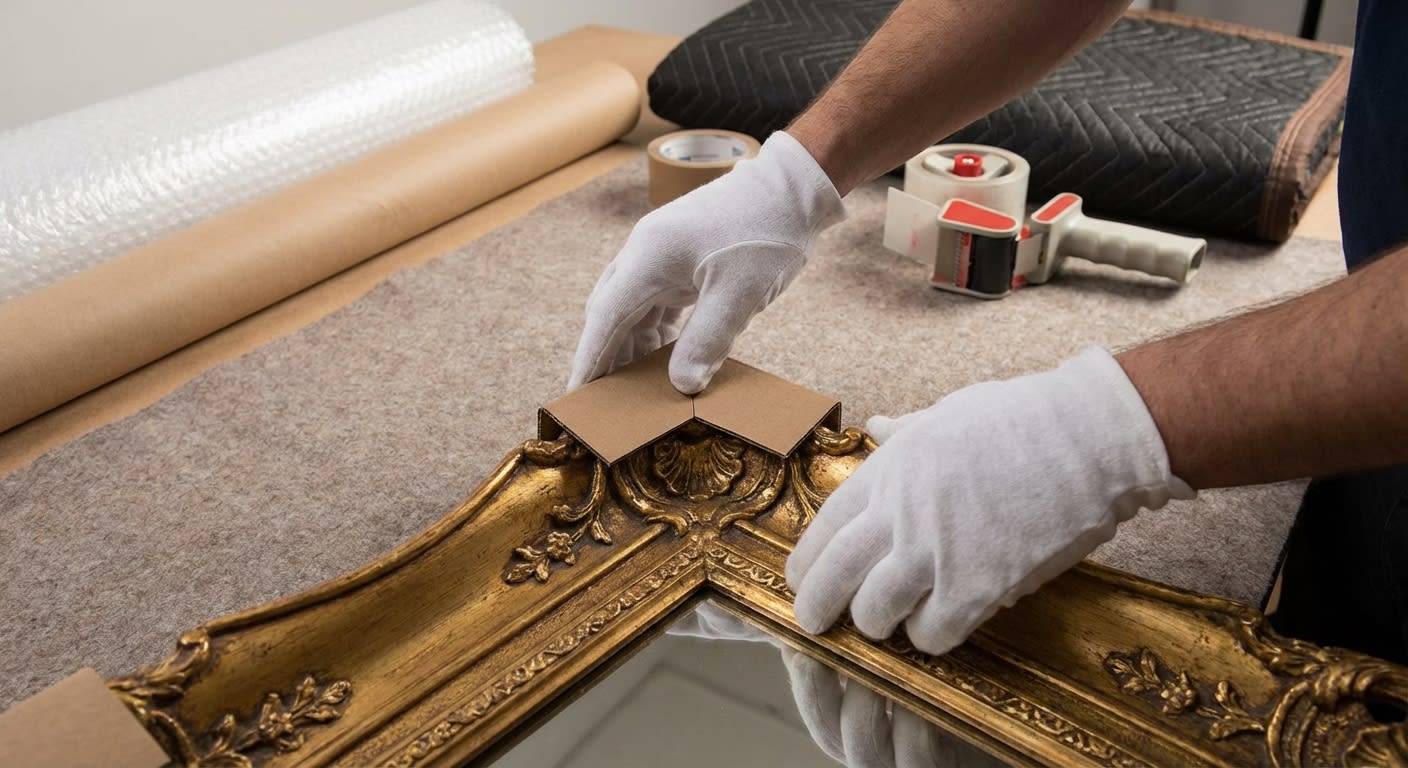
Cotton gloves: We wear white cotton gloves when handling exposed wood surfaces. Skin oils contain acids that can etch into original finishes over time. This isn't excessive—museum handlers do the same.
Furniture blankets (quilted moving pads): We use 72" x 80" professional-grade blankets weighing at least 6.5 pounds each. Cheap blankets compress and don't protect against impact. For an average armoire, I use six to eight blankets.
Acid-free tissue: For pieces with original finishes, we layer acid-free tissue between the surface and blankets. Regular moving blankets can contain dyes and chemicals that transfer to delicate finishes.
Custom crating materials: We carry quarter-inch plywood, two-inch foam, and corner protectors for on-site crating. A marble-top table gets a custom box built around it before it goes on the truck.
Forearm forklifts (lifting straps): These distribute weight across the forearms and core rather than relying on grip strength. Grip strength fails; leverage doesn't. For pieces over 200 pounds, straps are mandatory on my crew.
Furniture dollies with pneumatic tires: Standard dollies have hard rubber wheels that transmit every sidewalk crack and threshold bump. Pneumatic tires absorb shock. For extremely heavy case pieces, we use four-wheel piano dollies rated for 1,200 pounds.
Ramp systems: Steps are the enemy of antiques. Every step is a potential drop or collision. We carry telescoping aluminum ramps to bridge thresholds and small stair runs. For larger elevation changes, we assess whether crane service is safer.
Room-by-Room Handling Techniques
Different antique types require different handling approaches. Here's how my crew handles common categories:
Case pieces (armoires, highboys, secretaries): These are always moved empty. Every drawer comes out. Every shelf is removed. Hardware is bagged. Then we wrap the carcase in blankets, secure with stretch wrap over the blankets (never directly on wood), and move with two to four people depending on weight. A tall highboy requires a spotter watching the top at all times—ceiling fans and doorframes claim more finials than drops do.
Tables: If legs are original and sturdy, we leave them attached but protect them with foam corner guards and wrap each leg individually before blanketing the whole piece. If legs show any looseness, they're removed and wrapped separately. We never carry tables by their legs—always by the apron or frame. Marble tops are crated separately.
Upholstered pieces: Antique upholstery is often original horsehair, silk, or early velvet that cannot be replicated. We cover with clean cotton sheets before blanketing to prevent fiber transfer. No plastic—antique textiles need to breathe. We never stack anything on upholstered surfaces.
Mirrors and artwork: Custom crating is standard for anything irreplaceable. We build boxes with corner bracing and foam supports. The piece never contacts the crate walls directly. We mark "GLASS" and "THIS SIDE UP" and ensure the piece travels vertically, not flat. A flat mirror can flex and crack under its own weight over bumps.
Navigating Los Angeles Architecture with Antiques
LA's housing stock creates specific challenges for antique movers. I've learned them all the hard way:
Craftsman homes (Pasadena, Highland Park, West Adams): Beautiful original woodwork and narrow doorways. Many have 30-inch bedroom doors that won't pass large case pieces without door removal. The good news: original Craftsman doors usually have removable hinge pins. I carry a pin punch.
Spanish Colonial Revival (Los Feliz, Silver Lake, Beverly Hills): Watch for tile floors with irregular surfaces, wrought iron railings that narrow staircases, and interior archways that look wider than they are. I measure everything twice.
Mid-Century Modern (Palm Springs, Hollywood Hills, Brentwood): These homes often have floor-to-ceiling glass and tight corners where hallways meet living spaces. The danger is swinging a piece through a turn and hitting glass you didn't see. I tape paper over glass panels before moving in these homes.
High-rise condos (Downtown, Century City, Marina del Rey): Elevator dimensions are the limiting factor. Most building elevators are 54" x 80" with 84" height. A tall armoire may not fit vertically. I get elevator dimensions before quoting. Some buildings have freight elevators with 96" height—always ask.
Hillside homes: The driveway is the obstacle. Many hillside homes in Beachwood Canyon, the Bird Streets, or Pacific Palisades have driveways too steep or narrow for trucks. We may need to hand-carry from street level—which adds time and crew members. I always do site visits for hillside antique moves.
Insurance and Valuation for Antique Moves
This is where I get direct with my clients. Standard moving insurance—the basic coverage included with any move—typically covers items at $0.60 per pound. An 1850s cherry chest of drawers might weigh 80 pounds and be worth $12,000. Basic coverage would pay $48 for a total loss. That's unacceptable.
At Green Moving LA, we offer full replacement value protection, but antiques require special handling even within that framework. Here's what I tell every antique client:
Get a current appraisal. Not what you paid, not what you think it's worth—what a qualified appraiser documents in writing. Appraisals should be dated within the past three years for insurance purposes. Keep digital copies accessible.
Photograph everything. Close-ups of existing damage, overall condition shots, detail of hardware and finishes. These photos establish baseline condition. If there's a dispute later, documentation protects everyone.
Declare high-value items in writing. We need to know if something is worth $20,000. Our crew handles declared items differently—more padding, slower pace, senior crew members only. This isn't about liability avoidance; it's about appropriate care.
Consider third-party specialty insurance for museum-quality pieces. Your homeowner's policy may cover items in transit, but verify coverage limits and deductibles. Some clients use specialty art and antique insurers for pieces exceeding $50,000.
Working with Dealers, Estates, and Auction Houses
A significant portion of my antique work comes from the trade—dealers moving inventory, auction houses transporting consignments, estate executors clearing properties. These clients have specific requirements:
Dealers need precise scheduling because they're coordinating with clients, shipping companies, or show deadlines. I've delivered pieces to the LA Antique Show setup at Barker Hangar with thirty-minute windows. We hit them.
Auction houses require chain-of-custody documentation. I provide detailed inventories with timestamps and crew signatures. For high-value consignments, I've had auction house staff present during pickup to verify condition.
Estate situations often involve working around ongoing sales, family members, and sometimes appraisers or attorneys. Discretion matters. My crew doesn't comment on valuables, doesn't take photos beyond documentation requirements, and understands that estate clearances can be emotional for families.
For the trade, I offer full service moving packages that include inventory management, temporary storage coordination, and flexible scheduling. Many dealers use us as their exclusive logistics partner because consistency matters when your reputation depends on piece condition.
FAQ
How far in advance should I schedule an antique move in Los Angeles?
I recommend booking at least two weeks ahead for standard antique moves, and three to four weeks for large collections or estate clearances. This allows time for pre-move assessment and any necessary custom crating. Peak moving season (May through September) requires even earlier booking—sometimes six weeks for specialty work.
Do you move antiques from Los Angeles to other states?
Yes. I coordinate long distance moves for antiques regularly. Cross-country transport requires climate-controlled trucks, specialized packing, and careful route planning. I've moved pieces to New York, Chicago, and Miami. The process involves more documentation and typically custom crating for every major piece.
What should I do if I notice damage after an antique move?
Document immediately with photographs and contact us the same day. Compare against pre-move documentation. Most claims are filed within 24-48 hours of delivery. The faster you report, the clearer the timeline. My crew's condition photos help establish whether damage occurred during transit or was pre-existing.
Can you move antiques from a second-floor apartment without an elevator?
Yes, though it requires additional crew members and time. My standard for stair carries is two experienced movers per 100 pounds of piece weight, plus a spotter. A 300-pound armoire going down two flights of narrow apartment stairs needs a four-person crew minimum. I assess stairway dimensions and turning radiuses during the pre-move visit.
How do you handle antique moves for items I've just purchased at auction?
I coordinate with auction house shipping departments regularly. We can pick up directly from houses like Bonhams LA, John Moran, or Andrew Jones. I handle all documentation, verify condition at pickup, and deliver to your location. Many collectors use us exclusively because they know their purchases are handled by specialists from the moment they win the bid.
Get Expert Antique Moving in Los Angeles
Moving antiques in Los Angeles requires knowledge, equipment, and experience that most moving companies simply don't have. I've spent years learning what can go wrong—and developing systems to prevent it. My crew trains specifically for specialty items. Our environmental commitment means we're thinking long-term about everything we do, including how we treat the irreplaceable pieces our clients trust us with. Green Moving LA operates with a 1% environmental commitment and rates starting from $129/hour, with the expertise to handle your most valuable possessions.
If you have antiques, heirlooms, or collectibles that need professional handling, I want to talk to you before your move—not after something goes wrong. Visit our blog and resources section for more specialty moving guides, or check our client reviews to see what collectors and dealers say about working with my crew.
Call me directly at (949) 266-9445 or email sales@greenmovingla.com to schedule a consultation. You can also request a quote online. Green Moving LA is fully licensed under CAL-T 201327 and insured for specialty moves. Your antiques survived this long—let me make sure they survive the move.
Booking early ensures you get your preferred date and often better rates.
Always ask for a detailed written estimate before signing.
3-bedroom house: $1,200–$2,200 (5–7 hours)
Prices include 2–3 movers, truck, and basic insurance.