How to Move Fine Art in Los Angeles: 2026 Expert Guide
- Understanding Fine Art Categories and Their Specific Risks
- Pre-Move Assessment: What I Look For
- Packing Materials and Techniques for Different Media
- Climate Control: Why LA Weather Complicates Art Moves
- Insurance and Documentation Requirements
- Handling Oversized and Awkward Pieces
- Working with Galleries, Museums, and Private Collections
- Common Mistakes I See Collectors Make
- What to Expect on Moving Day
- Cost Factors for Fine Art Moving in Los Angeles
- FAQ
Three weeks ago, I got a call from a collector in Hancock Park who needed to move seventeen pieces—including a 6-foot oil painting by a contemporary LA artist and a series of delicate watercolors from the 1940s—to his new residence in Pacific Palisades. The oil painting alone was valued at $180,000, and the watercolors required climate-controlled transport because any humidity fluctuation could cause warping. When I walked through his home gallery, I immediately identified three major challenges: a narrow spiral staircase, a front door clearance of just 32 inches, and August temperatures that would hit 95 degrees during our loading window.
I'm Marcus, Head of Operations at Green Moving, and I've spent the better part of a decade figuring out how to move fine art Los Angeles collectors can't afford to risk. From oversized canvases that won't fit through standard doorways to fragile works on paper that react to every temperature change, I've developed systems that protect art worth more than most homes. This guide covers everything I've learned about moving fine art safely in our unique Southern California environment.
Understanding Fine Art Categories and Their Specific Risks
Not all art moves the same way, and the biggest mistake I see collectors make is treating every piece identically. Oil paintings, for example, are more resilient than most people think—but they're extremely vulnerable to temperature extremes. When oil paint gets too cold, it becomes brittle and can crack. When it's too hot, the paint layer softens and can stick to protective coverings. In LA's climate, where we can swing from 58 degrees in the morning to 90 degrees by afternoon, this is a real concern.
Watercolors and works on paper present a completely different challenge. They're hygroscopic, meaning they absorb and release moisture based on ambient humidity. A watercolor that's been stored in an air-conditioned Beverly Hills home at 45% relative humidity will warp or buckle if exposed to coastal moisture in Santa Monica. I've seen valuable prints develop foxing—those brown spots collectors dread—within months of an improperly managed move.
Sculptures require yet another approach. I recently moved a bronze piece weighing 340 pounds from a second-floor gallery in Venice. The weight wasn't the primary concern—my crew handles heavy items daily. The real issue was the sculpture's extended arm, which created a precarious center of gravity and required custom rigging to prevent tipping during transit. For more on moving three-dimensional pieces, my colleague Marcus covers related techniques in our guide to moving sculptures safely.
Pre-Move Assessment: What I Look For
Before any fine art move, I conduct an in-person assessment that goes far beyond measuring dimensions. I'm documenting the current condition of every piece with high-resolution photography—not just the front, but the back, the frame corners, any existing damage or repairs. This documentation protects both the collector and my crew. If there's a pre-existing crack in the frame, I want it recorded before we touch anything.
I'm also analyzing the pathway. How wide are the doorways? Is there a tight corner at the landing? Will we need to remove doors from hinges? For a recent move in Los Feliz, the client's Thiebaud painting—valued at roughly $400,000 as of 2026 market estimates—measured 72 by 48 inches in its frame. The front door was 36 inches wide. We had to remove the door entirely and still angled the piece through at a precise 15-degree tilt.
Environmental factors matter too. If we're loading in direct sunlight, I'll schedule for early morning or late afternoon. If the destination has different climate control than the origin, I'll plan for an acclimation period. These details don't show up in a phone quote—they require boots on the ground.
Packing Materials and Techniques for Different Media
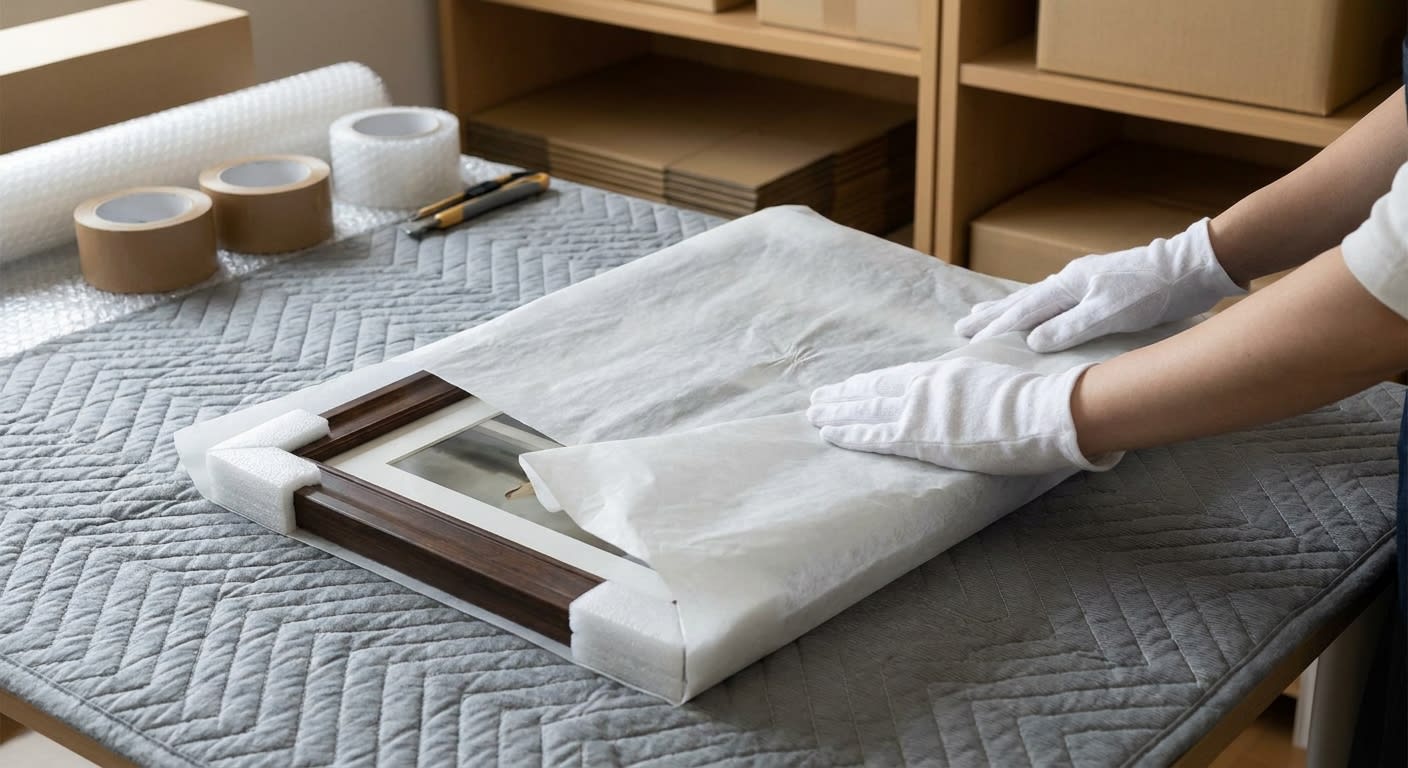
For framed works, I start with glassine paper—an acid-free, pH-neutral material that won't react with paint surfaces. This goes directly against the artwork face. Next comes a layer of foam corner protectors, sized to the frame dimensions. I don't use cardboard corners from office supply stores; they're not designed for artwork and can shift during transit.
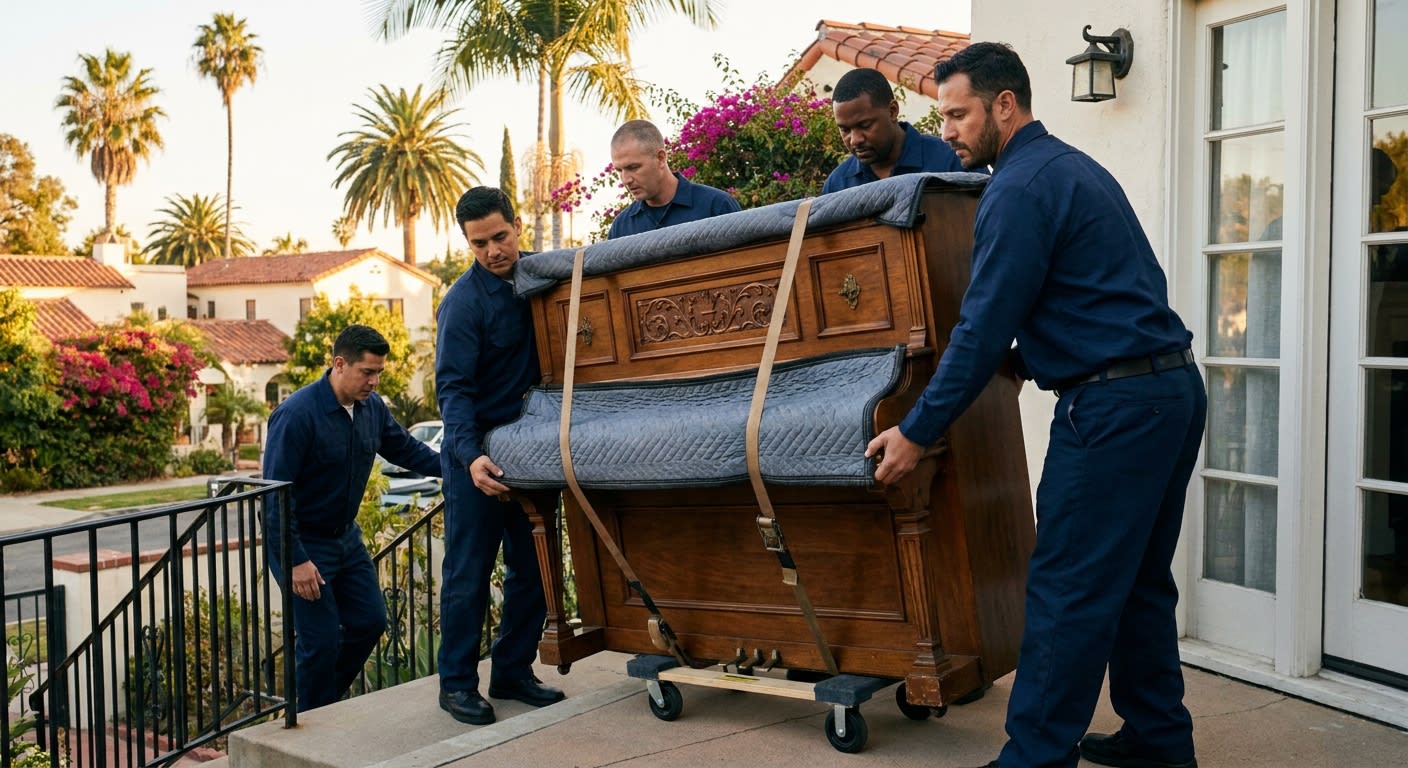
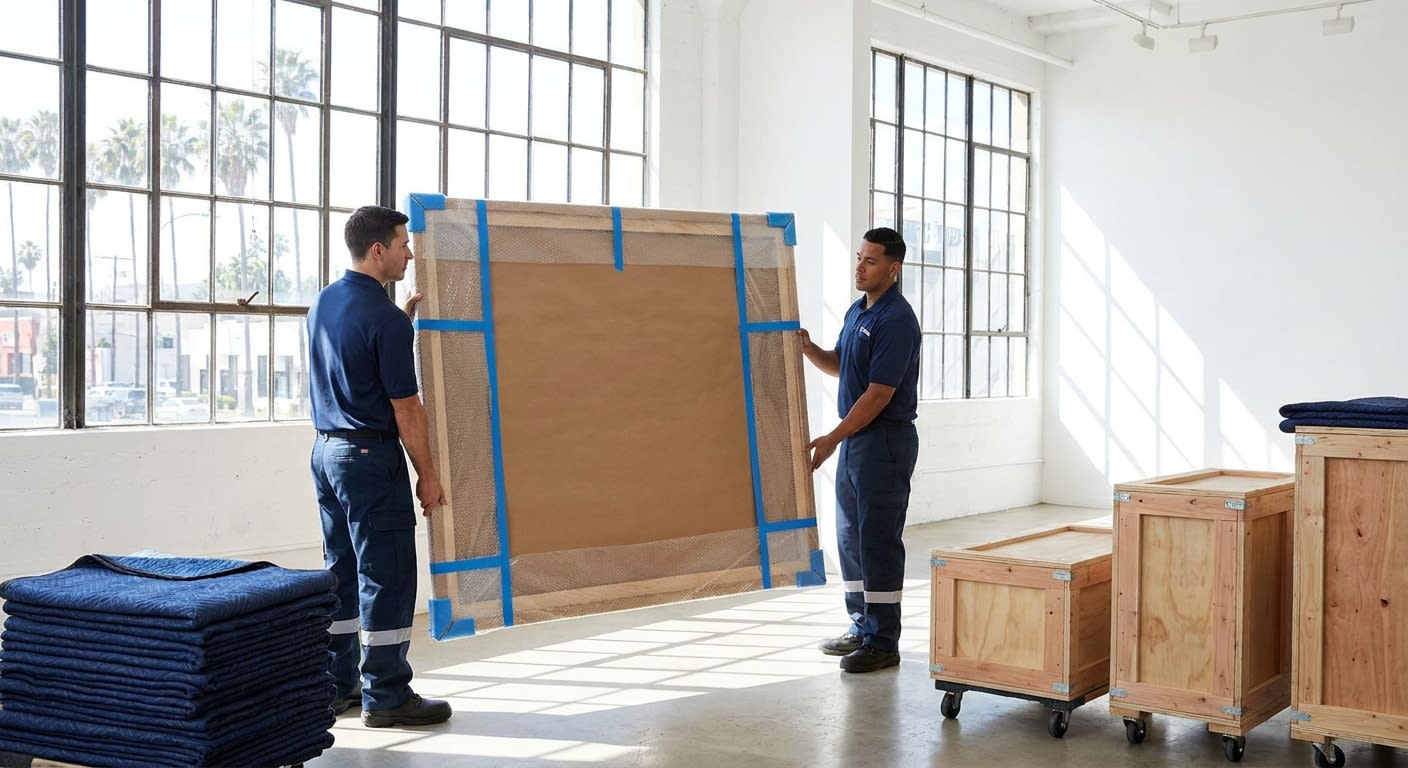
The frame then gets wrapped in moving blankets, secured with painter's tape—never packing tape, which can leave residue on frames. For high-value pieces, I build custom wooden crates on-site. These aren't generic boxes; they're engineered with interior foam padding that suspends the artwork, preventing any contact with crate walls. A crate for that Hancock Park oil painting took my carpenter three hours to construct, but the $180,000 piece arrived without a scratch.
Unframed canvases require even more care. I've seen well-meaning collectors roll canvases to save space—this creates stress cracks in the paint layer that may not appear for months. Instead, I transport unframed works flat, sandwiched between acid-free foam boards, in a climate-controlled vehicle. For details on professional packing approaches, check out our packing services page.
🖼️ Moving valuable artwork? Our white glove services team specializes in fine art transport with custom crating and climate control. Call (949) 266-9445 or request your free consultation.
Climate Control: Why LA Weather Complicates Art Moves
Los Angeles has a reputation for perfect weather, but that's misleading when it comes to fine art transport. We have microclimates that shift dramatically across short distances. I've loaded art in Pasadena at 78 degrees and 30% humidity, then delivered to Manhattan Beach at 68 degrees and 65% humidity—a swing that can stress sensitive materials.
Our climate-controlled trucks maintain a consistent 68-72 degrees regardless of exterior conditions. This isn't luxury; it's necessity. During summer months, an uncontrolled truck interior can reach 140 degrees while parked. That temperature will damage virtually any artwork—cracking varnish, softening adhesives, warping wooden stretcher bars.
For moves during LA's occasional heat waves, I schedule loading and unloading for before 9 AM or after 6 PM. The temperature inside a truck rises fastest during the first hour of sun exposure, so timing matters enormously. I've turned down same-day requests during extreme weather because the risk to the artwork simply isn't worth it.
Insurance and Documentation Requirements
Standard moving insurance covers items at roughly $0.60 per pound. A watercolor that weighs two pounds would be covered at $1.20—obviously inadequate for a piece worth $15,000. This is why I always recommend clients secure fine art insurance, either through their existing homeowner's policy or a specialized art insurance provider.
As of 2026, fine art insurance typically runs between $100 and $300 per year per $100,000 of coverage, depending on the collection's value and storage conditions. For a single move, collectors can often purchase temporary transit coverage. I provide detailed condition reports and chain-of-custody documentation that insurers require for any claim.
I also recommend having high-value pieces appraised within the past two years. Art markets fluctuate, and a piece purchased for $50,000 in 2020 might be worth $120,000 today—or $35,000. Without current appraisal documentation, settling an insurance claim becomes complicated. One percent of every move we complete goes toward California environmental causes, but protecting your investment through proper documentation is equally important.
Handling Oversized and Awkward Pieces
The largest piece I've moved in LA was a 14-foot commissioned mural panel that had to travel from an artist's studio in Frogtown to a collector's home in Bel Air. It wouldn't fit in any standard truck, so we used a flatbed with a custom-built climate tent—essentially a portable clean room that maintained temperature and protected against road debris.
For oversized pieces, I always conduct a test run with cardboard templates cut to the artwork's dimensions. I'll walk the template through every doorway, around every corner, measuring clearances to the quarter inch. It's tedious work, but it prevents that horrible moment when you're halfway through a doorway and realize the piece won't fit.
LA's older homes—especially in neighborhoods like Hancock Park, Los Feliz, and parts of Pasadena—often have narrower doorways and lower ceilings than contemporary construction. I've removed picture windows, coordinated crane lifts through upper-floor balconies, and in one memorable case, created a temporary opening in a garage wall that we patched afterward. These solutions require planning, permits, and sometimes coordination with contractors, but they're preferable to the alternative.
Working with Galleries, Museums, and Private Collections
Institutional moves come with additional requirements. Museums typically require certificate of insurance naming them as additionally insured, detailed condition reports at pickup and delivery, and specific handling protocols. Some institutions won't allow my crew to touch the artwork directly—instead, their conservators or art handlers work alongside us, and we provide the transportation and logistics.
For gallery moves, timing often matters as much as technique. I've moved pieces from LA galleries to art fairs in San Francisco, New York, and Miami, where the artwork needs to arrive on a specific day during a specific window. A piece arriving two hours late might miss its installation slot entirely. I build buffer time into every schedule and maintain backup plans for traffic, weather, and mechanical issues.
Private collectors often have unique requirements too. One client in the Hollywood Hills required all crew members to sign NDAs before entering the property—his collection included works by extremely recognizable contemporary artists, and he was concerned about security. Another collector in Malibu needed us to work only during specific hours when her staff was present. Flexibility and discretion are part of the job.
Common Mistakes I See Collectors Make
The first mistake is underestimating the complexity of the move. A collector will tell me they have "just a few paintings" to transport, and I'll arrive to find thirty pieces, three of which are over six feet wide. Always conduct a thorough inventory before requesting quotes—it saves time and ensures accurate pricing.
Second, collectors sometimes remove artwork from frames to "make it easier." Unless you're trained in proper handling, this creates more risk than it solves. Stretcher bars are fragile, canvas can be punctured by fingernails, and unframed works are harder to grip securely. Leave the artwork in its frame; that's what the frame is for.
Third, I've seen collectors wrap artwork in bubble wrap with the bubbles facing the artwork surface. Those air pockets can leave impressions in soft paint or create moisture pockets against the surface. Bubble wrap should always face outward, with a protective layer of glassine or foam between the wrap and the artwork.
Finally, some collectors try to save money by using personal vehicles for transport. Your SUV's trunk isn't climate-controlled, and a sudden stop at a red light can send your $50,000 painting sliding into the wheel well. The cost savings don't justify the risk. For more on understanding true moving costs, check out our 2026 pricing guide.
What to Expect on Moving Day
When my crew arrives for a fine art move, we're bringing specialized equipment: foam corner protectors in multiple sizes, acid-free glassine paper, moving blankets rated for art transport, custom mirror boxes, and in some cases, pre-built crates. We wear cotton gloves when handling artwork directly—the oils from bare hands can damage surfaces over time.
I walk through the collection with the client first, confirming our inventory and noting any pieces that require special attention. We'll conduct condition documentation with the client present, photographing any existing damage and having them sign off on the current state. This protects everyone and eliminates disputes later.
Loading follows a specific order. Heavy items go first, positioned low and secured against the truck walls. Framed works travel vertically whenever possible, strapped to padded A-frame racks that prevent any piece from touching another. Unframed works travel horizontally in flat packs. Nothing is stacked on top of artwork—ever.
At the destination, I supervise unloading and placement. If the client hasn't decided on final positions, we'll stage artwork in designated safe areas. For collectors who need installation, I can coordinate with art installers who handle mounting, wiring, and lighting. My job is complete when every piece is exactly where you want it, in the same condition it left your previous location.
Cost Factors for Fine Art Moving in Los Angeles
Fine art moves cost more than standard residential moves because they require specialized equipment, training, and time. As of 2026, expect to pay between $150 and $400 per hour for a crew experienced in art handling, depending on crew size and equipment needs. Custom crating adds to the cost—a simple wooden crate starts around $75, while complex builds for oversized or unusually shaped pieces can exceed $500.
Distance matters less than complexity. Moving a single high-value piece from Silver Lake to Pasadena might take four hours of total crew time—an hour of packing, an hour of loading, thirty minutes of transit, and ninety minutes of unloading, unpacking, and placement. Moving that same piece to San Diego adds drive time but doesn't change the handling time significantly.
The most cost-effective approach is consolidating moves when possible. If you're relocating your entire household and have a significant art collection, we'll integrate the art move into the overall project rather than treating it as a separate service. For collectors moving from a primary residence, our full service moving packages often make more sense than piecemeal approaches.
FAQ
How far in advance should I schedule a fine art move?
I recommend booking at least two weeks ahead for local moves and four weeks for long-distance or complex moves. High-value pieces requiring custom crating need additional lead time—sometimes three to four weeks—for crate fabrication and proper fitting. During peak moving season from June through September, add another week to all timelines.
Can you move fine art in extreme temperatures?
We can, but I adjust our methods accordingly. Climate-controlled trucks maintain consistent temperatures regardless of exterior conditions. During heat waves, I schedule loading and unloading for cooler hours and minimize the time artwork spends outside the truck. For extremely sensitive pieces, I may recommend postponing until conditions improve.
Do I need to be present during the move?
For fine art, I strongly recommend it. Condition documentation requires your sign-off, and questions about placement arise during unloading. If you absolutely can't be present, designate a representative who can make decisions about the artwork. Never leave a fine art move entirely to movers without oversight.
What happens if something is damaged during the move?
Damage is rare when proper protocols are followed, but our process accounts for this possibility. All pre-move condition documentation serves as a baseline. If damage occurs, we photograph it immediately, note it on the delivery receipt, and work with your insurance provider to process the claim. Green Moving carries comprehensive liability coverage, but I always recommend collectors maintain their own fine art insurance as well.
Can you store fine art temporarily during a move?
We can coordinate with climate-controlled storage facilities that specialize in fine art. Standard self-storage units aren't appropriate for valuable artwork—they lack climate control and security measures. Fine art storage in LA runs roughly $50 to $150 per month per piece, depending on size and facility quality. For more on storage options, see our guide on storage during your LA move.
Do you move art for galleries and museums?
Yes, we work with galleries, museums, and institutional collections throughout Los Angeles and Orange County. These moves require additional documentation, specific insurance certificates, and coordination with institutional staff. Contact us directly to discuss your institution's requirements and timeline.
Ready to move fine art Los Angeles collectors trust us to protect? Green Moving serves Los Angeles and Orange County with specialized art handling, climate-controlled transport, and custom crating. Call (949) 266-9445, email sales@greenmovingla.com, or get your free quote. Licensed and insured—CAL-T 201327.