Long Beach vs Redondo Beach Moving Costs 2026

Two weeks ago, I sat down with a software engineer relocating from Austin who had narrowed his California search to two cities: Long Beach and Redondo Beach. He'd visited both, loved both, but couldn't figure out which one made financial sense for a single professional making $145,000 annually. After we walked through the numbers together—rent, moving logistics, commute costs, lifestyle expenses—he chose Long Beach and saved roughly $14,000 in his first year. That conversation is why I'm writing this guide.
I'm Kuanysh, the Founder and CEO of Green Moving LA. Since launching this company in 2022, I've built our operation around data transparency and eliminating the pricing games that plague the moving industry. When people ask me to compare two cities, I don't give vague answers. I give them the same spreadsheet analysis I'd run for my own family's move.
Long Beach vs Redondo Beach moving costs vary significantly based on factors most people don't consider until they're signing a lease. This guide breaks down every cost category—from the moving day itself to your monthly burn rate—so you can make a decision based on real 2026 numbers, not gut feelings.
The Fundamental Difference: Scale vs. Intimacy
Long Beach is California's seventh-largest city with approximately 470,000 residents. It has its own port, its own airport, its own downtown skyline. Redondo Beach has around 68,000 residents and functions more like a collection of beach neighborhoods than a traditional city. This scale difference affects everything from rental inventory to traffic patterns to how much you'll pay for a basic move.
When I analyze moving costs between these two cities, I'm not just comparing hourly rates. I'm looking at elevator availability, parking permit requirements, average distance from curb to unit, and neighborhood-specific access challenges. Long Beach has significantly more high-rise buildings, which means more elevator moves. Redondo Beach has more single-family homes and low-rise apartments, which often means more stair carries.
Both cities sit along the Pacific Coast Highway, making moves between them relatively straightforward logistics. A typical move from Long Beach to Redondo Beach—or vice versa—covers about 15 miles and takes 25-40 minutes depending on traffic. But the similarities end there.
Moving Day Costs: Long Beach Breakdown
Let me walk you through what a typical Long Beach move actually costs in 2026. Our local moving service starts from $129/hour, but your final bill depends on variables specific to your origin and destination addresses.
Downtown Long Beach presents the most complex logistics. Buildings like the International Tower, Pacific Tower, and the Alamitos Beach high-rises require Certificate of Insurance filings 48-72 hours in advance. Elevator reservations typically cost $100-300 and must be booked through building management. If you're moving on a weekend, expect to pay premium rates for elevator access—some buildings charge $150 for Saturday moves versus $75 on Tuesdays.
A studio or one-bedroom apartment in downtown Long Beach typically requires 2-3 hours with a two-person crew. Adding in elevator wait times, COI processing, and loading zone coordination, most moves run $350-550 all-in. Two-bedroom units in the same area average $500-750, and three-bedroom apartments or condos push into the $700-1,000 range.
The neighborhoods of Belmont Shore and Naples present different challenges. Street parking is notoriously difficult, especially on Second Street near the retail corridor. My crews often arrive at 7 AM to claim loading zones before the brunch crowds descend. Homes here tend to be older with narrower doorways and tighter staircases—factors that add 15-20% to your move time compared to modern apartment buildings.
Bixby Knolls and California Heights offer the easiest moves in Long Beach. Single-family homes with driveways, wide streets, and reasonable parking mean my crews can work efficiently. A three-bedroom home in these neighborhoods typically costs $600-900 to move locally.
Moving Day Costs: Redondo Beach Breakdown
Redondo Beach moves tend to cost 10-15% more than equivalent Long Beach moves, and the reasons are purely logistical. The Esplanade and waterfront areas have extremely limited parking. Riviera Village commercial restrictions mean certain streets prohibit moving trucks entirely during business hours. And the hilly terrain in North Redondo adds physical difficulty that translates to longer move times.
A one-bedroom apartment in South Redondo near the pier typically runs $400-600 for a local move. The challenge isn't the unit itself—it's getting a 26-foot truck within reasonable distance of the building entrance. Many addresses require us to use a shuttle vehicle, adding $100-150 to the total.
The Hollywood Riviera neighborhood presents unique access issues. Streets like Via Monte d'Oro and Palos Verdes Boulevard have hairpin turns that larger trucks can't navigate. I've had crews use 16-foot trucks instead of 26-foot trucks just to access these addresses, which means more trips and higher costs. Budget $700-1,100 for a two-bedroom in this area.
North Redondo, closer to the 405 freeway, offers more suburban logistics. Parking is easier, streets are wider, and homes tend to have garages and driveways. A three-bedroom home in North Redondo typically costs $650-950 to move—comparable to similar-sized moves in Long Beach's inland neighborhoods.
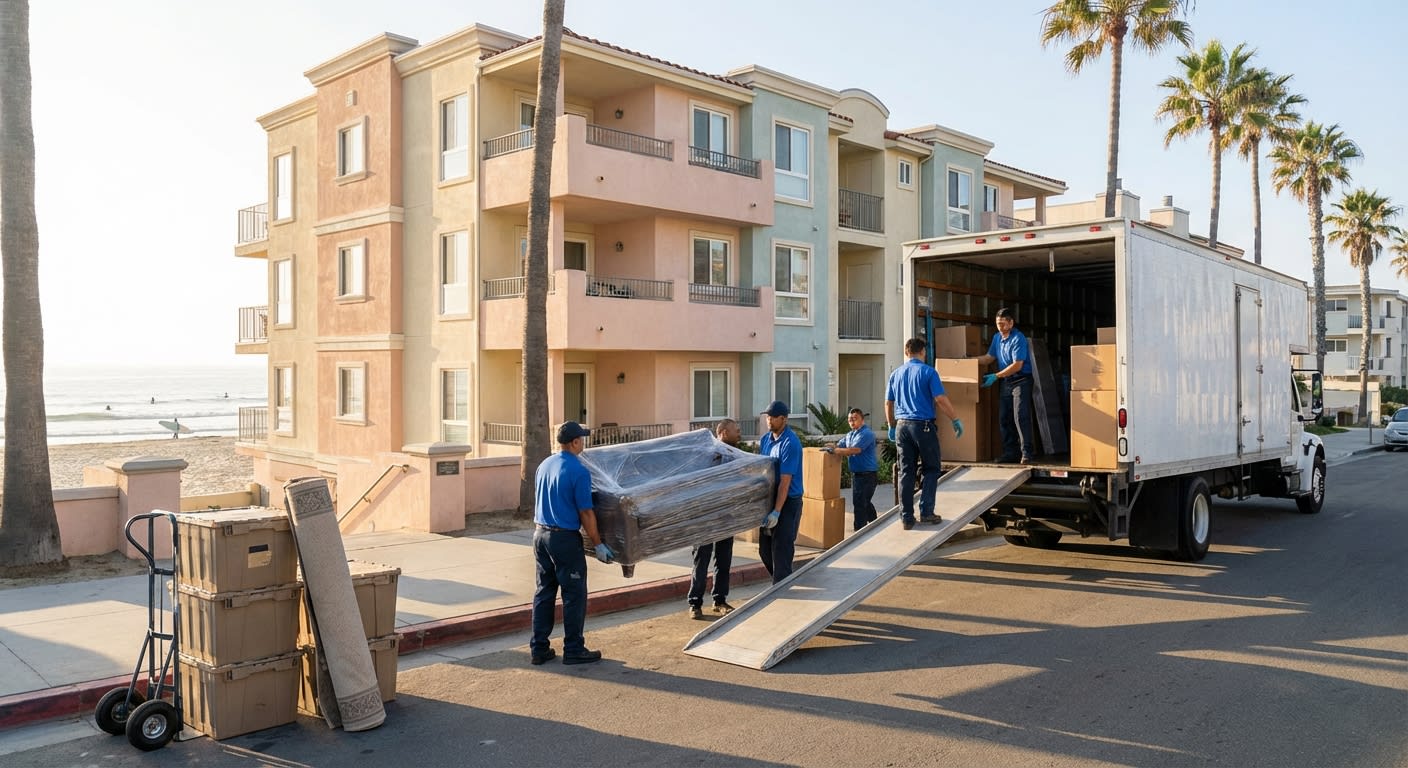
📦 Need help with a beach city move? Our packing specialists handle everything from fragile items to furniture protection. Call (949) 266-9445 or request your free quote.
Rent Comparison: Where Your Money Actually Goes
Here's where the Long Beach vs Redondo Beach moving costs conversation gets interesting. Moving day is a one-time expense. Rent is forever—or at least feels that way when you're signing a 12-month lease.
As of 2026, Long Beach median rent for a one-bedroom apartment sits around $2,100-2,300 per month, depending on neighborhood. Downtown and waterfront addresses push toward $2,500-2,800. Belmont Shore and Naples hover around $2,400-2,700. Bixby Knolls and North Long Beach offer relative value at $1,800-2,200.
Redondo Beach median rent for comparable one-bedroom units runs $2,400-2,700 per month. South Redondo and the Esplanade command $2,800-3,200. Hollywood Riviera averages $2,600-3,000. North Redondo offers the most accessible pricing at $2,200-2,500.
The math is straightforward: expect to pay $200-400 more per month for equivalent square footage in Redondo Beach. Over a two-year lease, that's $4,800-9,600 in additional rent. This difference alone often determines which city makes financial sense for my clients.
I covered similar rent dynamics in my Beverly Hills cost breakdown—premium coastal locations always carry a premium price, but the specific premium varies dramatically by neighborhood.
The Commute Equation: Hidden Costs Most People Miss
When I built Green Moving LA, I wanted to help people make holistic decisions about relocating—not just handle the physical move. Commute costs represent one of the most underestimated factors in choosing between Long Beach and Redondo Beach.
Long Beach connects to the Metro A Line (Blue Line), providing direct rail access to downtown LA. Monthly Metro passes run roughly $100 as of 2026. If you work in downtown LA, DTLA, or anywhere along the rail corridor, Long Beach offers a legitimate car-free commute option. The Anaheim Street station and downtown stations put you 45-65 minutes from 7th Street/Metro Center.
Redondo Beach has no direct rail connection. The nearest Metro stations are the Green Line stops in El Segundo and Hawthorne, requiring a bus transfer or significant drive. Most Redondo Beach residents drive everywhere. If you're commuting to Santa Monica, expect 35-50 minutes without traffic, 75-90 minutes during rush hour. If you're heading to downtown LA, budget 40-55 minutes off-peak, 80-120 minutes during peak hours.
Gas, parking, and vehicle wear add roughly $300-500 per month for Redondo Beach car commuters versus $150-250 for Long Beach residents who can use transit part-time. Over a year, this difference compounds to $1,800-3,000 in additional transportation costs.
Neighborhood-by-Neighborhood Moving Logistics
Let me get specific about what my crews encounter in each area. This information will help you budget accurately and avoid surprises on moving day.
Downtown Long Beach: High-rise moves dominate. Expect COI requirements, elevator reservations, and loading dock scheduling. Most buildings restrict moves to weekdays 9 AM-5 PM. The Ocean Boulevard buildings have the strictest policies—some require security escorts for all moving crew members.
Belmont Shore: Street parking is the primary challenge. Second Street businesses create constant foot traffic. Best moving windows are Tuesday-Thursday before 10 AM. Many homes have rear alley access that's easier than front-door loading.
Naples Island: The canals create beautiful views but challenging logistics. Some addresses are only accessible via narrow pedestrian bridges—we've had moves where crews hand-carried items 200+ feet from the nearest truck-accessible point. Budget extra time and labor for Naples addresses.
South Redondo Beach: Parking permits required for most streets. The Esplanade has 2-hour limits that don't apply to permitted commercial vehicles, but you'll need to coordinate with Redondo Beach parking enforcement. Pier-adjacent addresses often require early morning moves to avoid tourist traffic.
Hollywood Riviera: Hilly terrain means crews work harder. Narrow streets limit truck size. Some addresses have 100+ steps from street to front door. If you're moving to Riviera, request an in-home estimate—these moves are notoriously difficult to quote over the phone.
North Redondo: The most straightforward logistics in either city. Suburban streets, driveways, and garages. Most moves here feel like standard LA residential moves.
Total First-Year Cost Comparison
I've built this analysis for dozens of clients choosing between Long Beach and Redondo Beach. Here's how the numbers typically shake out for a single professional or couple moving from elsewhere in LA County:
Long Beach (Downtown, 1BR): Moving costs $450, rent $27,600/year, commute $2,400/year (hybrid transit), utilities $1,800/year. First-year total: roughly $32,250.
Long Beach (Belmont Shore, 1BR): Moving costs $500, rent $30,000/year, commute $3,000/year, utilities $1,800/year. First-year total: roughly $35,300.
Redondo Beach (North, 1BR): Moving costs $500, rent $28,800/year, commute $4,200/year (car-dependent), utilities $1,800/year. First-year total: roughly $35,300.
Redondo Beach (South/Esplanade, 1BR): Moving costs $550, rent $34,800/year, commute $4,500/year, utilities $1,800/year. First-year total: roughly $41,650.
The spread between cheapest (Downtown Long Beach) and most expensive (South Redondo) is nearly $10,000 per year. That's real money that affects your savings rate, investment capacity, and financial flexibility.
What Each City Offers Beyond the Numbers
I'd be doing you a disservice if I only talked about costs. The right city for you depends on what you value beyond your bank account.
Long Beach delivers urban diversity. The city has distinct neighborhoods with different characters—from the artsy vibe of Fourth Street Retro Row to the quiet wealth of Naples to the working-class authenticity of North Long Beach. You'll find world-class jazz at certain venues downtown, street tacos at every other corner, and a genuine mix of cultures that smaller beach cities can't replicate. The Queen Mary, Aquarium of the Pacific, and downtown's walkable entertainment district give you options without driving.
Redondo Beach delivers beach-town simplicity. You can walk to the pier, grab fish tacos, watch the sunset, and feel like you're on permanent vacation. The community is tighter-knit, the pace is slower, and the ocean is never more than a few minutes away regardless of where you live. If your priority is maximizing beach lifestyle over urban amenities, Redondo delivers that experience more consistently than Long Beach's sprawl.
My colleague Daniel covered some of these lifestyle factors in his Huntington Beach guide—the beach city lifestyle has common threads, but each community has distinct personality.
Settling In: Your First Month After the Move
Once you've handled the move itself, here's what I tell clients to prioritize during their first month in either city:
For Long Beach: Get your parking permit immediately—the city's permit system is complex and enforcement is aggressive. Explore the neighborhoods beyond your own; Long Beach rewards curiosity. Join a beach volleyball league at Granada Beach or hit the Belmont Pool if you swim. The Long Beach Flea Market on Sundays is worth the early wake-up for furniture and decor.
For Redondo Beach: Figure out your parking situation before anything else. The Riviera Village Farmers' Market on Friday mornings is your new grocery routine. Learn which restaurants along the pier are tourist traps versus local favorites—the difference is significant. Join a surf or paddleboard group; the community bonds over water activities.
Both cities have strong local business communities that appreciate new residents who shop local. Introduce yourself to your neighbors—beach communities are friendlier than most LA neighborhoods, and those relationships pay dividends when you need recommendations or help.
Why Eco-Friendly Moving Makes Sense for Beach Cities
When I founded Green Moving LA, I committed to donating 1% of every move to California environmental causes. Beach cities like Long Beach and Redondo Beach face real environmental pressures—coastal erosion, water quality issues, marine habitat protection. Choosing a moving company that invests in these causes isn't just good karma; it's practical support for the community you're joining.
Our environmental commitment extends to operations too. We use fuel-efficient routing, recycled packing materials, and minimize waste on every job. When you're moving to a beach community, starting that relationship with environmental responsibility sets the right tone.
FAQ: Long Beach vs Redondo Beach Moving Costs
Which city is cheaper to move to overall?
Long Beach is consistently 15-25% cheaper across all cost categories—moving day, rent, and ongoing expenses. The gap is largest in premium waterfront neighborhoods, where Redondo Beach commands significantly higher rents than equivalent Long Beach locations.
How do parking permits work for moving trucks in these cities?
Both cities require permits for commercial vehicles parking in residential zones. Long Beach permits can be obtained through the city's parking division with 48 hours notice. Redondo Beach requires similar advance notice but has stricter enforcement near the pier and Esplanade. We handle permit coordination for all full-service moves.
Is it worth paying more for Redondo Beach?
That depends entirely on your priorities. If beach access, a smaller community feel, and a slower pace matter more than savings, Redondo Beach delivers those qualities more consistently. If you want urban amenities, transit options, and diverse neighborhoods, Long Beach offers better value.
What's the best time of year to move to either city?
September through November offers the best combination of weather and availability. Summer months are peak season for both cities, with higher moving costs and competitive rental markets. Winter moves are cheapest but can encounter rare Southern California rain delays.
Can I afford Redondo Beach on a $100,000 salary?
It's tight. Using the 30% rule for housing costs, a $100,000 salary supports roughly $2,500/month in rent. That limits you to North Redondo or studio apartments elsewhere. In Long Beach, that same salary opens up one-bedroom options in most neighborhoods except the most premium waterfront addresses.
How long does a typical move take between these cities?
A one-bedroom local move averages 3-4 hours total including travel time. Two-bedroom moves run 4-6 hours. Three-bedroom homes typically require 6-8 hours. Add 1-2 hours if either location has significant access challenges like stairs, elevators, or difficult parking.
Ready to Make Your Move?
Whether you choose Long Beach's urban diversity or Redondo Beach's coastal intimacy, Green Moving LA serves both cities with the same commitment to transparent pricing and professional service. Call me at (949) 266-9445, email sales@greenmovingla.com, or get your free quote online. We're fully licensed and insured—CAL-T 201327—and I personally stand behind every move we complete.
Booking early ensures you get your preferred date and often better rates.
Always ask for a detailed written estimate before signing.
3-bedroom house: $1,200–$2,200 (5–7 hours)
Prices include 2–3 movers, truck, and basic insurance.