How Much Does Storage Cost in Los Angeles? 2026 Rates & Analysis
- The Real Numbers: LA Storage Costs by Unit Size in 2026
- Why the Same Unit Size Costs Twice as Much Across Town
- Standard Units: When It Actually Matters
- Hidden Fees That Inflate Your Storage Bill
- Strategic Timing: When Storage Rates Drop in LA
- Neighborhood-by-Neighborhood Pricing Breakdown
- How to Actually Reduce Your Storage Costs
- Portable Storage Containers: An Alternative Worth Considering
- The True Cost of Long-Term Storage: A Reality Check
- FAQ
- Ready to Move Your Items Into Storage?
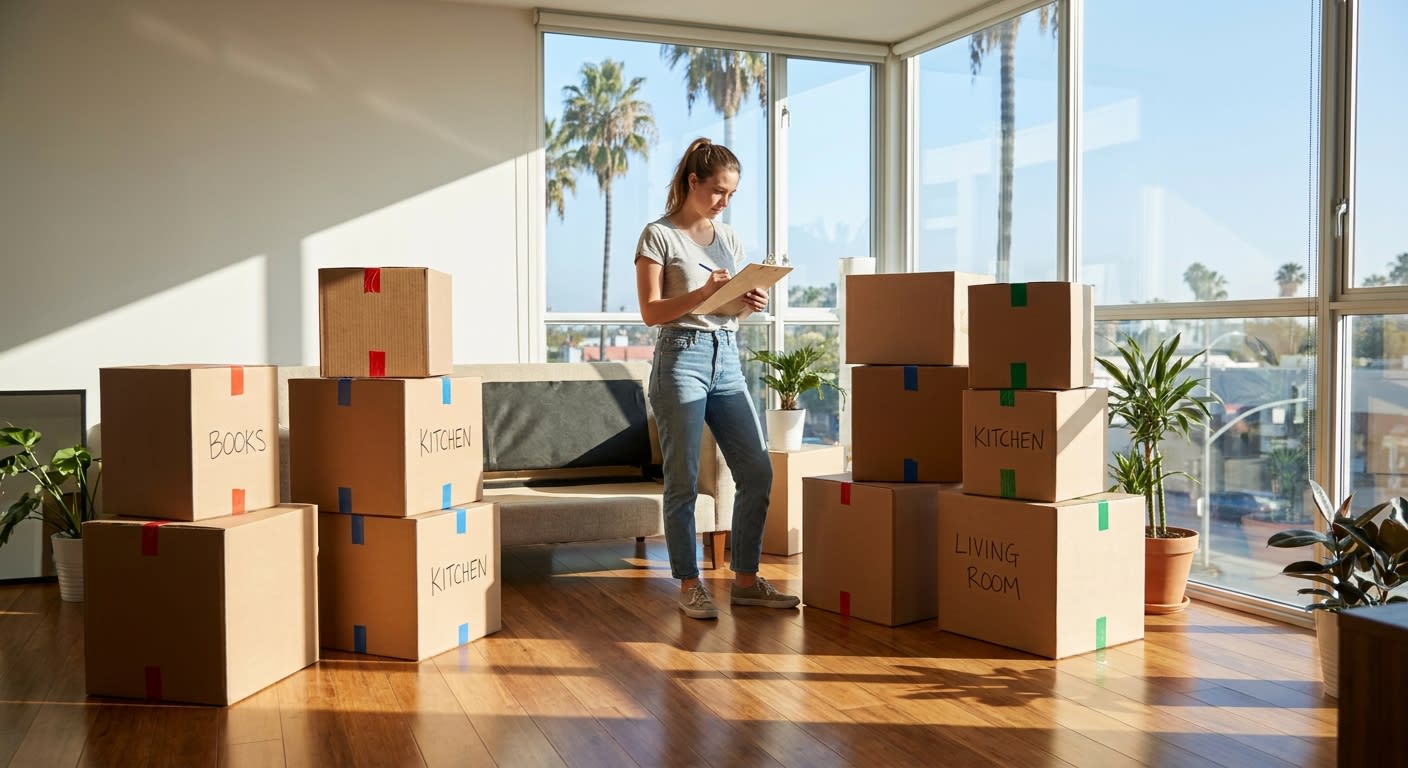
Last Tuesday, I sat down with a client who was relocating from a 1,400-square-foot apartment in Koreatown to a 900-square-foot condo in Long Beach. She'd already signed her lease and had three weeks until move-in, but she hadn't accounted for one thing: roughly 500 square feet worth of furniture and belongings that simply wouldn't fit in her new place. When she started calling storage facilities, the quotes ranged from $189 to $467 per month for what seemed like identical unit sizes. She called me confused, frustrated, and convinced someone was trying to rip her off.
I'm Kuanysh, Founder and CEO of Green Moving LA. Since launching this company in 2022, I've helped over 500 families navigate moves across Los Angeles and Orange County—and at least half of those moves involved some form of storage coordination. I've tracked pricing trends, negotiated facility partnerships, and watched clients waste thousands on storage mistakes that were entirely avoidable. Today, I'm going to break down exactly what storage costs in Los Angeles in 2026, why prices vary so dramatically, and how to make strategic decisions that protect your budget.
The Real Numbers: LA Storage Costs by Unit Size in 2026
Let's start with hard data. I've compiled pricing from over 40 storage facilities across Los Angeles County as of Q1 2026. These aren't promotional rates—they're the standard month-to-month prices you'll actually pay after any introductory discounts expire.
For a 5x5 unit (25 square feet, roughly a closet), expect to pay between $75 and $145 per month. These work well for seasonal items, a few boxes, or small furniture pieces. A 5x10 unit (50 square feet, about half a standard one-car garage) runs $120 to $215 monthly. This size handles a studio apartment's overflow or a small bedroom's worth of furniture.
The most popular size I see clients rent is the 10x10 unit (100 square feet). In 2026, these cost between $195 and $340 per month across LA. A 10x10 can hold the contents of a one-bedroom apartment reasonably well. For larger needs, a 10x15 unit runs $250 to $425, and a 10x20 unit—which fits a two-bedroom apartment or small house—costs $320 to $520 monthly.
If you need vehicle storage, 10x30 units or dedicated parking spaces range from $275 for outdoor spots to $600+ for enclosed, climate-controlled garage storage. I've seen classic car collectors paying over $800 monthly for premium vehicle storage in West LA facilities with 24-hour security and climate systems.
Why the Same Unit Size Costs Twice as Much Across Town
That $189 to $467 range my Koreatown client encountered wasn't random—it reflected a predictable pattern I've observed across hundreds of moves. Storage cost in Los Angeles correlates almost perfectly with three factors: real estate prices in the neighborhood, proximity to dense residential areas, and facility age.
In West LA, Santa Monica, and Beverly Hills, a 10x10 unit averages $310 to $340 monthly. These facilities pay premium commercial rents, and they pass that cost directly to customers. Drive 15 miles east to El Monte or Baldwin Park, and the same 10x10 drops to $195 to $230. The units are physically identical—same construction, same access hours—but the zip code changes everything.
I tell my clients to think of storage like parking: you'll pay $40 to park in downtown LA for an evening, or $8 in Pasadena. The convenience premium is real, but it's worth asking yourself whether that convenience actually matters for items you'll access once every few months.
Facility age also impacts pricing significantly. Newer facilities built after 2020 typically feature climate control, digital access systems, and USB charging stations in the hallways. They charge 20-35% more than older facilities with basic locks and manual gates. For most household items, those premium features don't add meaningful protection—but they do add meaningful cost.
Climate-Controlled vs. Standard Units: When It Actually Matters
Climate-controlled units run 25-40% higher than standard units of the same size. In 2026, that premium translates to roughly $50 to $120 extra per month depending on unit size. The question I get constantly is whether it's worth it.
Here's my honest assessment after years of helping clients retrieve items from storage. You genuinely need climate control for: wooden antique furniture, musical instruments (especially pianos and string instruments), wine collections, leather goods, important documents and photographs, electronics you plan to use again, and artwork or collectibles.
My colleague Marcus, who heads our operations, moved a client's vintage vinyl collection out of a non-climate-controlled unit in Chatsworth last summer. The records had warped beyond playability after eight months of 100°F+ attic temperatures. That collection was worth roughly $15,000. The client had saved maybe $600 on storage over those eight months. The math doesn't work.
Conversely, standard units work fine for: metal furniture, plastic bins of clothing (cleaned and sealed), kitchen equipment, tools, sporting goods, and most cardboard-boxed household items. LA's coastal climate is actually forgiving compared to Houston or Miami. If you're storing in facilities near the coast—Torrance, Long Beach, Santa Monica—temperature swings are milder, and climate control becomes less critical.
Hidden Fees That Inflate Your Storage Bill
The advertised rate is never the final rate. Every storage facility in Los Angeles adds fees, and some are more aggressive than others. Here's what to watch for when you're comparing quotes.
📦 Need help moving items into storage? Our full service moving team handles packing, transport, and storage coordination. Call (949) 266-9445 or get a free quote.
Administrative fees range from $20 to $45 at move-in. Nearly every facility charges these, though some waive them during promotional periods. Insurance requirements are where costs really sneak up. Most facilities require you to carry insurance on stored items—either through their in-house policy ($12 to $25 monthly) or proof of coverage from your renter's or homeowner's insurance. Check your existing policy before paying for redundant coverage.
Lock purchases are often mandatory for new rentals. Facilities sell disc locks for $15 to $25 that you could buy at Home Depot for $8. Some allow outside locks; many don't. Late payment fees typically run $20 to $50, and facilities will auction your belongings after 60-90 days of non-payment. I've seen clients lose everything over missed payments during transitional housing situations.
The sneakiest fee is the rate increase clause buried in most contracts. Many facilities advertise a low introductory rate—often 50% off the first month—then increase rates after 3-6 months. I've documented cases where clients' rates jumped 30% after the promotional period. Always ask for the "street rate" (what you'll pay after promotions end) and get written confirmation of any rate-lock guarantees.
Strategic Timing: When Storage Rates Drop in LA
Storage follows predictable seasonal patterns, and understanding them can save you hundreds annually. The cheapest months to rent storage in Los Angeles are November through February. Demand drops after the summer moving rush, and facilities offer aggressive promotions to fill empty units.
I've tracked promotional offers across major LA facilities, and the pattern holds every year. In January 2026, I saw multiple facilities offering first-month-free deals plus 20% off for three months on new rentals. By June, those same facilities had waiting lists for 10x10 units.
If you know you'll need storage during peak season (May through August), lock in your rate early. Many facilities allow you to reserve units 30-60 days in advance without charge. I advise clients planning summer moves to secure their storage unit by early April.
The other timing consideration is rental duration. Month-to-month flexibility costs more. If you can commit to 6 or 12 months upfront, most facilities offer 10-15% discounts. Run the math: a 10x10 at $275/month costs $3,300 annually. A 12-month commitment at $240/month costs $2,880—a $420 savings that justifies the commitment if you're confident about your timeline.
Neighborhood-by-Neighborhood Pricing Breakdown
I've compiled average 10x10 unit prices across LA neighborhoods as of 2026 to give you concrete numbers for planning. These represent standard, non-climate-controlled units at mid-tier facilities.
West Side (Santa Monica, Venice, Brentwood): $295-$340/month. Premium pricing reflects premium real estate. Facilities here are newer, often with rooftop units that command even higher rates.
Hollywood/West Hollywood: $260-$310/month. Mid-range pricing with good availability. The Vermont/Santa Monica area has several competitive facilities.
Downtown LA: $275-$330/month. Prices have increased roughly 18% since 2023 as downtown population density grows. If you're moving to DTLA, I covered neighborhood specifics in our guide to moving to Downtown LA.
San Fernando Valley (Burbank, Glendale, North Hollywood): $220-$275/month. Solid value, especially in the eastern valley. Our Burbank moving guide includes storage recommendations for that area.
South Bay (Torrance, Hawthorne, Gardena): $195-$250/month. Some of the best value in LA County with modern facilities. Marine air makes climate control less necessary for most items.
East LA/SGV (Alhambra, Monterey Park, El Monte): $175-$235/month. The most affordable storage in the greater LA area, often 40% cheaper than West Side equivalents.
How to Actually Reduce Your Storage Costs
Beyond location arbitrage, here are the strategies I recommend to every client who needs storage. These come from watching what works—and what doesn't—across hundreds of moves.
Right-size ruthlessly before you store. Storage costs are proportional to volume. Every cubic foot you eliminate is money saved monthly, compounding over time. I tell clients to imagine paying $3 per box per month forever. Does that lamp you haven't used in two years justify $36 annually? Our guide to donating before a move can help with this process.
Stack vertically. A well-packed 5x10 can hold what most people put in a 10x10. Use uniform box sizes, build stable columns, and utilize vertical space up to the ceiling. Professional movers—including my team—can pack a storage unit to maximize every cubic foot. It's one reason we offer storage coordination as part of our packing services.
Share a unit. If you're storing temporarily and have a trusted friend in the same situation, a shared 10x15 often costs less than two separate 5x10s while providing more total space. Draft a simple agreement covering access, payment splits, and duration.
Negotiate at move-in. Storage facility managers have flexibility on pricing, especially if units are sitting empty. I've helped clients knock $20-40 off monthly rates simply by asking, "Is this your best rate?" This works particularly well at privately-owned facilities versus national chains.
Portable Storage Containers: An Alternative Worth Considering
Traditional self-storage isn't your only option. Portable storage containers—where a company drops off a container at your home, you load it, and they store it at their facility—have grown significantly in LA over the past few years.
As of 2026, portable container storage runs approximately $150 to $280 monthly for units comparable to a 10x10 traditional space. The major players serving LA include PODS, 1-800-PACK-RAT, and several local alternatives. The pricing is competitive, but the real value is convenience: you load at your pace on your property, and the container moves with you if needed.
The downsides are access limitations (you can't visit your items easily) and the pickup/delivery fees ($75-150 each way). For clients in transitional situations—say, selling one home before closing on another—portable containers often make more financial sense than traditional storage. For long-term storage where you'll need occasional access, traditional facilities win.
From a business perspective, I appreciate the portable container model because it eliminates one of the biggest moving inefficiencies: multiple trips between home and storage facility. At Green Moving LA, we coordinate with container companies regularly, and the process is genuinely smoother for clients. With 1% of every move donated to California environmental causes, we're always looking for ways to reduce unnecessary truck trips.
The True Cost of Long-Term Storage: A Reality Check
Here's a conversation I've had dozens of times. A client rents a 10x10 for $250/month, intending to store items "temporarily" for a few months. Three years later, they've paid $9,000 to store furniture worth maybe $2,000.
Storage is seductive because monthly payments feel small. But long-term storage is financially irrational for most household items. I run this calculation with every client: take the replacement value of what you're storing and divide by monthly storage cost. That's your break-even point in months.
If you're storing a $1,500 couch at $250/month, your break-even is 6 months. After that, you're paying more to store the couch than it would cost to replace. If you genuinely love that couch and will use it again, fine. But I've watched clients store generic IKEA furniture for years because getting rid of it felt wasteful—not realizing that storage itself was the waste.
Set a hard calendar reminder when you sign any storage contract: reassess in 90 days. Pull everything out, evaluate what you've actually needed, and make decisions about the rest. This single habit will save you more money than any pricing negotiation.
FAQ
What's the average storage cost in Los Angeles for a one-bedroom apartment's worth of stuff?
For a one-bedroom apartment, you'll typically need a 10x10 unit, which costs between $195 and $340 monthly in 2026 depending on location. Budget around $250 monthly as a reasonable estimate for a mid-tier facility. Add approximately $25 monthly if you need climate control for sensitive items.
Is it cheaper to store items in Orange County versus Los Angeles?
Generally yes, though the difference has narrowed. As of 2026, Orange County storage runs roughly 10-15% cheaper on average. Irvine and Costa Mesa facilities offer competitive rates, while Newport Beach prices rival West LA. Our Orange County cost guide covers more pricing details for that area.
Do storage facilities in LA negotiate on price?
Many do, especially privately-owned facilities and during off-peak months. I've seen clients save $20-50 monthly by simply asking. National chains have less flexibility, but often run promotions. Always ask about rate-lock guarantees to avoid surprise increases after your first few months.
What happens if I stop paying for my storage unit?
California law requires facilities to notify you of delinquency and provide a minimum of 14 days' notice before lien sale. Most facilities wait 60-90 days before auctioning contents. Fees accumulate during this period. If you're struggling to pay, contact the facility immediately—many will work out payment plans rather than deal with auction logistics.
Should I use storage during a move, or try to avoid it entirely?
If your move-in and move-out dates align and you're not downsizing, skip storage entirely. But if there's a gap between closing dates, if you're transitioning between rental and purchase, or if you're downsizing significantly, storage often makes the move less stressful. Budget for it as a line item and set a firm end date.
Are there any truly cheap storage options in Los Angeles?
The cheapest legitimate options are facilities in the eastern San Gabriel Valley and southeastern LA County—El Monte, Baldwin Park, Whittier—where 10x10 units dip below $200 monthly. Avoid Craigslist garage rentals and unofficial spaces; they lack security, climate protection, and legal recourse if something goes wrong.
Ready to Move Your Items Into Storage?
If you're coordinating a move that involves storage, Green Moving LA handles the entire process—from packing and loading to delivery directly to your storage facility. Call me at (949) 266-9445, email sales@greenmovingla.com, or get your free quote online. We're licensed (CAL-T 201327) and insured, and our team knows the storage facilities across LA and Orange County inside and out.