Piano Moving in Los Angeles: Complete 2026 Guide
Last month our crew moved a 1920s Steinway baby grand from a second-floor home in the Hollywood Hills. The staircase was narrow, the front door barely cleared the instrument's width, and the driveway dropped at a 25-degree grade. The piano weighed 560 pounds. One wrong angle, one slip, one moment of lost control — and a $45,000 instrument becomes irreparable. That's the reality of piano moving in Los Angeles, and it's why this job demands a completely different approach from standard furniture.
I've overseen piano relocations across every type of LA property — hillside estates in Bel Air, high-rise condos in Downtown, 1940s bungalows in Pasadena with doorways that were built for smaller furniture. Each one presents unique obstacles, but the fundamentals are the same: the right equipment, the right team size, and a process that accounts for every variable before the piano leaves its current position. Here's exactly what that process looks like, what it costs, and what to prepare for.
What Piano Moving Costs in Los Angeles
Green Moving charges a flat $200 surcharge for piano moves, which covers the specialized equipment and the required 4-mover crew. That fee applies on top of your standard hourly moving rate. Here's how total costs break down by piano type for a typical local move.
Upright pianos weigh 300–500 pounds and fit through most standard doorways. They're the most straightforward piano move. With Green Moving's weekday rate for 4 movers at $209/hour and a 3-hour minimum, a local upright move runs approximately $827 ($627 labor + $200 piano surcharge) for straightforward access.
Baby grand pianos weigh 500–600 pounds. They require leg removal, specific wrapping protocols, and more careful maneuvering through doorways. Expect the move to take 30–60 minutes longer than an upright, adding $100–$200 to the total.
Standard grand pianos range from 600–900 pounds. The size and weight demand the full 4-person crew working in coordination, and the disassembly and reassembly process is more involved. Total cost for a local move: roughly $1,000–$1,400 depending on access complexity.
Concert grand pianos exceed 900 pounds — some reach 1,200. These moves often require additional equipment, extended labor time, and sometimes crane service for hillside or multi-story access. Costs range from $1,400 upward, with crane service adding $500–$1,000 or more.
Additional cost factors: stair carries add time and complexity — each flight adds roughly 15–20 minutes of careful, controlled work. Long carries from the piano's location to the truck (common in properties with extended driveways or gated entries) extend the timeline similarly. If your building requires a COI, that's $50.
Why Pianos Aren't Just Heavy Furniture
I explain this to clients regularly because it changes how people think about the job. A 500-pound dresser is awkward and heavy, but if it bumps a wall, you're looking at a scuff mark. A 500-pound piano that bumps a wall is a potential $5,000 repair.
Weight concentration. A grand piano's mass sits on three legs — thin points supporting enormous loads. During transport, that weight needs to be redistributed across a specialized piano board (a heavy-duty padded dolly designed specifically for this purpose). Standard furniture dollies can't handle the load distribution safely.
Internal mechanics. Inside every piano are thousands of precisely calibrated parts — strings under enormous tension, felt hammers aligned to fractions of a millimeter, a soundboard that resonates based on its structural integrity. Vibration, impact, and improper tilting angles can knock these components out of alignment. The damage isn't always visible — a piano can look fine and sound wrong.
Finish vulnerability. Piano finishes — especially the high-gloss lacquer on grand pianos — scratch and dent from contact that wouldn't mark regular furniture. Our wrapping protocol uses multiple layers of padded moving blankets secured with fabric straps (never tape directly on the finish) to create a protective shell around the entire instrument.
Shape and geometry. Grand pianos can't be moved assembled. The legs come off, the lyre (pedal assembly) detaches, and the piano rides on its side on a piano board. Getting the angle right during leg removal and reattachment requires experience — I've seen crews without piano experience crack a leg joint by forcing the wrong angle.
The Professional Piano Moving Process
Here's the step-by-step process our crew follows. Knowing what to expect helps you prepare and helps you evaluate whether any mover you're considering actually knows what they're doing.
Pre-move assessment. Before moving day, we evaluate the piano type, its current location in the home, every doorway and hallway between the piano and the truck, stair count and configuration, driveway grade, and truck access points. For properties in the Hills, canyon neighborhoods, or older areas of Pasadena and Glendale, this assessment is critical — access challenges that aren't identified in advance create dangerous situations on moving day.
Preparation and disassembly. The keyboard lid gets locked or taped shut to prevent it from swinging open. Pedals are padded. For grand pianos, legs are removed one at a time with the piano supported on the board, then the lyre comes off. Each removed component gets wrapped individually and tracked.
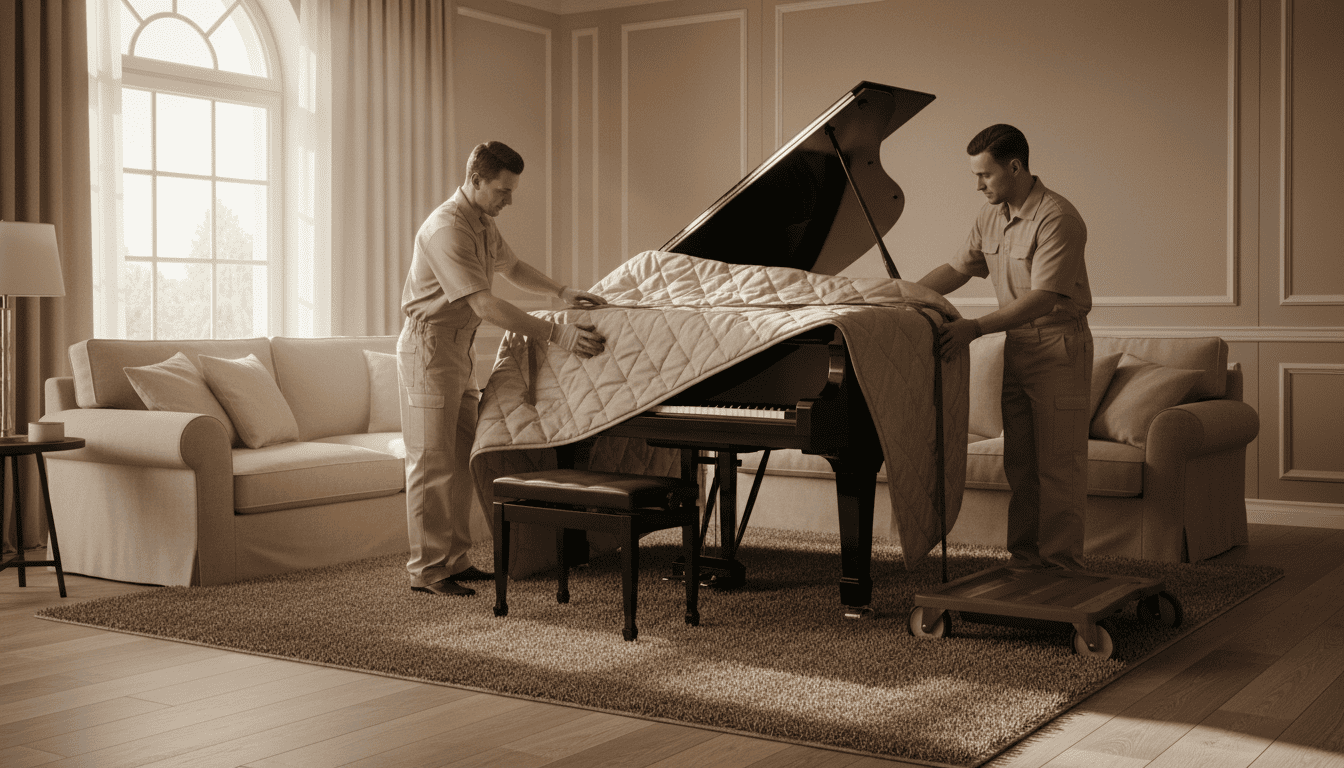
Wrapping. Multiple layers of professional-grade moving blankets cover every exposed surface. Corners — the most vulnerable points — get extra padding. The blankets are secured with straps, not tape. The goal is a fully enclosed protective shell that absorbs impact from any direction.
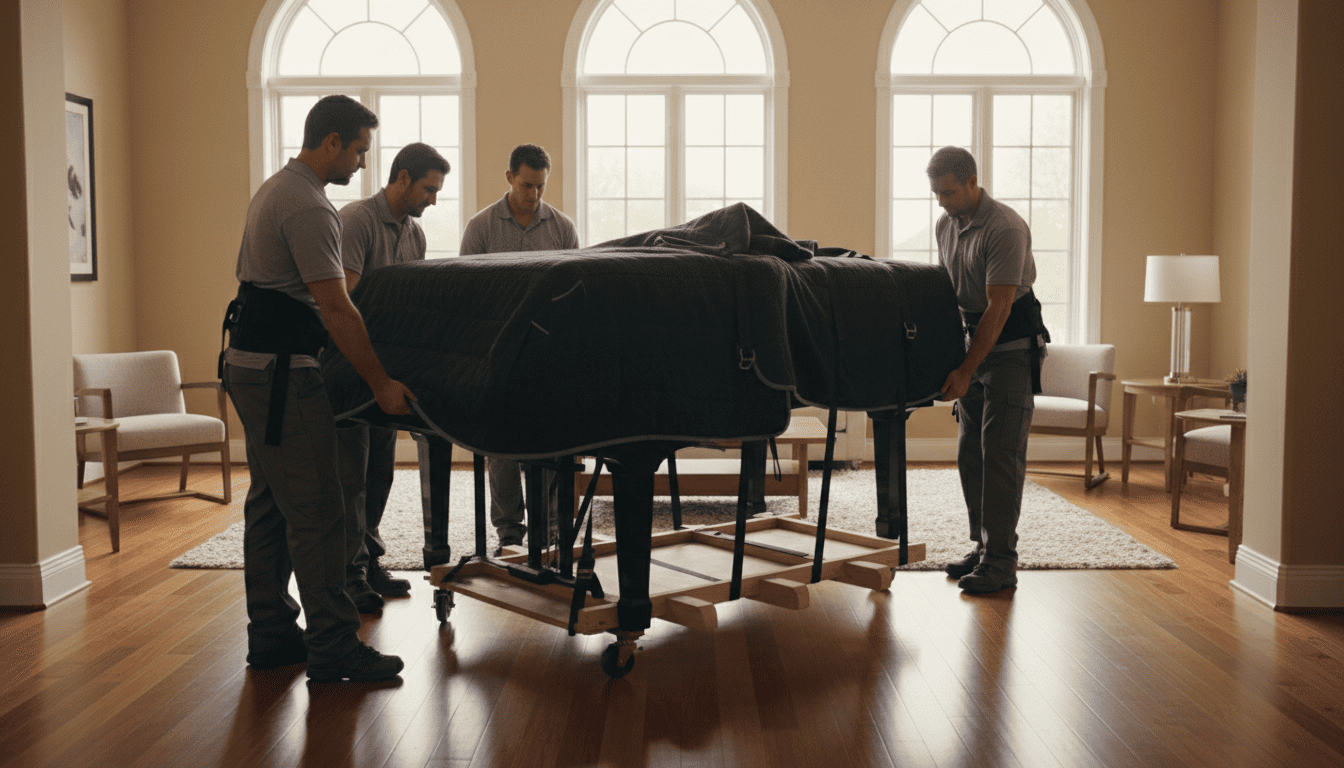
Transport through the home. The wrapped piano rides on a piano board, guided by the full 4-person crew. One person controls direction, one manages the board, and two stabilize the instrument. Through doorways, the margin for error is often less than an inch. On stairs, the crew coordinates each step verbally — one step at a time, no rushing.
Loading and securing. The piano is loaded onto the truck using a ramp and positioned against the truck wall with heavy-duty ratchet straps. It doesn't share wall space with other items that could shift during transit. The truck's interior temperature matters too — extreme heat or cold during transport can affect tuning stability and, over time, structural integrity.
Delivery and reassembly. At the destination, the process reverses. Grand pianos get legs and lyre reattached, positioned per the owner's instructions, and unwrapped carefully. We check for any visible issues before leaving.
Need professional piano moving? Our crew handles it safely — call (949) 266-9445 or get your free quote.
LA-Specific Challenges Our Crews Face
Los Angeles makes piano moving harder than almost any other metro area in the country. The geography, architecture, and building regulations create obstacles you won't find in flat, grid-planned cities.
Hillside homes are the biggest challenge. Properties in the Hollywood Hills, Bel Air, and Pacific Palisades often sit above steep driveways with multiple stair levels between the street and the front door. Some have no truck access at all — the piano has to travel 100+ feet by hand on a dolly. In extreme cases, crane service is the only option: the piano gets lifted over a balcony or through a window opening. Our crew recently moved a Yamaha C7 grand out of a Bel Air estate using a crane because the interior staircase was too narrow and the driveway too steep for a safe carry.
Narrow doorways in older homes. LA has a massive stock of pre-1960 homes — Craftsman bungalows, Spanish colonials, mid-century ranches — with doorways measuring 30–32 inches. A standard upright piano is 58 inches wide. A baby grand with legs removed is roughly 58–60 inches at its widest. Sometimes the door itself needs to come off the hinges. Sometimes we reroute through a larger back door or patio entry. Measuring every opening in advance prevents day-of surprises.
High-rise buildings in Downtown LA, Century City, and Wilshire Corridor add elevator restrictions and HOA requirements. Freight elevators have weight limits and must be reserved in advance. Some buildings require COIs ($50 each), floor protection, and specific moving windows — often limited to weekday mornings. A piano that can't fit in the freight elevator isn't going up, period. We confirm elevator dimensions during the assessment phase.
Canyon access. Homes in Laurel Canyon, Topanga Canyon, and Beachwood Canyon sit on narrow roads where a full-size moving truck sometimes can't park within reach. Shuttle vehicles or hand-carries over extended distances become necessary — adding labor time and requiring additional crew coordination.
What to Do Before Your Piano Move
Preparation on your end makes the process safer and faster.
Clear the path completely. Remove rugs, small furniture, decor, and anything fragile between the piano and the exit. Our crew needs a minimum 40-inch clearance width through every hallway and doorway. Wider is better — every extra inch of margin reduces risk.
Measure doorways and communicate results. If any opening between the piano and the truck is under 36 inches, tell us during the quote process. We'll plan the route and may need to schedule door removal.
Arrange building access in advance. For apartments and condos, reserve the freight elevator, obtain any required COIs, and confirm the building's moving time windows. A piano move that gets delayed because the elevator wasn't booked costs everyone time and money.
Don't try to help lift. I say this respectfully but firmly — an untrained person joining a 4-person piano carry introduces unpredictable force angles that make the lift more dangerous, not less. Let the crew work their system. Your help is most valuable in keeping the path clear and answering questions about the destination layout.
Plan tuning for two weeks after delivery. Moving shifts a piano's internal components and exposes it to temperature and humidity changes. The instrument needs roughly 14 days to acclimate to its new environment before a tuner can accurately calibrate it. Schedule the tuning appointment in advance so you're not waiting weeks for availability.
How to Evaluate a Piano Mover
Not every moving company should move pianos, and not every company that says they can actually has the right equipment or experience. Here's what to verify.
Ask how many pianos they move per month. A crew that handles 2–3 pianos a week operates differently from one that does it twice a year. Ask what equipment they use — piano boards, 4-person minimum crews, padded blankets, and ratchet straps should be standard, not improvised. Ask about insurance coverage specific to pianos — basic moving insurance at $0.60 per pound covers a 500-pound piano at only $300, which is nowhere near replacement value. Full-value protection or a rider for high-value items is essential for instruments worth $10,000 or more.
Red flags: a company that quotes piano moving at standard furniture rates likely treats it as standard furniture. A crew of 2 attempting a grand piano is dangerous. Any mover who hasn't asked about stairs, doorway widths, and access before providing a quote hasn't done this enough.
Green Moving's white-glove service covers piano moves with the specialized equipment, crew sizing, and insurance options these instruments require.
Frequently Asked Questions
Can I move an upright piano myself?
Technically possible with enough strong helpers, but I don't recommend it. Uprights weigh 300–500 pounds with a high center of gravity that makes them tip-prone. Without a piano board and proper technique, the risk of injury to people and damage to the instrument is high. A professional upright move costs roughly $200 as a surcharge — a fraction of what a back injury or piano repair would cost.
How far in advance should I book a piano move?
Two to three weeks minimum. Piano moves require specific crew sizing (4 movers), equipment allocation, and often a pre-move assessment. During peak season (May–September), book 4–6 weeks ahead. If your move involves crane service, the crane company needs separate scheduling.
Will my piano need tuning after the move?
Yes, always. Moving disrupts the piano's internal calibration regardless of how carefully it's handled. Wait 14 days for the instrument to acclimate to the new room's temperature and humidity, then schedule a professional tuning. Some concert-quality instruments benefit from a second tuning 4–6 weeks later.
What if my piano doesn't fit through the door?
Our pre-move assessment catches this before moving day. Options include removing the door from its hinges (adds 1–2 inches of clearance), routing through an alternative entry point (back door, patio, garage), or in rare cases, crane service through a window or balcony. We determine the best approach during assessment and include any added costs in the quote.
Does Green Moving insure pianos during the move?
Yes. Our basic coverage is included, but for high-value instruments, we offer full-value protection options. Given that piano repairs can cost $1,000–$10,000+ and replacement runs far higher, full-value coverage is strongly recommended. Discuss your instrument's value with us during the quote process and we'll match the right coverage level.
Get Started
A piano is one of the most valuable and most vulnerable items in any home. The right crew with the right equipment turns a high-risk move into a controlled, professional operation. Our team handles it from assessment to final placement.
Schedule Your Free Consultation:
- Call: (949) 266-9445
- Email: sales@greenmovingla.com
- Online: greenmovingla.com/contacts
Green Moving — Licensed (CAL-T 201327) & Insured. 1% of every move supports California environmental causes.